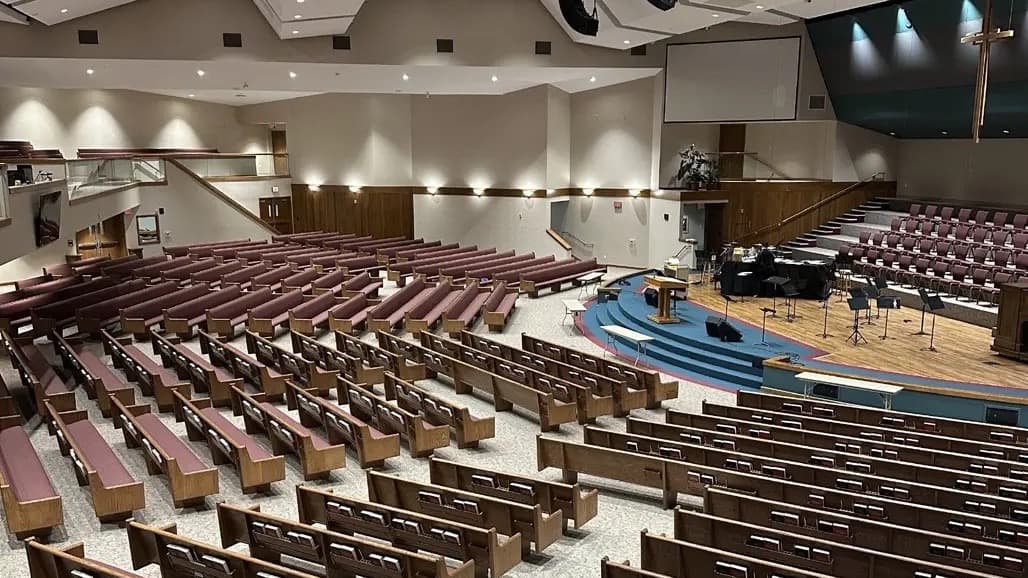
Why Sanctuary Lighting Is a Bigger Facility Challenge Than Most Churches Expect
For facility managers and maintenance supervisors at churches across St. Charles, O'Fallon, Wentzville, and the broader Greater St. Louis region, sanctuary lighting rarely rises to the top of the priority list — until something goes wrong. A flickering fixture mid-service, a burned-out lamp sixty feet overhead, or a washed-out livestream image can suddenly make lighting the most urgent issue in the building.
The reality is that sanctuary lighting systems in most houses of worship were designed and installed decades ago, often using incandescent, halogen, or fluorescent sources that demand constant upkeep. As those systems age, maintenance costs climb, energy bills grow, and the quality of light inside the worship space quietly deteriorates. Understanding the full scope of the challenge — and the modern solutions available — is the first step toward making a sound, long-term decision for your congregation and your facility team.
The Unique Maintenance Demands of Church Sanctuaries
Sanctuaries aren't like office buildings or retail spaces. Their architectural features — vaulted ceilings, decorative trusses, stained glass, theatrical lighting rigs, and historically sensitive interiors — create a set of maintenance conditions that standard commercial approaches don't fully address.
High-ceiling access is a persistent operational burden. In many St. Charles area sanctuaries, replacing a single burned-out lamp requires scheduling a lift or scaffolding rental, coordinating around the church calendar, and dedicating staff time to a task that can take hours. When traditional bulbs need replacement every few thousand hours, this cycle repeats itself multiple times a year — adding up to significant labor costs and scheduling disruptions that many facility teams simply absorb without fully accounting for them.
Aging ballasts and dimmer incompatibility cause chronic problems. Flickering, buzzing, and premature lamp failures are often symptoms of failing magnetic ballasts or mismatched dimmer controls rather than the lamps themselves. Many churches continue replacing bulbs when the root cause is the ballast or control infrastructure — a cycle that wastes both money and staff time.
Uneven light distribution affects more than aesthetics. Poor illumination across pews creates genuine safety concerns, particularly for older congregants navigating steps and aisles. It also directly impacts the quality of video production and livestreaming, which has become a standard ministry tool for congregations throughout the St. Louis metro area. Hotspots, shadows, and color temperature inconsistencies that are barely noticeable to the eye can be dramatically unflattering on camera.
What LED Retrofits Actually Deliver for Church Facilities
The shift from traditional sources to LED in sanctuary environments isn't simply about saving energy — though the energy savings are real and significant. For facility managers, the more immediate benefit is operational: fewer service calls, longer fixture life, and lighting systems that are genuinely easier to manage over time.
Extended lamp life reduces the high-ceiling access cycle. Quality LED products used in sanctuary applications are rated for 50,000 hours or more — roughly ten times the lifespan of the halogen and incandescent sources they replace. For a church that previously scheduled lift rentals two or three times a year to address lamp failures, that represents a dramatic reduction in both direct cost and operational disruption. Fewer unplanned maintenance events also means fewer interruptions to services, rehearsals, and events that fill the typical church calendar.
Dimming and control compatibility opens new possibilities. Modern LED systems are designed to work with a wide range of dimming and control platforms, giving sanctuaries the ability to set and recall lighting scenes for different service types — traditional worship, contemporary services, weddings, funerals, and community events — without manual fixture adjustments. This kind of programmable flexibility was once the exclusive domain of large performing arts venues; today it's accessible to mid-sized congregations across St. Charles County.
Improved color rendering benefits both worship and media. LED technology has advanced significantly in its ability to reproduce accurate, natural color. High-CRI (Color Rendering Index) LED sources make choir robes, floral arrangements, and architectural details look truer to life — and they translate far better to video than older fluorescent or high-pressure sources that cast greenish or inconsistent tones.
Planning an Upgrade: Considerations Specific to Historic and Traditional Sanctuaries
Many of the churches throughout St. Charles — a city with deep roots and a historic downtown corridor — occupy buildings that carry architectural and aesthetic significance. Lighting upgrades in these spaces require a more careful, consultative approach than a straightforward commercial retrofit.
Fixture aesthetics matter as much as performance. In a sanctuary with exposed wood beams, decorative plasterwork, or period-appropriate chandeliers, the physical appearance of lighting fixtures is part of the building's character. Modern LED retrofit options include a wide variety of form factors — including historically styled sconces, discreet recessed sources, and slim-profile pendants — that allow facilities to achieve contemporary performance without compromising visual integrity.
Staged implementation protects budgets and minimizes disruption. Most facility managers overseeing church properties in the O'Fallon, Lake St. Louis, and St. Peters corridor aren't working with a blank-check capital budget. A phased approach — prioritizing the sanctuary proper, then fellowship halls, then support spaces — allows congregations to spread investment over time while capturing the most impactful improvements first.
Structural access planning reduces total project cost. The most efficient sanctuary upgrades are planned carefully in advance, batching all high-ceiling work into a single mobilization rather than addressing fixtures one at a time as they fail. This approach requires an upfront assessment but typically delivers meaningfully lower total cost compared to reactive, piecemeal maintenance.
Cooperative Purchasing Options for Missouri Congregations and Public Facilities
For houses of worship affiliated with school districts, municipalities, or other public entities in the St. Charles area, procurement flexibility can make the difference between a project that moves forward and one that stalls. VOSS holds an approved state contract in Missouri, which public agencies can use to streamline procurement and access competitive, pre-negotiated pricing without a separate bidding process.
Eligible organizations — including faith-based institutions that participate in cooperative purchasing consortia — may also benefit from programs such as Houston Church COOP, Sourcewell, BuyBoard, TIPS, Omnia Partners, AEPA, PACE, and Nebraska ESU Co-Op. These programs are designed to reduce administrative burden and accelerate project timelines for qualifying buyers.
If your organization serves both a congregation and a community function — operating a school, childcare center, or community services program — it's worth exploring whether cooperative purchasing access applies to your lighting project. Our team can help navigate that question directly.
Trends Worth Watching: Where Church Lighting Technology Is Heading
Facility managers making lighting decisions today aren't just solving for the present — they're establishing an infrastructure platform that will shape their facilities for the next fifteen to twenty years. Several trends are worth understanding as you plan.
Integration with building automation is accelerating. Lighting controls are increasingly part of broader smart building ecosystems that also manage HVAC, security, and access. Forward-thinking facilities in the Greater St. Louis area are designing their lighting upgrades with integration in mind, choosing control platforms that can communicate across building systems and reduce total operational overhead.
Tunable white technology supports circadian wellness. Some congregations — particularly those with significant senior populations or large early-morning programming — are exploring tunable white LED systems that can shift color temperature throughout the day to support natural circadian rhythms. This is an emerging application in worship environments, and while it remains a premium option, costs are declining steadily.
Energy efficiency programs and utility incentives continue to evolve. Missouri utility programs and national energy efficiency incentives can offset a meaningful portion of LED upgrade costs for qualifying facilities. Our article on Energy Audits, Incentives, and Rebate Navigation for Businesses covers the broader landscape of available incentives in detail and is a useful companion read for any facility manager building a financial case for an upgrade project.
For congregations specifically evaluating the energy side of this decision, our Energy Efficient Church Lighting Upgrades article offers additional depth on consumption benchmarks, payback periods, and rebate considerations for faith-based facilities.
Service Availability
While VOSS offers a comprehensive suite of national services, specific capabilities may vary by location. Please contact your local branch to confirm the current availability of specific services, technology solutions, or contracting capabilities in your immediate market.
Talk With Our St. Louis Team
VOSS serves churches and faith-based facilities throughout St. Charles, O'Fallon, Wentzville, St. Peters, Lake St. Louis, and the broader Greater St. Louis region from our local St. Louis branch. If your sanctuary is showing signs of aging lighting infrastructure — or if you're simply ready to explore what a modern, lower-maintenance system could look like for your congregation — we'd welcome a conversation.
Our approach starts with listening. We want to understand your facility's specific constraints, your congregation's aesthetic priorities, and your team's capacity before recommending any course of action. The goal is a lighting system that serves your ministry well for decades, not just a product installation.
VOSS — St. Louis Branch Phone: (636) 660-0088 Toll-Free: (877) 577-5409
Reach out to schedule a facility consultation with our local lighting specialists.