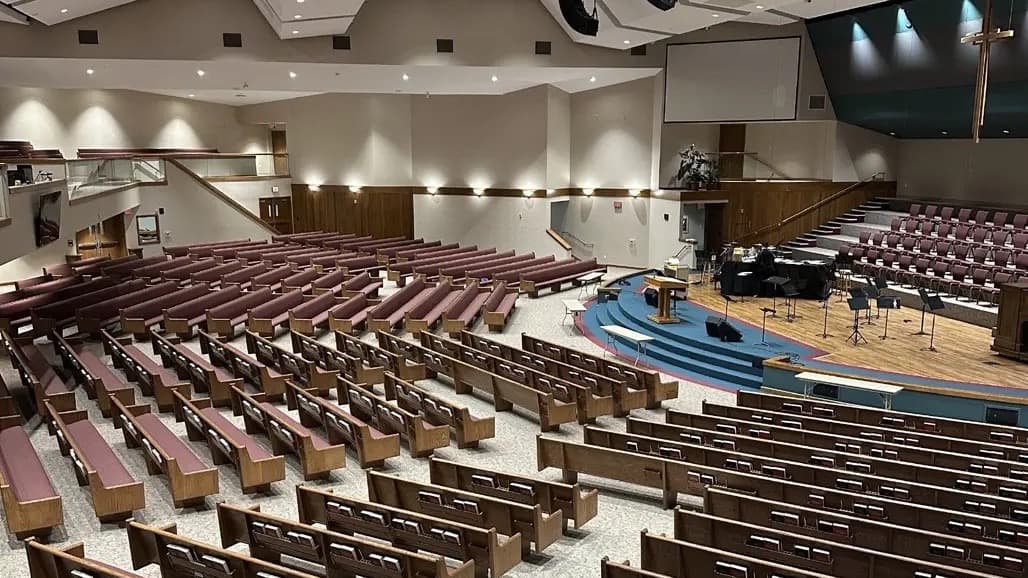
Why Sanctuary Lighting Is a Growing Concern for O'Fallon-Area Churches
O'Fallon, Missouri has grown into one of the most dynamic communities in the greater St. Louis region — and its faith community has grown right alongside it. With a population approaching 93,000 and continued residential expansion into nearby communities like Wentzville, Lake St. Louis, St. Peters, and St. Charles, congregations across western St. Louis County and St. Charles County are managing larger facilities, more programming hours, and greater demands on aging infrastructure.
For many of these churches, the sanctuary is the heart of the building — and the lighting system that serves it may be decades old. Incandescent, halogen, and fluorescent fixtures that were installed when a congregation was a fraction of its current size now struggle to meet the visual and operational demands of modern worship. The result is a familiar cycle: frequent bulb replacements in hard-to-reach locations, flickering caused by aging ballasts, rising utility bills, and inconsistent light quality that affects everything from congregant comfort to livestream video production.
Understanding how this issue has evolved — and what today's best practices look like — is the first step toward making a confident, informed decision about your facility.
The Modern Sanctuary Has New Lighting Demands
The role of sanctuary lighting has changed significantly over the past decade. It's no longer simply about illuminating a space for a Sunday morning service. Today's churches use their sanctuaries for a wide range of purposes: worship services, livestreamed and recorded programming, special events, community gatherings, concerts, and more. Each of these use cases has different lighting requirements — and a one-size-fits-all fixture approach simply can't deliver.
Key trends reshaping sanctuary lighting in active church facilities:
- Livestream and video production have become standard in many congregations. Camera sensors behave very differently from the human eye — they require consistent, high color-rendering illumination (typically a CRI of 90 or above) and flicker-free operation to produce broadcast-quality video. Older fluorescent and incandescent systems often fail both tests.
- Tunable white LED systems now allow facility managers to adjust color temperature throughout the day or across different services — warmer tones for intimate worship, cooler tones for youth events or community gatherings — all from a single control interface.
- Scene-based lighting controls enable a pastor or A/V volunteer to activate preset lighting configurations with a single button press, eliminating the need for manual dimmer adjustments during transitions between worship segments.
- Energy codes and efficiency expectations continue to tighten. Missouri facilities that have not yet completed a lighting retrofit are likely operating at a significant cost disadvantage compared to peers who have upgraded to LED.
For churches in O'Fallon, Cottleville, Dardenne Prairie, and the surrounding communities, these trends translate into a real opportunity: a well-planned lighting upgrade doesn't just solve a maintenance problem — it transforms the experience your sanctuary delivers.
Common Maintenance Challenges in Church Sanctuaries
Before discussing solutions, it's worth grounding the conversation in the practical, day-to-day challenges that facility managers and maintenance supervisors in the St. Louis area consistently face. These are not abstract concerns — they are the friction points that consume staff time, drain budgets, and create risk.
High-ceiling access and re-lamping frequency are among the most significant issues. Many sanctuaries feature vaulted ceilings, decorative chandeliers, or theatrical rigging systems that require scaffolding or aerial lifts to access. When traditional bulbs in these fixtures burn out every few months, the cumulative labor cost — and the disruption to the building — adds up quickly. LED sources rated for 50,000+ hours can reduce re-lamping frequency dramatically, often stretching the interval between lamp changes from months to years.
Aging ballasts and dimmer incompatibility are another common source of complaints. Fluorescent and metal halide systems rely on ballasts that degrade over time, producing flickering, humming, and delayed starts. When congregations install aftermarket dimmers hoping to create atmosphere, the incompatibility between legacy ballasts and modern dimming controls can cause erratic behavior that frustrates staff and distracts from worship. LED drivers paired with purpose-built dimming systems eliminate this class of problems entirely.
Uneven illumination — bright spots near windows or under chandeliers, dark areas in balconies or side aisles — creates both safety concerns and aesthetic problems. Modern photometric design tools allow lighting professionals to model a sanctuary's specific geometry and specify fixtures that deliver consistent foot-candle levels across the entire space before a single fixture is installed.
Historic and architectural constraints present unique considerations for older sanctuaries in communities like St. Charles and along the St. Louis metro corridor. Retrofitting a space with ornate woodwork, stained glass, or historically significant architectural details requires a thoughtful approach that preserves the character of the space while delivering modern performance. This is an area where experience with church properties specifically — not just commercial buildings — makes a meaningful difference.
What a Thoughtful Upgrade Process Looks Like
One of the most important things facility managers can understand about a sanctuary lighting project is that it should not begin with a fixture catalog. It should begin with a thorough audit of what you have, a clear definition of what you need, and a realistic assessment of what your budget and timeline can support.
A well-structured upgrade process typically includes the following phases:
- Lighting audit and assessment — A qualified team evaluates existing fixtures, controls, wiring, and electrical infrastructure. This step identifies not just what needs replacing, but what can be retained or reused, which informs a more accurate budget estimate.
- Photometric design and application planning — Using the sanctuary's actual dimensions, ceiling heights, and reflective surfaces, a lighting designer models the proposed system and produces a plan that specifies fixture types, mounting positions, and control zones.
- Controls and integration planning — This step determines how the new system will be operated. Will it connect to an existing A/V control system? Will it use a dedicated lighting controller, a smartphone app, or a wall-panel interface? For churches with active tech ministries, integration with existing production infrastructure is often a priority.
- Phased installation scheduling — For active congregations, timing matters enormously. A skilled contractor understands how to schedule work around Sunday services, Wednesday programs, and special events — minimizing disruption to the congregation's calendar.
- Commissioning and staff training — The upgrade isn't complete when the last fixture is hung. Proper commissioning ensures the system performs as designed, and hands-on training ensures your facility team and volunteers can operate it confidently.
At VOSS, our approach to church projects reflects 85+ years of experience working with institutional and community facilities across the country. We understand that a church is not a warehouse or a retail store — it is a gathering place with its own rhythms, constraints, and character.
Cooperative Purchasing: A Practical Option for Eligible Organizations
While most churches are privately governed, some faith-based organizations and religiously affiliated nonprofits may have access to cooperative purchasing programs that simplify procurement and deliver competitive value. VOSS participates in several nationally recognized programs — including Houston Church COOP, Sourcewell, TIPS, BuyBoard, Omnia Partners, AEPA, PACE, and Nebraska ESU Co-Op — that eligible organizations can leverage to streamline the purchasing process.
For Missouri public-sector organizations — school districts, municipalities, and government agencies in O'Fallon, St. Charles County, and the broader St. Louis region — VOSS holds an approved Missouri state contract, providing access to reliable products, competitive pricing, and expert support without the complexity of a standalone bid process.
If you're unsure whether your organization qualifies for any of these programs, our local St. Louis team can help you evaluate your options.
Further Reading in Our Latest Lighting Series
This article is part of VOSS' ongoing Latest Lighting editorial series, which covers trends, innovations, and best practices across a range of commercial and institutional lighting applications. If sanctuary lighting has prompted broader questions about energy efficiency and financial incentives, our Energy Efficient Church Lighting Upgrades and Maximize ROI with Commercial LED Lighting Rebates articles offer deeper dives into those topics. For facility managers overseeing multiple building types, our pieces on Parking Lot and Outdoor LED Lighting Upgrades and Energy Audits, Incentives, and Rebate Navigation for Businesses may also be useful starting points.
Service Availability
While VOSS offers a comprehensive suite of national services, specific capabilities may vary by location. Please contact your local branch to confirm the current availability of specific services, technology solutions, or contracting capabilities in your immediate market.
Talk to Our St. Louis Team About Your Sanctuary
If your church in O'Fallon, St. Peters, Wentzville, Lake St. Louis, or anywhere across the greater St. Louis metro is navigating a sanctuary lighting challenge — whether it's a maintenance issue you're trying to resolve or an upgrade project you're beginning to plan — we'd welcome the conversation. Our local branch team brings direct experience with faith community facilities in Missouri and can help you think through the options that make sense for your building, your congregation, and your budget.
VOSS — St. Louis Branch
Phone: (636) 660-0088 Toll-Free: (877) 577-5409
Reach out to start a no-pressure conversation about what better sanctuary lighting could mean for your facility.