Why Baseball Lighting Is a Bigger Decision Than Most Facility Managers Expect
Lighting a baseball or softball field is one of the most technically demanding projects in sports facility management. Unlike a parking lot or warehouse, a baseball diamond presents a uniquely complex geometry — infield corners, deep outfield gaps, a pitched mound, and a warning track that each respond differently to pole placement, beam angles, and fixture intensity. Get it wrong, and you end up with shadowed gaps in the outfield, glare that blinds batters at the plate, or light spill that draws complaints from neighboring residents.
For facility managers and parks administrators in O'Fallon, MO and surrounding communities like Wentzville, Lake Saint Louis, St. Peters, and St. Charles, the stakes are high. O'Fallon is one of Missouri's fastest-growing cities, with a population approaching 93,000 and a vibrant parks and recreation culture that supports youth leagues, adult softball, and tournament-level play. Getting the lighting right means more games after dark, safer conditions for players and officials, and a better experience for the families filling the bleachers.
The good news: LED technology has fundamentally changed what's possible — and what's affordable — for fields of every size and budget.
What LED Technology Actually Changes for Baseball Facilities
The shift from traditional metal halide or high-pressure sodium (HPS) systems to LED is not simply a fixture swap. It represents a rethinking of how athletic fields are lit — and the improvements are measurable across multiple dimensions.
Visibility and Uniformity
Modern LED systems are engineered to produce consistent, uniform illumination across the entire playing surface, from the batter's box to the deepest part of center field. High-quality photometric design eliminates the hot spots and dark pockets that metal halide systems often create as they age and lamps begin to shift in color and output. For players, this means better depth perception, sharper tracking of fly balls, and reduced eye fatigue during doubleheaders or late-season twilight games.
Instant Performance
Metal halide lamps require a warm-up and restrike cycle that can take 15–20 minutes — a meaningful operational constraint during rain delays, power interruptions, or late-arriving teams. LED systems reach full brightness instantly, giving facility operators far greater flexibility in managing game schedules and unexpected weather events.
Energy Efficiency That Changes the Financial Picture
LED fixtures typically consume 50–70% less energy than the metal halide systems they replace. For a multi-field complex running lights several nights per week across a full spring and summer season, that reduction translates into real, recurring savings on utility bills. Facilities served by utilities in the St. Louis region may also qualify for incentive programs that offset a portion of upfront project costs. VOSS helps clients identify and pursue those opportunities — for more on the rebate landscape in Missouri and across the region, the Maximize ROI with Commercial LED Lighting Rebates page in our Latest Lighting series is a useful companion resource.
Reduced Maintenance Burden
LED fixtures carry rated lifespans of 50,000–100,000 hours, compared to 15,000–20,000 hours for metal halide lamps. For a parks department or school district managing multiple fields across O'Fallon, Dardenne Prairie, or the broader St. Charles County area, fewer lamp replacements means lower maintenance labor costs and fewer emergency callouts when a fixture fails mid-game.
From Little League to Tournament Play: Matching the System to the Facility
Not every baseball facility has the same lighting requirements — and not every lighting provider understands the difference. Recreational leagues, high school programs, collegiate facilities, and tournament venues each operate under different governing body standards for illuminance levels, uniformity ratios, and glare control. VOSS designs to the standard that applies to your facility and your league.
For youth recreational fields in community parks, the design priority is typically achieving safe, adequate illuminance at a project budget that works for municipal parks departments. LED systems at this scale often deliver compelling payback periods when energy savings and reduced maintenance are factored in.
For high school and travel ball programs, compliance with Missouri State High School Activities Association (MSHSAA) guidelines and field-specific standards becomes a key design input. Pole placement, mounting heights, and fixture selection must all be coordinated to meet those requirements while fitting within the physical footprint of the facility.
For tournament complexes and collegiate venues, the design standard rises further — broadcast readiness, higher foot-candle targets, tighter uniformity ratios, and integration with lighting controls systems that allow operators to manage multiple fields from a single interface. VOSS has the photometric engineering capability and field experience to deliver at this level.
For readers managing gymnasium or indoor court facilities alongside outdoor fields, our LED Gymnasium Lighting Solutions and Pickleball LED Lighting Solutions articles in the Latest Lighting series address those environments in depth.
Proof Point: What Professional-Grade LED Design Delivers
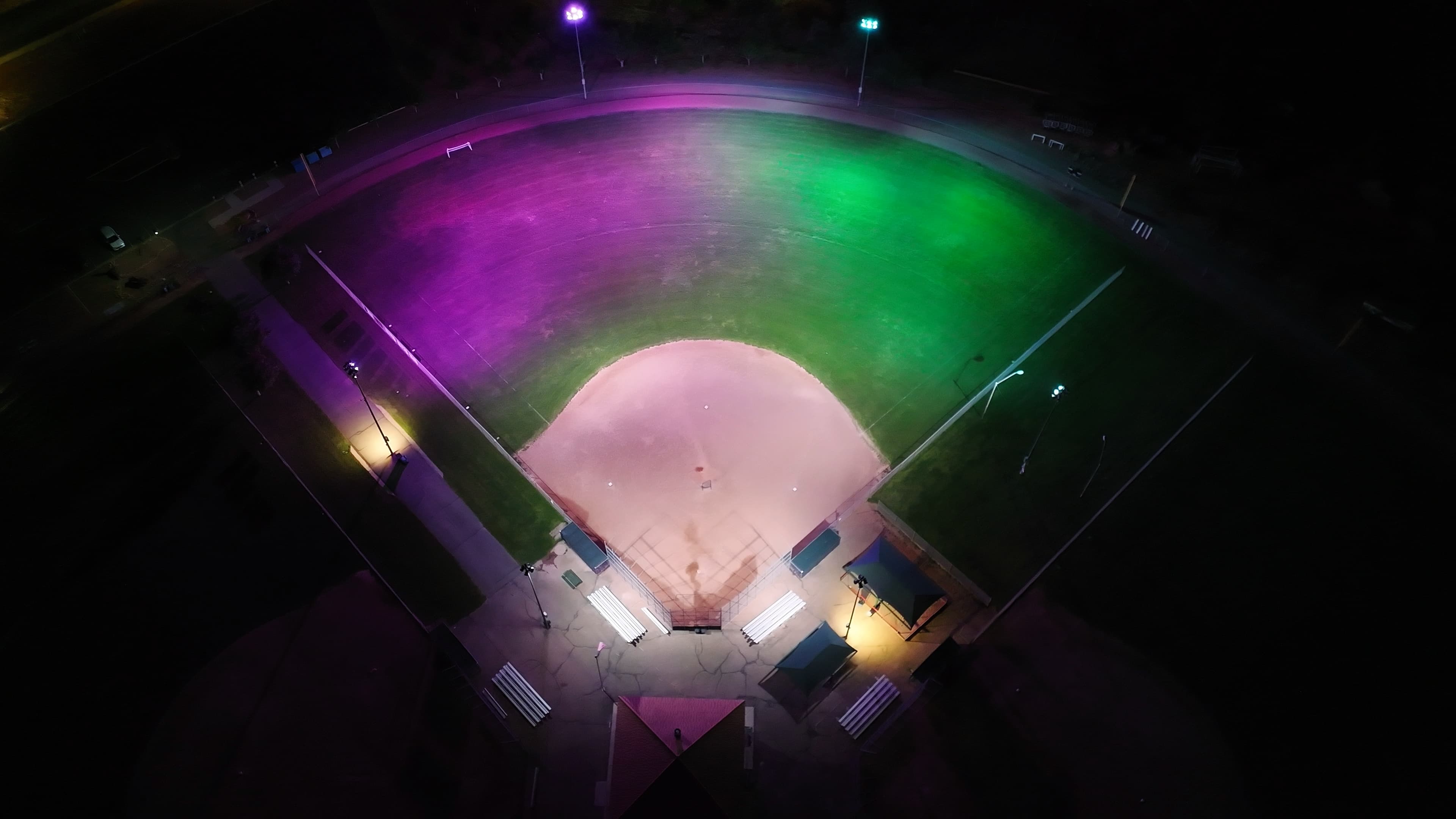
VOSS has executed LED sports lighting projects across the country, including a notable baseball lighting project in Page, AZ. That project demonstrated what a well-engineered LED system delivers in a real-world athletic facility context: dramatically improved on-field visibility, meaningful energy consumption reductions compared to the prior metal halide installation, and a finished result that met the specific standards required for the level of play hosted at that facility.
Projects like this reinforce a broader truth about baseball lighting upgrades: the quality of the outcome is determined not just by the fixture manufacturer, but by the engineering rigor behind pole layout, aiming angles, and photometric modeling — and by the experience of the contractor managing installation and commissioning. VOSS brings both.
Controls Integration: The Feature Facility Managers Don't Know They Need Until They Have It
One of the most underappreciated dimensions of a modern LED sports lighting installation is the controls layer. Advanced sports lighting controls allow facility operators to do things that simply were not possible with older systems:
- Scene-based presets — Instantly switch between illuminance levels optimized for practice, game play, warm-ups, or post-game cooldown
- Scheduled automation — Program lights to activate and shut off automatically based on game schedules, eliminating the cost of lights running on empty fields after events conclude
- Remote management — Monitor system performance, receive fault alerts, and adjust settings from a smartphone or facility management platform without sending a staff member to the field
- Dimming capability — Reduce output during non-peak hours for additional energy savings without compromising safety
For parks and recreation departments managing multiple fields across O'Fallon's park system, controls integration can meaningfully reduce both energy waste and staff time. For school districts across St. Charles County, automated scheduling ensures that athletic fields at multiple campuses operate efficiently without requiring manual oversight at each site.
A Practical Note for Public Agencies and School Districts
For municipalities, park districts, and public school systems in Missouri evaluating a baseball or softball lighting project, procurement pathway matters. VOSS holds an approved state contract in Missouri, which can streamline the procurement process for eligible public agencies and help you move from project approval to installation more efficiently.
In addition, VOSS participates in a number of cooperative purchasing programs — including Sourcewell, TIPS, BuyBoard, AEPA, Omnia Partners, and others — that are available to qualifying government and education organizations. These programs are designed to reduce procurement complexity while ensuring competitive pricing and contract compliance. If your organization is navigating public procurement requirements for an upcoming lighting project, our team can help you identify the right path.
Service Availability
While VOSS offers a comprehensive suite of national services, specific capabilities may vary by location. Please contact your local branch to confirm the current availability of specific services, technology solutions, or contracting capabilities in your immediate market.
Talk to VOSS About Your Field Lighting Project
Whether you're managing a single recreational field in O'Fallon's park system or overseeing a multi-field complex serving teams across St. Charles County and the greater St. Louis area, VOSS has the expertise to help you evaluate your options, build a business case, and execute a lighting upgrade that performs for decades.
We welcome the conversation — not to hand you a proposal on the spot, but to understand what your facility needs and share what the current generation of LED sports lighting can realistically deliver for your situation.
VOSS — St. Louis Branch
Phone: (636) 660-0088 Toll-Free: (877) 577-5409
Reach out to your local VOSS team to schedule a consultation or request a photometric assessment for your baseball or softball facility.