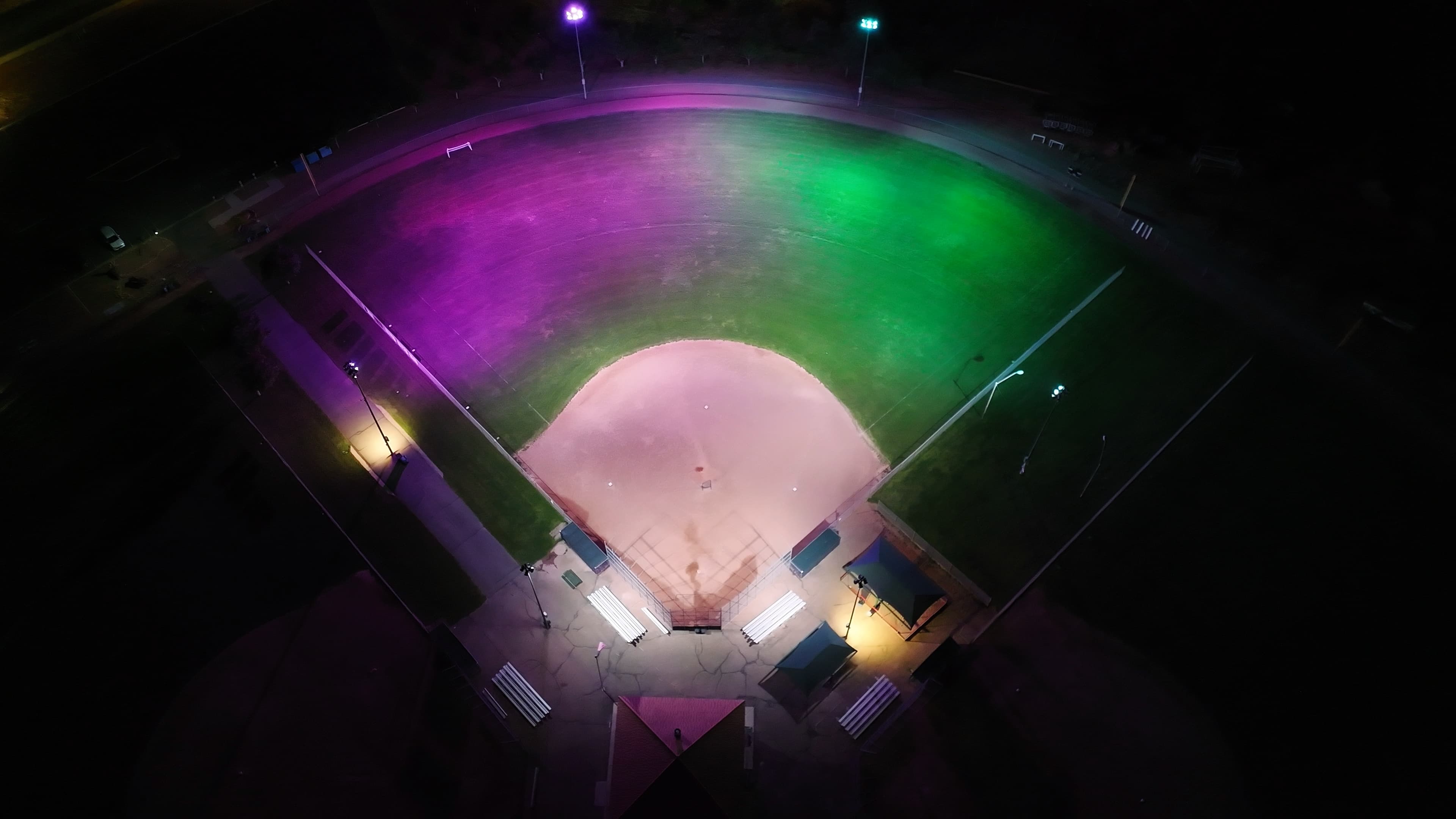
Why Baseball Lighting Matters More Than Ever in the St. Louis Region
Baseball is more than a pastime in Florissant and across the Greater St. Louis area — it is woven into the fabric of community life. From youth recreational leagues in Florissant's parks to travel ball tournaments drawing teams from St. Charles, O'Fallon, Hazelwood, Ferguson, and beyond, the demand for well-lit, safe, and broadcast-ready athletic facilities has never been higher.
Yet many fields across North St. Louis County still rely on aging metal halide or high-pressure sodium (HPS) lighting systems that were installed decades ago. These legacy systems come with well-documented limitations: slow warm-up times, uneven light distribution, high energy consumption, and escalating maintenance costs. As leagues grow and night game schedules expand, outdated lighting has become one of the most common barriers to delivering a quality on-field experience.
The good news: LED technology has fundamentally changed what facility owners, parks departments, and athletics organizations can achieve — and the investment case has never been clearer.
What Makes Baseball Lighting Uniquely Demanding
Not all sports lighting challenges are the same. Baseball and softball fields present a distinct set of design requirements that separate a well-engineered system from one that simply turns the lights on.
Field geometry is complex. Unlike a rectangular court or a football field, a baseball diamond creates asymmetrical coverage zones. The infield, outfield, foul territory, and warning track all require different lighting intensities and angles. Poor placement of poles or fixtures creates shadows in critical areas — exactly where a fielder needs to pick up a fly ball or a batter needs to track a pitch.
Glare control is critical. Elevated light poles pointing toward the field of play can create disabling glare for batters looking into the sky, outfielders tracking pop flies, or pitchers looking toward home plate. Professional photometric design accounts for beam angles, shielding, and fixture orientation to minimize glare while maximizing uniform illumination.
Standards vary by level of play. The Illuminating Engineering Society (IES) publishes recommended footcandle levels for recreational, amateur, collegiate, and professional baseball, and organizations like Little League Baseball, NFHS, and NCAA have their own specifications. A lighting system designed for a youth recreational league looks very different from one supporting a college program or a professional minor league affiliate.
Broadcast and event demands are rising. With youth sports video streaming now commonplace and tournaments increasingly attracting regional attention, even community-level facilities are being asked to meet higher lighting standards that support cameras and provide a more professional atmosphere for fans.
This is why engineering precision — not just fixture specification — defines a successful baseball lighting project.
The LED Advantage: What Facility Owners in Florissant Should Know
For parks directors, school athletics administrators, and facility managers evaluating a lighting upgrade, understanding the practical benefits of LED technology is essential to building the business case.
Energy savings are substantial. Modern LED sports lighting systems typically consume dramatically less energy than the metal halide systems they replace. For a field running multiple nights per week across a full spring and summer season, the reduction in kilowatt-hour consumption translates directly to lower utility bills — year after year. In a market served by utilities operating under Missouri's regulatory environment, those savings compound over a long asset life.
Maintenance costs drop significantly. Metal halide lamps require periodic relamping cycles, and accessing fixtures atop 60- to 80-foot poles is a costly, time-consuming operation. LED fixtures carry rated lifespans that far exceed traditional sources, reducing the frequency of maintenance events and the associated labor and equipment costs. For municipal parks departments managing multiple facilities across Florissant and North St. Louis County, this is a meaningful operational benefit.
Instant-on performance changes how facilities operate. LED systems reach full brightness the moment they are switched on, with no warm-up period. This matters for night games that start at dusk, for fields that share scheduling with other community uses, and for broadcast productions that require precise control over lighting conditions. Rain delays and re-starts that once required waiting for metal halide lamps to cool down and restart are no longer an issue.
Controls integration opens new possibilities. Today's LED sports lighting systems can be paired with sophisticated control platforms — enabling remote dimming, scheduling, zone control, and real-time monitoring from a smartphone or facility management system. For a parks department overseeing multiple fields across a community, centralized controls reduce wasted energy during low-use periods and give operations staff greater flexibility. This connects naturally to the broader conversation about smart building and energy management solutions that VOSS explores across our Latest Lighting content series.
Proof in the Field: Lessons from Page, AZ
One of the clearest demonstrations of what a well-executed baseball LED lighting project can deliver comes from Page, Arizona — a community with a deep investment in youth and recreational athletics. VOSS managed a comprehensive LED lighting upgrade for baseball facilities there, applying photometric design, precision pole placement, and fixture specification aligned with the specific standards for that level of play.
The results reflected what LED technology delivers when it is properly engineered and installed: improved light uniformity across the playing surface, reduced glare for players, and meaningful energy savings for the facility operator. The project required navigating real-world site conditions, coordinating with local utilities, and ensuring compliance with applicable standards — exactly the kind of multi-phase project management that separates a knowledgeable contractor from a simple equipment supplier.
For organizations in Florissant, St. Peters, Bridgeton, Maryland Heights, and across the Greater St. Louis metro, the takeaway is straightforward: the combination of engineering expertise, project management, and the right technology platform produces outcomes that generic lighting vendors cannot replicate.
Serving Florissant and Greater St. Louis at Every Level of Play
VOSS works with baseball and softball facilities across the full spectrum — from Little League and youth recreational fields managed by municipal parks departments to high school programs, travel ball complexes, collegiate facilities, and professional or semi-professional venues. Each project begins with a photometric study that models light levels, uniformity ratios, and glare metrics before a single fixture is ordered or a pole is set.
Our St. Louis branch serves Florissant and the surrounding communities throughout Missouri, including Hazelwood, Ferguson, Jennings, Normandy, St. Ann, Berkeley, Bellefontaine Neighbors, and communities across St. Louis County and St. Charles County. We understand the local parks infrastructure, the school districts that operate athletic facilities across the region, and the operational realities facing facility managers in this market.
For public agencies — including municipal parks departments, school districts, and other government entities across Missouri — VOSS holds an approved Missouri state contract, which simplifies the procurement process and ensures access to competitive, compliant pricing without requiring a separate bid process. Eligible organizations may also access VOSS services through cooperative purchasing programs including Sourcewell, BuyBoard, TIPS, AEPA, Omnia Partners, PACE, and others — providing flexible, efficient pathways to fund and procure a lighting upgrade.
Those exploring the financial side of an LED upgrade may also find value in our related content on LED lighting rebates and energy incentives — topics covered in depth in our Latest Lighting series alongside discussions of outdoor LED upgrades, sports court lighting, and pickleball and tennis facility solutions.
Service Availability
While VOSS offers a comprehensive suite of national services, specific capabilities may vary by location. Please contact your local branch to confirm the current availability of specific services, technology solutions, or contracting capabilities in your immediate market.
Talk to a VOSS Lighting Expert in St. Louis
If your organization is evaluating a baseball or softball lighting upgrade — whether it is a single recreational field or a multi-diamond complex — we encourage you to start with a conversation. Our St. Louis team can walk you through the photometric design process, discuss applicable standards for your level of play, and help you understand the energy and maintenance economics of an LED upgrade in your specific context.
VOSS — St. Louis Branch Phone: (636) 660-0088 Toll-Free: (877) 577-5409
We work with parks departments, school districts, private clubs, and professional organizations across Florissant and the Greater St. Louis region. Reach out to schedule a consultation and learn how the right lighting system can transform your facility's performance, safety, and energy profile.