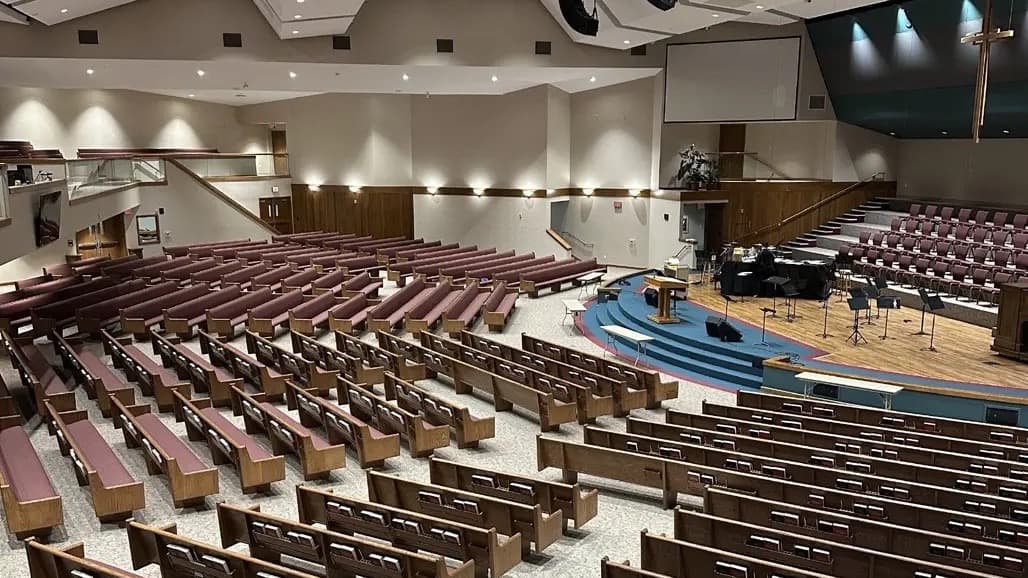
Why Sanctuary Lighting Is a Growing Priority for Chesterfield-Area Churches
The greater St. Louis region is home to a remarkably active faith community. From the established congregations along Chesterfield's Baxter Road corridor to growing churches in Wildwood, Ballwin, and Ellisville, houses of worship here range from historic stone sanctuaries to expansive modern campuses. What many share, regardless of size or denomination, is a common set of facility challenges rooted in aging lighting infrastructure.
Across West St. Louis County, church facility managers are increasingly confronting the same compounding pressures: incandescent and halogen fixtures that burn out every few months in 30- to 50-foot ceiling applications, fluorescent systems showing signs of ballast failure, and energy bills that climb year over year with no clear return on investment. These aren't minor inconveniences — they directly affect the worship experience, safety, and the operational workload of already stretched facility teams.
The broader national shift toward LED technology, accelerating utility rebate programs, and the growing role of video and livestreaming in church ministry have all converged to make lighting modernization a top-of-mind decision for church leadership and facilities directors alike.
The Real Costs of Deferred Sanctuary Lighting Maintenance
For many churches, lighting maintenance has historically been reactive — a bulb burns out, scaffolding gets rented, a volunteer crew spends a weekend on lifts. This approach feels low-cost in the moment, but the true expense compounds over time.
High-access fixture replacements in traditional sanctuaries with vaulted ceilings or ornate architectural details can require specialized lift equipment, experienced crews, and significant labor hours — sometimes multiple times per year per fixture type. When you multiply those costs across a full sanctuary and supporting fellowship spaces, the numbers add up quickly.
Ballast and dimmer incompatibility is another widespread issue in older church facilities. Many sanctuaries across the Chesterfield area were wired during the 1970s through 1990s, using dimming infrastructure that was never designed to work with today's lighting technology. The result is often flickering, humming, or premature fixture failure — creating distractions during services and frustrating facilities teams who can't pin down the root cause.
Video and livestream quality has raised the stakes further. Congregations in the St. Louis metro that have invested in production-quality cameras for hybrid or online worship find that inconsistent color temperature, poor foot-candle levels, or uneven wash across the platform severely limits the value of that investment. Lighting is no longer just about visibility — it's about communicating effectively with audiences both in the room and online.
What Modern LED Retrofits Actually Deliver for Church Facilities
The promise of LED technology has been discussed for years, but the practical reality for church sanctuaries has matured significantly. Today's retrofit solutions are designed specifically for the architectural, operational, and budgetary realities of faith-based facilities.
Dramatically reduced relamping frequency is the most immediate operational benefit. High-quality LED sources rated at 50,000 hours or more can go years between service cycles in a typical church use pattern — replacing a fixture that previously required annual attention with one that may not need touch for a decade. For facilities teams in Chesterfield and surrounding communities like Creve Coeur and Des Peres, this translates directly into fewer emergency calls, less scaffolding time, and reduced vendor dependency.
Intelligent dimming and scene control is a particularly meaningful upgrade for sanctuaries that host diverse programming — Sunday morning worship, Wednesday evening services, special events, weddings, funerals, and community gatherings all benefit from different lighting atmospheres. Modern LED-compatible control systems allow facility managers to program and recall scenes instantly, without manual adjustment of every fixture.
Energy efficiency gains are consistent and measurable. LED technology typically reduces lighting-related energy consumption by 50–75% compared to legacy incandescent or halogen systems. For Missouri churches on standard commercial utility rates, this can represent meaningful annual savings that compound over the life of the system.
Color rendering and consistency improvements matter both aesthetically and functionally. Modern LED sources with high Color Rendering Index (CRI) values render skin tones, fabric colors, and architectural details more naturally — enhancing the visual quality of the sanctuary for in-person congregants and on-camera alike.
Navigating the Practical Challenges Unique to Church Buildings
Church sanctuaries present installation and retrofit challenges that standard commercial lighting projects simply don't encounter. Understanding these complexities upfront is what separates a smooth, low-disruption upgrade from a project that runs long and frustrates staff and volunteers.
Historic and architectural constraints are common in older churches throughout St. Louis County and the surrounding region. Fixtures may be custom, original to the building's construction, or integrated into architectural elements that cannot be modified. Successful retrofit projects respect these constraints while still delivering modern performance — often through careful fixture matching, adapter solutions, or selective replacement strategies that preserve the sanctuary's character.
Access and scheduling logistics demand careful coordination. Unlike a commercial office building where work can happen after hours without disruption, churches operate on complex, multi-day schedules. Installations need to be planned around Sunday services, midweek programming, seasonal events, and community uses — often with very short windows for high-access work. Phased project approaches that keep the sanctuary functional throughout the upgrade are frequently the right answer for active congregations.
Budget cycles and phased investment are a practical reality for most faith communities. Church facilities operate on annual budgets with board or congregation approval processes that rarely align with urgent maintenance timelines. Understanding this, experienced contractors structure proposals that allow phased implementation — addressing the most critical areas first while building toward a comprehensive facility upgrade over one to three budget cycles.
Cooperative Purchasing Options for Eligible Missouri Organizations
For Missouri churches affiliated with school programs, community organizations, or other entities that may qualify for cooperative purchasing, VOSS participates in several programs that simplify procurement and can help stretch facility budgets further. Available programs for eligible organizations include Houston Church COOP, BuyBoard, Sourcewell, TIPS, Omnia Partners, AEPA, PACE, and Nebraska ESU Co-Op.
VOSS also holds an approved state contract in Missouri, providing reliable products, competitive pricing, and expert support for eligible government and public-sector facilities in the region.
Facility directors at churches with affiliated schools or community programs in the Chesterfield, Wildwood, and West St. Louis County area are encouraged to ask our local team about qualification and how these vehicles might apply to their specific project.
Related Topics in the VOSS Latest Lighting Series
If your church is evaluating a broader energy strategy alongside sanctuary lighting, several related topics in our Latest Lighting series may be relevant. Energy Efficient Church Lighting Upgrades explores the full spectrum of efficiency improvements available to faith-based facilities. Energy Audits, Incentives, and Rebate Navigation for Businesses provides context on how to identify and capture available utility incentives in your market. Fluorescent Tube Bans and LED Lighting Rebates is particularly relevant for facilities still operating fluorescent systems in fellowship halls, classrooms, or administrative areas.
Service Availability
While VOSS offers a comprehensive suite of national services, specific capabilities may vary by location. Please contact your local branch to confirm the current availability of specific services, technology solutions, or contracting capabilities in your immediate market.
Talk to VOSS About Your Sanctuary Lighting Challenges
VOSS has supported commercial and institutional lighting projects for more than 85 years, with hands-on experience navigating the real-world constraints of faith-based facilities. Our St. Louis branch team serves Chesterfield and the broader West St. Louis County area, including Wildwood, Ballwin, Ellisville, Creve Coeur, Des Peres, and surrounding communities.
If your congregation is dealing with flickering fixtures, high relamping costs, or a sanctuary that simply isn't performing the way it should — we'd welcome the conversation. Our team is equipped to evaluate your current system, identify practical upgrade paths, and help you build a phased approach that fits your facility's schedule and your board's budget process.
VOSS — St. Louis Branch
Phone: (636) 660-0088 Toll-Free: (877) 577-5409