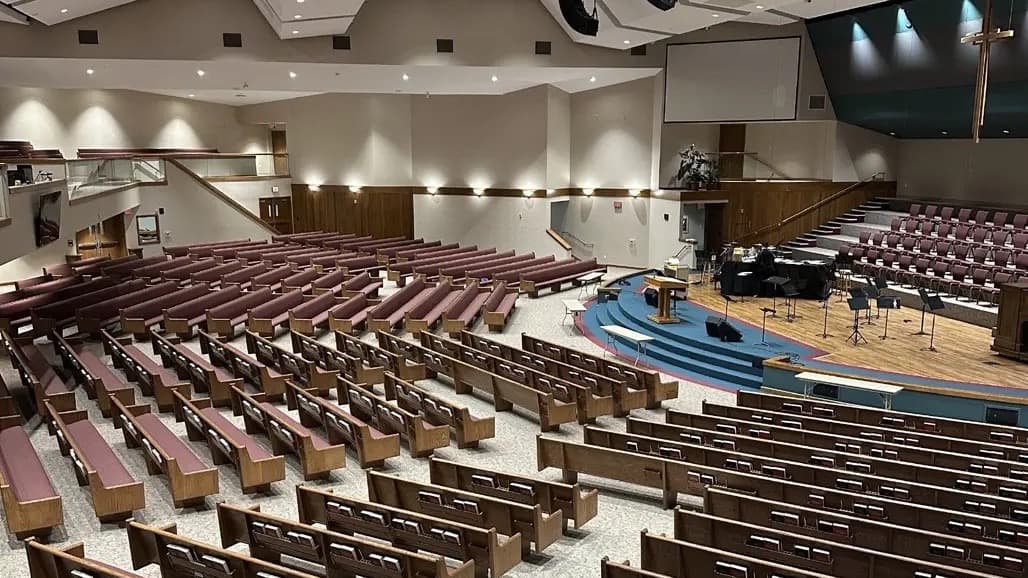
Why Sanctuary Lighting Deserves a Closer Look in Seguin
Seguin, Texas — a city of roughly 30,000 anchored by deep community traditions and a strong faith culture in Guadalupe County — is home to a wide variety of congregations, from historic downtown sanctuaries along Austin Street to newer suburban campuses serving the growing residential corridors between Seguin and the Greater San Antonio metro. Whether your congregation has worshipped in the same building for decades or recently expanded into a larger facility, the lighting systems inside your sanctuary are quietly shaping the experience your members have every single week.
For many church facility managers and maintenance supervisors in the region, the day-to-day reality involves climbing lifts to replace burned-out bulbs in 30-foot ceilings, troubleshooting aging ballasts that cause flickering during services, or fielding complaints from volunteers running the livestream camera that the sanctuary simply doesn't look right on screen. These are not minor inconveniences — they are symptoms of lighting infrastructure that has outlived its useful life and is now working against the mission of the facility.
Across the Greater San Antonio area — including communities like New Braunfels, Schertz, San Marcos, Gonzales, and Luling — congregations are increasingly recognizing that lighting is not just a facilities expense to manage, but a strategic asset to invest in thoughtfully.
The Real Cost of Deferred Sanctuary Lighting Maintenance
Church facilities operate under constraints that most commercial buildings don't face: volunteer-heavy maintenance teams, limited capital budgets, high emotional stakes around the worship environment, and in many cases, architecturally significant interiors that demand careful handling.
This creates a tendency to defer lighting upgrades until something breaks — and by then, the disruption cost is far higher than a planned retrofit would have been. Consider what deferred maintenance actually looks like in practice:
- Frequent bulb replacement cycles in traditional incandescent, halogen, or T12 fluorescent fixtures require scaffolding or lift rentals multiple times per year, consuming both budget and staff time
- Flickering and dimming failures caused by failing ballasts or incompatible dimmer systems interrupt services and can damage the perception of a congregation's professionalism in an era when many churches broadcast or record their services
- Uneven illumination across the sanctuary floor — bright spots at the front, dim corners in the balcony or rear pews — creates a fragmented experience for worshippers and makes video production significantly more difficult
- Energy costs from legacy metal halide, incandescent, or fluorescent systems running long service hours across multiple weekly gatherings add up meaningfully over a 12-month period
It's worth noting that as of 2023, federal efficiency standards have effectively phased out many common incandescent lamp types, and Texas has been an active participant in the broader national shift away from fluorescent lamp technologies. Church facilities still operating on these legacy systems may find replacement parts increasingly difficult to source — making the case for a proactive LED transition even stronger. Our sibling article on Fluorescent Tube Bans and LED Lighting Rebates covers this regulatory landscape in detail for those seeking more background.
What a Modern Sanctuary Lighting System Actually Delivers
The conversation around LED retrofits has matured significantly. Early-generation LED conversions sometimes produced clinical, flat light that felt out of place in a worship setting. Today's church lighting solutions are engineered specifically for the aesthetic and functional demands of sanctuary environments.
Color quality and warmth are now highly tunable. Warm white LEDs in the 2700K–3000K range replicate the inviting atmosphere of traditional incandescent sources, while fixtures designed for stage and chancel areas can render colors accurately — important for robes, altar elements, and projected media. Color Rendering Index (CRI) ratings of 90+ are now standard in quality fixtures, meaning the space looks as intentional under LED as it did under legacy sources.
Dimming and scene control have become both more reliable and more accessible. Modern LED-compatible dimming systems allow facility teams to program preset lighting scenes — one for Sunday morning worship, another for a Wednesday evening small group, another for a wedding or memorial service — and recall them with a single button press. This reduces the cognitive load on volunteers who may rotate through AV and lighting duties, and it ensures the room always looks its best regardless of who's running the board.
Fixture longevity is perhaps the most practical benefit for facility managers. Quality commercial LED fixtures carry rated lifespans of 50,000 hours or more — meaning a fixture installed today could realistically still be performing well into the 2040s under typical church usage patterns. For sanctuaries with 30- to 40-foot ceilings where every bulb replacement requires lift equipment, this represents a dramatic reduction in ongoing maintenance burden.
Livestream and video compatibility has become a genuine priority for congregations of all sizes. Even smaller churches in the Seguin area are now recording or streaming services regularly, and the quality of that broadcast is directly tied to the evenness and color accuracy of the sanctuary lighting. LED systems designed with video production in mind can significantly improve the on-screen appearance of a service without requiring a separate investment in broadcast lighting rigs.
For congregations also exploring broader energy efficiency goals, our Energy Efficient Church Lighting Upgrades article and the Energy Audits, Incentives, and Rebate Navigation for Businesses page in the Latest Lighting section offer complementary reading on how lighting upgrades fit into a larger sustainability and cost-reduction strategy.
Practical Considerations for Church Facilities in the Greater San Antonio Region
Church buildings present specific physical and institutional constraints that don't exist in standard commercial retrofits. Facility managers in Seguin and across Guadalupe County should be thinking about several factors as they evaluate a lighting upgrade:
Historic and architecturally significant interiors. Many of Seguin's older congregations are housed in buildings with stained glass, ornate woodwork, and decorative plasterwork that must be protected during any installation. Working in these environments requires experienced crews who understand how to manage rigging, lift placement, and dust containment without damaging irreplaceable features.
Phased implementation and budget alignment. Most congregations don't replace their entire lighting system at once. A well-structured upgrade plan identifies the highest-impact areas first — typically the main sanctuary floor and chancel — and phases subsequent work across multiple budget cycles. This approach lets congregations realize immediate operational benefits while managing capital expenditure responsibly.
Rebate and incentive programs. CPS Energy, which serves much of the San Antonio metro region, has historically offered commercial lighting rebate programs that can meaningfully offset the upfront cost of a qualified LED retrofit. Seguin is served by Guadalupe Valley Electric Cooperative (GVEC), and facility managers should confirm current incentive availability directly with their utility provider, as programs and eligibility requirements change. The return on investment timeline for a sanctuary LED upgrade can improve significantly when available incentives are properly captured.
Cooperative purchasing for eligible organizations. For churches affiliated with public or quasi-public institutions, or for faith-based organizations that participate in group purchasing, cooperative procurement programs such as BuyBoard, TIPS, Sourcewell, Omnia Partners, PACE, and the Houston Church COOP may provide access to pre-negotiated pricing and streamlined procurement processes. These programs are worth exploring early in the planning process, as they can simplify vendor selection and contracting.
VOSS and the Greater San Antonio Market
VOSS has served commercial, institutional, and faith-based facility clients across Texas for decades, with our San Antonio branch positioned to support congregations throughout the Greater San Antonio region — including Seguin, New Braunfels, Schertz, Converse, Universal City, Boerne, and the surrounding communities of the I-10 and I-35 corridors.
Our experience with church properties spans a wide range of building types and congregation sizes, from small historic sanctuaries to large multi-campus facilities. We approach every engagement as a long-term facilities partner — not a one-time contractor — which means our recommendations are shaped by what will perform reliably over a 10- to 20-year horizon, not just what's easiest to install today.
We understand the operational realities of church facility management: limited staff, volunteer-dependent teams, services that cannot be disrupted, and boards that require clear financial justification for capital expenditures. Our assessments are designed to give facility managers and church leadership the information they need to make confident, well-supported decisions.
Service Availability
While VOSS offers a comprehensive suite of national services, specific capabilities may vary by location. Please contact your local branch to confirm the current availability of specific services, technology solutions, or contracting capabilities in your immediate market.
Talk to VOSS About Your Sanctuary Lighting
If your congregation in Seguin or the surrounding Greater San Antonio region is navigating aging fixtures, rising maintenance costs, or a sanctuary environment that no longer serves your worship and media needs as well as it should, we'd welcome a conversation.
Our San Antonio team is available to discuss your facility's specific challenges, walk through what a lighting assessment would involve, and help you think through a realistic path forward — whether that means a phased retrofit plan, a controls upgrade, or a comprehensive sanctuary lighting redesign.
VOSS — San Antonio Branch Phone: (210) 967-8766
Reach out to start a no-pressure conversation about what better sanctuary lighting could mean for your congregation and your team.