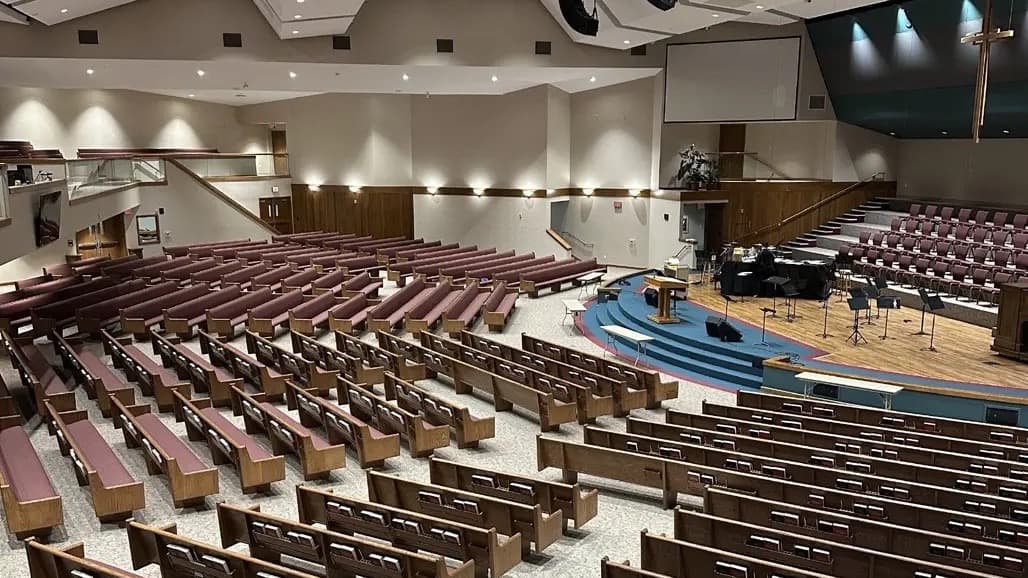
Why Sanctuary Lighting Is a Growing Priority for Schertz-Area Churches
Schertz, Texas has grown into one of the most dynamic communities in the Greater San Antonio region. Situated along the IH-35 corridor between San Antonio and Seguin — and neighboring thriving communities like Cibolo, Universal City, Live Oak, and Converse — Schertz has seen steady residential and institutional growth over the past decade. Its population of approximately 45,000 residents supports a vibrant network of faith communities spanning a wide range of denominations, building ages, and facility sizes.
For church facility managers and maintenance supervisors across this area, that growth brings both opportunity and responsibility. Many sanctuaries built during earlier waves of community expansion are now operating with lighting infrastructure that is 20 to 40 years old. Others are newer but were built with general-purpose commercial fixtures that don't serve the nuanced needs of a worship environment. Either way, the result is often the same: flickering lights, frequent burnouts in hard-to-reach fixtures, rising energy costs, and growing frustration from staff, volunteers, and congregants alike.
This article explores the key challenges driving church lighting upgrades in the Schertz area, the innovations making those upgrades more practical than ever, and what facilities leaders should consider before embarking on a project.
The Hidden Costs of Deferred Lighting Maintenance
One of the most common misconceptions among church facilities teams is that lighting maintenance can be safely deferred until a fixture fully fails. In practice, the costs of that approach accumulate well before complete failure — and they show up in ways that aren't always obvious at first glance.
Frequent relamping in elevated fixtures is among the most visible challenges. Sanctuary ceilings in traditional and contemporary church buildings alike commonly reach 20 to 40 feet or higher. Replacing incandescent, halogen, or fluorescent lamps at those heights requires scaffolding or aerial lifts, coordinating around service schedules, and significant labor time — often multiple times per year. Each service call represents not just a direct cost, but a disruption to the sanctuary space.
Aging ballasts and incompatible dimmers introduce a different category of problem. Flickering and dimming inconsistencies are often traced back to ballast degradation or mismatched dimmer technology — issues that worsen over time and can be difficult to diagnose without professional assessment. These symptoms erode the atmosphere that worship leaders work hard to create and can signal deeper wiring concerns that deserve attention.
Uneven illumination affects more than aesthetics. In an era when many Schertz-area congregations are livestreaming services or recording video content for online audiences, lighting quality has a direct impact on production value and outreach effectiveness. Inadequate or inconsistent light levels can also create safety concerns for older congregants navigating sanctuary spaces.
The cumulative cost of these issues — in labor, energy consumption, and missed ministry opportunities — often exceeds what a well-planned LED upgrade would have cost to begin with.
How LED Technology Is Reshaping Church Sanctuary Lighting
The evolution of LED lighting technology over the past decade has fundamentally changed the calculus for church facilities leaders. What was once a significant upfront investment with uncertain returns has become one of the most straightforward operational improvements available to faith-based organizations.
Extended fixture life is the headline benefit. Quality LED fixtures designed for sanctuary applications are rated for tens of thousands of hours of operation — dramatically reducing the frequency of relamping in those difficult-to-access high-ceiling locations. For a facilities team managing a busy church with multiple weekly services, rehearsals, and community events, that reduction in maintenance frequency is genuinely transformative.
Energy efficiency compounds over time. LED fixtures consume a fraction of the energy required by traditional incandescent and halogen sources, and even outperform fluorescent technology on efficiency metrics. In Central Texas, where summer cooling loads are significant, the reduction in heat output from LED fixtures also delivers secondary HVAC savings — a detail that facilities managers in the San Antonio region know well from experience with the region's climate.
Tunable color temperature and dimming compatibility have advanced significantly. Modern LED systems designed for worship environments can deliver warm, inviting light for traditional services and shift to brighter, more even illumination for contemporary programming — all within the same fixture ecosystem and controllable from a simple interface. This flexibility supports the diverse programming needs of many Schertz-area congregations without requiring separate fixture installations.
Dimming performance and control integration deserve particular attention for churches. Older fluorescent systems and even some early LED retrofits struggled with flicker at lower dim levels — a visible problem on camera and a distraction in person. Current-generation LED drivers and compatible dimming controls have largely resolved this, making smooth, broadcast-quality dimming accessible even in budget-conscious retrofit projects.
Practical Considerations for Church Lighting Projects in Schertz
Understanding the technology is one piece of the picture. Successfully executing a sanctuary lighting upgrade requires navigating a set of facility-specific considerations that are unique to church buildings — and that vary considerably from one property to the next across the Schertz, Cibolo, and greater Bexar County area.
Historic and architectural constraints are a factor for some congregations. Older sanctuaries may feature decorative fixtures, ornate ceiling details, or architectural elements that limit the placement or style of replacement fixtures. A well-executed upgrade respects the character of the space while achieving meaningful performance improvements — and that balance requires experience with church-specific projects, not just general commercial retrofitting.
Scheduling around active programming is non-negotiable. Unlike an office building or retail space, a church sanctuary is rarely idle. Services, rehearsals, small group gatherings, weddings, funerals, and community events fill the calendar throughout the week. Effective project planning accounts for this reality with phased installation schedules, off-hours work windows, and clear communication with facilities and programming staff from the outset.
Access planning for high ceilings requires advance coordination. Whether a project calls for scissor lifts, boom lifts, or scaffolding, ceiling height and sanctuary floor layout determine what equipment can be safely deployed — and that assessment needs to happen before a project begins, not during installation.
Controls and dimming integration should be evaluated holistically. A fixture-only replacement that doesn't address legacy dimmer compatibility or control infrastructure may solve the burnout problem but leave flickering and uneven dimming in place. The most successful upgrades treat the lighting system as a whole.
Budget and phasing strategies are especially relevant for nonprofit organizations managing limited capital budgets. Phased approaches — addressing the most critical fixtures or zones first, then expanding in subsequent budget cycles — allow congregations to realize meaningful improvements without requiring full funding upfront.
For eligible faith-based and nonprofit organizations, cooperative purchasing programs can provide another avenue for cost management. Programs such as Houston Church COOP, BuyBoard, TIPS, Sourcewell, and Omnia Partners may offer pre-negotiated pricing on qualified products and services, streamlining procurement and providing budget predictability. Organizations affiliated with public-sector entities may also have access to AEPA, PACE, or Nebraska ESU Co-Op programs. Confirming eligibility with your purchasing office or facilities leadership is a worthwhile step before any project moves to bidding.
What to Look for in a Church Lighting Partner
Not every electrical contractor has meaningful experience with the specific demands of worship facility projects. When evaluating a lighting partner for your Schertz-area church, a few criteria are worth weighing carefully.
Demonstrated experience with faith-based facilities — not just general commercial construction — matters. Church sanctuaries have specific acoustic, aesthetic, and scheduling sensitivities that require a contractor who understands the environment and has navigated its challenges before.
A consultative, assessment-first approach is a strong indicator of professionalism. Before recommending fixtures or controls, a qualified partner should conduct a thorough site assessment, understand your programming and operational needs, and present options calibrated to your priorities — not a one-size-fits-all solution.
Familiarity with utility incentive and rebate programs available in the Greater San Antonio region can meaningfully offset project costs. An experienced partner will know which programs apply, how to navigate the application process, and how to document the project for maximum incentive capture. Our sibling article, Maximize ROI with Commercial LED Lighting Rebates in Dallas, TX, explores rebate navigation strategies in depth — many of those principles apply equally to Texas markets served by regional utilities.
Long-term support capability is worth considering. A contractor who can provide ongoing maintenance, warranty support, and system adjustments after installation reduces your operational burden and protects your investment over time.
For context on the broader landscape of lighting innovation, the Energy Efficient Church Lighting Upgrades and Commercial LED Lighting Fixtures articles in our Latest Lighting series offer additional background on technology trends and product considerations relevant to faith-based facilities.
Service Availability
While VOSS offers a comprehensive suite of national services, specific capabilities may vary by location. Please contact your local branch to confirm the current availability of specific services, technology solutions, or contracting capabilities in your immediate market.
Talk With Our San Antonio Team
VOSS has served commercial and institutional clients across the Greater San Antonio region for decades, with deep familiarity with the communities of Schertz, Cibolo, Universal City, New Braunfels, Seguin, and surrounding Bexar and Guadalupe County areas. Our San Antonio branch is equipped to support church facilities leaders with site assessments, project planning, and full-service installation — all designed around your congregation's schedule and operational realities.
If your sanctuary is experiencing any of the challenges described in this article — or if you're simply wondering whether a lighting upgrade makes sense for your facility — we'd welcome the conversation.
VOSS — San Antonio Branch Phone: (210) 967-8766
Reach out to schedule a no-obligation consultation with our local team. We're here to help you understand your options, evaluate available incentives, and build a plan that works for your facility and your congregation.