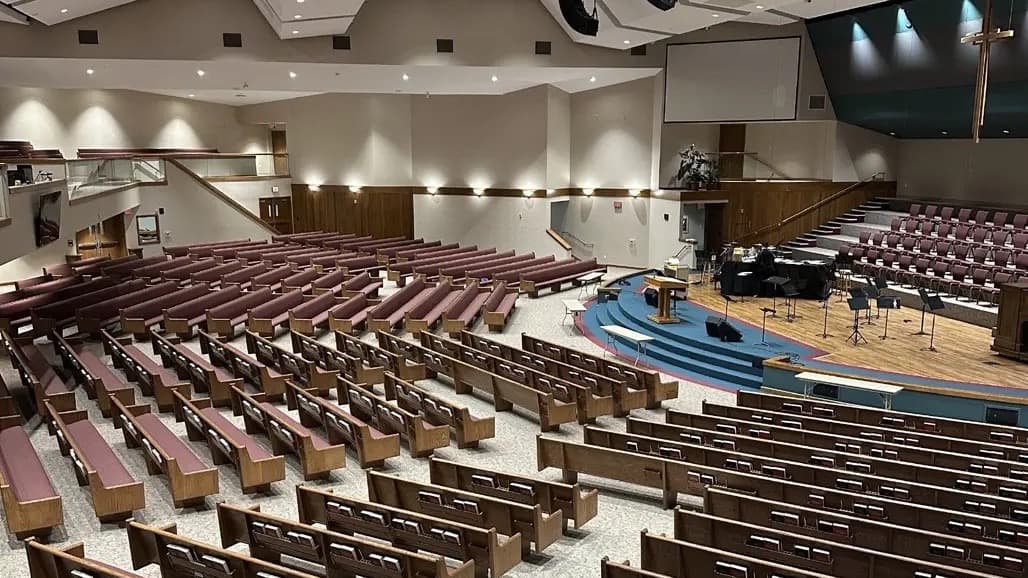
Why Sanctuary Lighting Is a Growing Priority for New Braunfels Churches
New Braunfels is one of the fastest-growing cities in Texas — and in the country. A community of roughly 100,000 residents situated between San Antonio and Austin along the I-35 corridor, it has seen a surge in residential development, new neighborhoods, and an expanding faith community landscape to match. Churches in New Braunfels range from historic limestone sanctuaries in the downtown area to large, modern multi-campus congregations serving families relocating from across the region.
With growth comes expectation. Congregants who have experienced high-quality lighting in contemporary venues — from the Pearl District in San Antonio to the newer developments in Kyle, Buda, and Seguin — increasingly notice when a sanctuary feels dim, uneven, or dated. But beyond aesthetics, there is a practical reality that church facility managers throughout Comal County know well: maintaining lighting in a traditional or large sanctuary is genuinely hard work.
High ceilings, ornate architectural features, and fixtures designed for incandescent or fluorescent technology create a cycle of frequent bulb replacements, scaffolding setups, and ongoing ballast failures. As churches expand their programming — adding livestream services, mid-week events, and community outreach activities — the lighting infrastructure that once served a single Sunday service is now under continuous demand.
Understanding these pressures is the first step toward solving them strategically, rather than reactively.
The Real Cost of Reactive Lighting Maintenance in Church Facilities
For many faith communities, lighting maintenance happens on a break-fix basis: a bulb fails, staff respond, the process repeats. This approach is understandable given the budget realities most churches navigate, but it consistently costs more over time than a planned upgrade strategy.
Consider the compounding factors that facility managers in the New Braunfels and greater San Antonio region are managing:
- Labor and lift costs associated with accessing fixtures in sanctuaries with 20-, 30-, or 40-foot ceilings can far exceed the cost of the bulbs themselves
- Aging ballasts in fluorescent systems degrade over time, causing flickering and humming that disrupts worship — and replacing ballasts is a recurring expense that adds up quickly
- Inconsistent color temperature and lumen output across a mix of old and newer fixtures creates a visually uneven environment that is particularly problematic for video production and livestreaming
- Energy consumption from older high-intensity discharge (HID) or fluorescent fixtures is substantially higher than modern LED alternatives, contributing to elevated utility bills month after month
Texas's climate adds another dimension. In New Braunfels, summer heat puts consistent pressure on air conditioning systems, and lighting that generates excess heat — as older fixture types do — compounds that load. Reducing the thermal output of sanctuary lighting through LED conversion can have a measurable downstream benefit on cooling costs, which is meaningful for facilities running services and events throughout the summer.
LED Retrofits and Upgrades: What Thoughtful Sanctuary Modernization Looks Like
The shift to LED lighting in church sanctuaries is not simply a bulb swap — it is a systems-level decision that, when done well, transforms the long-term operational profile of the facility. Here is what best practice looks like at each stage:
Lighting Assessment and Audit
A thorough assessment establishes a baseline: which fixtures are underperforming, where energy consumption is highest, and what the realistic lifespan is for existing components. In sanctuaries with mixed legacy systems — a common situation in churches that have grown and added on over decades — this audit often reveals opportunities to consolidate and standardize.
For churches in New Braunfels and surrounding communities like Canyon Lake, Seguin, and Schertz, a professional assessment also accounts for architectural constraints, including historic preservation considerations that may apply to older church buildings.
Retrofit vs. Full Fixture Replacement
Not every sanctuary requires a full fixture overhaul. In many cases, LED retrofit kits can be installed into existing housings, preserving the aesthetic character of the fixture while delivering dramatically improved performance — lower energy draw, longer lamp life (often 50,000+ hours), and better color rendering for both in-person and on-camera environments.
Where full replacement makes sense — particularly for churches expanding their sanctuary footprint or renovating worship spaces — the opportunity exists to specify fixtures purpose-built for the demands of a modern worship environment, including theatrical-grade dimming, tunable white capability, and color-changing technology for dramatic effect.
Lighting Controls and Dimming Integration
One of the most transformative changes a church can make is the addition of intelligent lighting controls. Scene-based systems allow worship leaders and AV teams to shift the sanctuary's entire lighting environment — from full-brightness welcome mode to intimate candlelight-style settings for prayer — with a single button press. For churches in the New Braunfels area that are investing in livestream and video production capabilities, controllable LED systems also enable the kind of consistent, high-quality illumination that dramatically improves camera performance.
Modern control systems also support scheduling and occupancy-based management, reducing energy consumption during periods when the building is unoccupied — a practical benefit for multi-use facilities running programming across the week.
Minimizing Disruption to the Congregation
Churches operate on a rhythm that cannot easily be interrupted. Weekend services, holiday programming, and mid-week commitments mean that installation windows are often limited. Professional planning and phased execution are essential to ensuring upgrades are completed without disrupting the congregation's experience. This is a priority that experienced contractors — familiar with the operational realities of faith facilities — bring to the engagement from the start.
Cooperative Purchasing: A Practical Option for Eligible Faith Organizations
Some church organizations and faith-based nonprofits may qualify for cooperative purchasing programs that streamline procurement and potentially reduce costs. Programs such as Houston Church COOP, BuyBoard, TIPS, Sourcewell, and Omnia Partners are available to eligible organizations and can simplify the contracting process significantly.
If your church is affiliated with a network, denomination, or organization that participates in cooperative purchasing, it is worth exploring whether these programs apply to your facility's planned lighting projects. VOSS works with organizations across these programs — contact our San Antonio branch team to learn more about what may be available for your specific situation.
How This Topic Connects to Broader Lighting Strategy
Sanctuary lighting is one piece of a larger facility lighting picture. Churches managing aging infrastructure often find that a sanctuary upgrade opens the door to a broader assessment of fellowship halls, parking lots, exterior lighting, and administrative spaces. Related topics worth exploring within the VOSS Latest Lighting resource library include guidance on Energy Efficient Church Lighting Upgrades, Parking Lot and Outdoor LED Lighting Upgrades, Energy Audits, Incentives, and Rebate Navigation for Businesses, and Fluorescent Tube Bans and LED Lighting Rebates — the last of which is increasingly relevant as regulatory timelines for legacy lamp types continue to advance.
Understanding the full scope of your facility's lighting needs before beginning any single project helps ensure that investments are sequenced strategically and that no opportunity for efficiency or rebate capture is missed.
Service Availability
While VOSS offers a comprehensive suite of national services, specific capabilities may vary by location. Please contact your local branch to confirm the current availability of specific services, technology solutions, or contracting capabilities in your immediate market.
Talk with VOSS About Your Sanctuary Lighting
If your church in New Braunfels, Canyon Lake, Seguin, Schertz, or anywhere in the Greater San Antonio region is navigating lighting challenges — whether that means frequent maintenance calls, rising energy costs, or a planned sanctuary renovation — our team is ready to have a practical, no-pressure conversation about what the right path forward looks like for your facility.
VOSS's San Antonio branch brings regional knowledge and the backing of 85+ years of commercial electrical and lighting expertise nationwide. We understand the unique demands of faith facilities and approach every engagement as a long-term partner, not a one-time vendor.
VOSS — San Antonio Branch Phone: (210) 967-8766
Reach out to schedule a facility consultation and explore how a thoughtful lighting strategy can reduce your maintenance burden, improve the worship environment, and position your church for the years ahead.