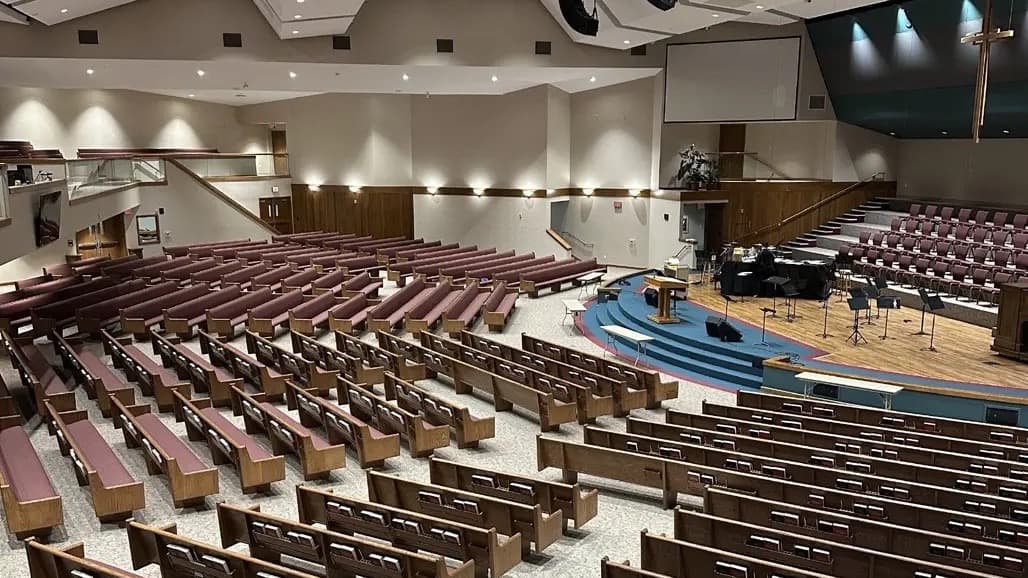
Why Sanctuary Lighting Is a Growing Priority for San Antonio Faith Communities
San Antonio is home to one of the most active and diverse faith communities in Texas. From historic Catholic parishes along the Mission Trail corridor and established Protestant congregations in Alamo Heights and Helotes, to rapidly growing megachurches in Stone Oak, Converse, and the Far West Side, the region's houses of worship represent an enormous range of building types, ages, and operational complexity.
What many of these facilities share, however, is an increasingly urgent conversation about lighting. Church facility managers and operations leaders across Bexar County and the surrounding communities of New Braunfels, Schertz, Universal City, and Boerne are discovering that aging lighting infrastructure is no longer a deferred maintenance problem — it's an active obstacle to ministry. Poor illumination affects congregant safety, degrades the quality of livestreamed and recorded worship, and consumes a disproportionate share of already-tight operational budgets.
As LED technology matures and utility incentive programs expand, 2024 and 2025 represent a compelling window for Texas faith communities to address these challenges strategically.
The Hidden Costs of Outdated Sanctuary Lighting
Many churches continue to operate with lighting systems installed decades ago — incandescent, halogen, or older fluorescent fixtures that were never designed for the demands of modern worship spaces. Facility managers at these properties tend to encounter the same recurring problems:
- High-altitude maintenance cycles — Sanctuary ceilings frequently range from 20 to 50 feet or higher. Replacing traditional bulbs in these fixtures requires scaffolding or aerial lifts, often multiple times per year, at significant cost in labor, equipment rental, and operational disruption during services.
- Aging ballast failures — Fluorescent and older HID fixtures depend on ballasts that degrade over time, causing flickering, humming, and inconsistent light output. These failures are frustrating during worship and can be difficult to diagnose without experienced electrical expertise.
- Uneven light distribution — Spotty illumination across the sanctuary creates a visually fragmented experience for in-person worshipers and creates serious challenges for churches that broadcast services. Poor light levels translate directly to washed-out video, unflattering color rendering, and a production quality that undercuts the message being shared.
- Energy waste — Older fixture technology consumes significantly more electricity per lumen delivered compared to modern LED systems. For a large sanctuary running multiple services per week, plus rehearsals, events, and community programming, the cumulative energy cost is substantial.
These aren't abstract concerns. They're the day-to-day reality for facility directors managing large campuses in areas like the South Side, Lackland area communities, and the growing suburban corridors along Loop 1604.
What Modern LED Upgrades Actually Deliver — and What to Expect
The shift from traditional lighting to LED in a church sanctuary is not simply a bulb swap. Done correctly, it's a comprehensive systems upgrade that addresses light quality, control capability, energy performance, and long-term maintainability simultaneously.
Light quality and worship experience are among the most immediate and visible improvements. LED fixtures designed for worship spaces offer high color rendering index (CRI) ratings, meaning colors — from the warmth of wood and stone to the vibrancy of choir robes and altar elements — appear truer and more natural. This matters deeply in sacred spaces where atmosphere and aesthetic integrity are part of the ministry itself.
Dramatically reduced maintenance frequency is one of the most operationally significant benefits for facility teams. LED sources are rated for tens of thousands of operating hours — often 50,000 hours or more — compared to a few thousand hours for incandescent or halogen alternatives. For a congregation in San Marcos or Seguin that doesn't have a large facilities staff, the ability to go years between bulb replacements on high fixtures is transformative.
Lighting controls and dimming compatibility are another area where modern systems pull ahead. Today's LED fixtures pair with sophisticated dimming systems and scene-control presets, allowing worship leaders to program specific lighting environments for different service segments — bright and energetic for contemporary worship, warm and contemplative for communion, optimized for livestream recording, or safety-appropriate for entry and exit. These capabilities, once limited to large campus budgets, are now accessible to mid-size congregations as well.
Energy efficiency and utility savings round out the case. Churches that complete full sanctuary LED retrofits consistently report meaningful reductions in electricity consumption. In Texas, where summer cooling loads are already significant, reducing heat output from lighting fixtures also provides a secondary benefit to HVAC performance.
Navigating the Practical Challenges of Church Lighting Projects
For facility managers in San Antonio and across South-Central Texas, the theory of LED upgrades is easy to appreciate — the execution is where questions arise. Several practical realities distinguish church lighting projects from standard commercial retrofits, and understanding them upfront leads to better outcomes.
Historic and architecturally sensitive buildings require careful planning. Many of San Antonio's older congregations — particularly those in established neighborhoods like Woodlawn, Monte Vista, and King William — occupy buildings with historic significance or architectural character that must be preserved. Lighting upgrades in these spaces require fixtures that respect the aesthetic integrity of the environment, and installation methods that avoid damage to irreplaceable materials.
Scheduling around ministry programming is a logistical challenge that cannot be overlooked. Unlike an office building that can be partially vacated during an upgrade, a church campus may have services, programs, or community events running seven days a week. Experienced contractors plan installations in phases that minimize disruption to regular programming, often working in off-hours or staging work across multiple weeks.
Budget phasing and financing is a real consideration for nonprofit organizations operating on giving-based revenue. The good news is that several cooperative purchasing programs can simplify procurement for eligible faith-based and nonprofit organizations. Programs such as BuyBoard, TIPS, Sourcewell, and Houston Church COOP offer pre-negotiated contract vehicles that can streamline the bidding process and make high-quality upgrades more accessible. Facility leaders who are unfamiliar with these programs often find that they significantly reduce the administrative burden of a large capital project.
Utility rebate programs available through CPS Energy — the primary electric utility serving San Antonio and most of Bexar County — can offset a meaningful portion of upgrade costs. Navigating rebate eligibility, documentation requirements, and application timelines is a process that benefits from experienced guidance. Our related article on Energy Efficient Church Lighting Upgrades covers this topic in depth for faith communities exploring the financial case for action.
Trends Shaping the Future of Church Lighting in Texas
The conversation around church sanctuary lighting is evolving beyond simple efficiency upgrades. Several broader trends are worth understanding as faith community leaders plan for the next decade of their facilities.
Integration with audiovisual and broadcast systems is increasingly expected by congregations that stream services. As more San Antonio-area churches invest in professional-grade video production, the lighting infrastructure must be designed with camera performance — not just in-room experience — as a primary design criterion. Color temperature consistency, flicker-free operation at video frame rates, and controllable intensity across zones are all technical parameters that affect production quality.
Smart controls and building automation are finding their way into church campuses of all sizes. Occupancy-based lighting in fellowship halls, automated scheduling for exterior lighting across parking areas and walkways, and centralized control platforms that allow a single staff member to manage lighting across an entire campus are no longer premium options — they're becoming standard expectations. Our broader Latest Lighting content series includes resources on commercial LED controls and outdoor lighting that are directly relevant to multi-building church campuses.
The fluorescent phase-out is creating urgency for facilities that haven't yet acted. Federal and state-level restrictions on certain fluorescent lamp types are tightening, and the supply chain for replacement tubes and ballasts is shrinking. Churches still relying on fluorescent fixtures in sanctuaries, classrooms, and fellowship spaces should view the current moment as a practical deadline, not a distant concern. Our article on Fluorescent Tube Bans and LED Lighting Rebates provides essential context for facilities managers navigating this transition.
Service Availability
While VOSS offers a comprehensive suite of national services, specific capabilities may vary by location. Please contact your local branch to confirm the current availability of specific services, technology solutions, or contracting capabilities in your immediate market.
Talk With VOSS About Your San Antonio Sanctuary Lighting Project
VOSS has served commercial and institutional facilities across the United States for more than 85 years, bringing the depth of a national contractor with the accountability of a local team. Our San Antonio branch serves faith communities throughout Bexar County and the surrounding region — including communities in Comal, Guadalupe, Medina, and Kendall counties.
If your congregation is dealing with persistent maintenance challenges, planning a sanctuary renovation, or simply exploring what modern lighting could look like in your facility, we'd welcome the conversation. There's no obligation — just a practical discussion about what's possible for your specific building, budget, and ministry goals.
VOSS — San Antonio Branch
(210) 967-8766
Reach out to schedule a consultation with our local team. We're here to help you move from reactive maintenance to a lighting strategy that serves your congregation for decades to come.