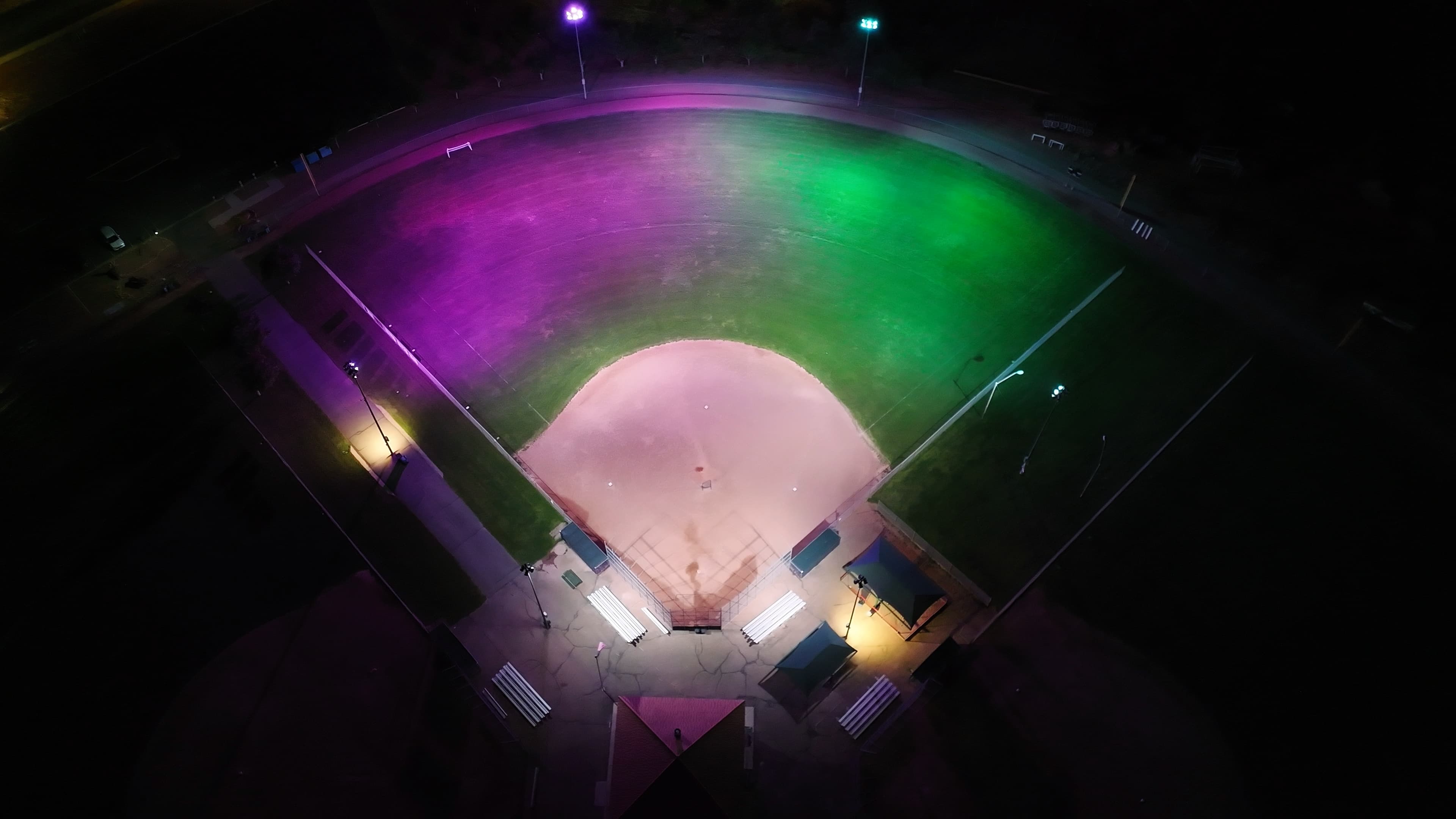
Why Baseball Lighting Deserves More Attention in Cibolo and South-Central Texas
Cibolo is one of the fastest-growing communities in the Greater San Antonio region — and that growth is showing up on the diamond. From youth recreational leagues at city parks to competitive travel ball programs drawing players from Schertz, Selma, Universal City, and beyond, the demand for high-quality athletic facilities in this corridor has never been stronger. As Cibolo continues to expand its parks and recreation infrastructure, the lighting decisions made today will shape player safety, community pride, and operational costs for decades to come.
Across South-Central Texas — including Bexar County and the surrounding Guadalupe and Comal County communities — facility managers and parks directors are increasingly asking the same question: is it time to replace aging metal halide or high-pressure sodium field lights with modern LED systems? The answer, in nearly every case, is yes — and understanding why matters as much as knowing who to call.
This article explores the trends, technologies, and best practices shaping baseball and softball LED lighting upgrades in markets like Cibolo's, and what facility operators should know before starting a project.
The LED Revolution on the Baseball Field: What's Actually Changing
For decades, metal halide lighting was the standard for athletic fields. It was reliable — but far from ideal. Long warm-up times, inconsistent light distribution, high energy consumption, and significant maintenance costs made it a compromise facility operators simply lived with. Today, LED technology has matured to a point where those compromises are largely unnecessary.
Here's what the shift to LED actually looks like in practice for baseball and softball facilities:
- Uniform Light Distribution — Modern LED systems are engineered using photometric modeling software to deliver consistent foot-candle levels across every zone: infield, outfield, warning track, and dugouts. Shadows and hot spots — long a problem for batters and outfielders — are dramatically reduced.
- Instant-On Performance — Unlike metal halide fixtures, which can take 15–20 minutes to reach full brightness and must cool down before restarting, LED lights reach full output immediately. This matters enormously for rain delays, twilight game starts, and broadcast lighting requirements.
- Energy Efficiency at Scale — LED systems typically consume 50–70% less energy than the metal halide systems they replace. For a facility running multiple fields several nights a week through a full season, that reduction translates to meaningful operational savings year over year.
- Longer Service Life — Quality LED fixtures are rated for 100,000 hours or more of operation, significantly reducing the frequency and cost of lamp replacements — a persistent maintenance burden under legacy systems.
- Controls Integration — Today's LED sports lighting systems can be paired with sophisticated lighting controls, allowing operators to program scene-based lighting levels for practice, game play, or field maintenance — and manage everything remotely through a connected platform.
For parks and recreation professionals in Cibolo and across the Schertz-Cibolo-Universal City corridor, these benefits aren't abstract. They represent real reductions in utility bills, maintenance labor, and capital replacement cycles.
Designing for the Game: What Makes Baseball Lighting Technically Distinct
Not all sports lighting is created equal, and baseball presents some of the most demanding design challenges in the athletic lighting world. The geometry of the game itself — a batter tracking a pitch at 90+ mph, an outfielder reading a fly ball against an evening sky, an infielder reacting in real time — demands a lighting design that goes far beyond simply "illuminating the field."
Key design considerations for baseball and softball LED projects include:
- Pole Placement and Height — Fixture placement must account for the unique shape of a baseball diamond and the sweep of the outfield arc. Poorly placed poles can create glare in batters' eyes or dark zones in critical outfield gaps. Engineering this correctly requires sport-specific photometric expertise.
- Glare Control — Glare is one of the most common and impactful complaints at athletic facilities. Advanced LED optics and proper aiming angles minimize direct glare for players and spectators without sacrificing light levels on the field surface.
- League and Governing Body Standards — Different levels of play carry different lighting requirements. Little League, high school (UIL in Texas), collegiate (NCAA), and professional leagues each specify minimum foot-candle levels and uniformity ratios. A compliant design isn't optional — it's a prerequisite for competition.
- Spill Light and Light Trespass — In growing communities like Cibolo, where residential neighborhoods are often adjacent to parks and recreational fields, managing spill light onto surrounding properties is both a community relations priority and, in many cases, a local ordinance requirement. Modern LED optics are far more controllable than legacy systems in this regard.
- Broadcast and Event Readiness — Facilities that host televised games, streaming content, or high-profile tournaments have additional requirements around color rendering index (CRI) and flicker suppression. Planning for these capabilities during initial design is significantly more cost-effective than retrofitting later.
VOSS approaches every project — whether it's a single Little League field in Cibolo or a multi-diamond complex serving the broader San Antonio metro — with this full scope of technical considerations in mind, beginning with a photometric design process tailored to the specific field dimensions, use case, and governing standards.
A Proof Point: What Thoughtful LED Design Delivers in the Field
One of the most instructive examples of what professional LED sports lighting design can accomplish comes from a project VOSS completed in Page, Arizona — a community-scale baseball facility upgrade that demonstrated just how transformative the right LED solution can be.
The Page, AZ project involved the full replacement of an aging sports lighting system with a modern, engineered LED installation. The results reflected what well-executed LED sports lighting delivers: dramatically improved visibility for players and spectators, significant reductions in energy consumption, and a facility that now meets the standards required for competitive play and community events. The project also demonstrated the operational value of a single-source contractor — one team managing design, procurement, installation, and commissioning — rather than piecing together multiple vendors.
For facility managers and parks directors in the Greater San Antonio region evaluating similar projects, the Page experience reinforces a critical point: the quality of the outcome is directly tied to the quality of the design process. LED fixtures alone don't solve baseball lighting challenges. Engineered systems — designed by professionals who understand the sport, the site, and the standards — do.
What Facility Operators and Decision-Makers in Cibolo Should Consider Now
Whether you oversee a municipal parks system, manage a private athletic complex, or lead operations for a school district serving students across Cibolo, Schertz, or Marion, the timing of a lighting upgrade decision has real financial and operational implications.
For Operations and Facilities Leaders: The shift from reactive maintenance (replacing failing lamps and ballasts) to a proactive LED infrastructure is one of the most reliable ways to reduce the unpredictability of athletic facility operating costs. A well-designed LED system essentially eliminates routine lamp replacement for the better part of a decade or more, and the energy savings begin immediately upon commissioning.
For Finance and Administration: LED sports lighting upgrades are increasingly supported by utility incentive programs and energy efficiency rebates — reducing the net capital outlay of a project. Texas utility providers, including those serving the San Antonio and surrounding Hill Country regions, have offered programs to offset the cost of qualifying LED conversions. Understanding what's available in your service territory before finalizing a project budget is a step that's easy to overlook and expensive to miss.
For Public-Sector and Educational Organizations: Parks departments, school districts, and municipal recreation programs often have access to cooperative purchasing programs that streamline the procurement process and provide price transparency without the time burden of a full competitive bid. Eligible organizations in Texas may be able to access contracts through programs such as BuyBoard, TIPS, Sourcewell, Omnia Partners, AEPA, and PACE — all of which are available to qualifying public agencies and educational institutions. These vehicles can meaningfully accelerate project timelines and simplify vendor qualification.
In fast-growing communities like Cibolo, the quality of athletic facilities is more than a quality-of-life amenity — it's a signal about the kind of community residents and families are choosing to invest in. Well-lit, professionally designed baseball and softball fields attract competitive leagues, support youth development, and extend the usable hours of public park assets that represent significant capital investment.
The trend across South-Central Texas and the broader Greater San Antonio market is clear: communities are upgrading their athletic lighting infrastructure, and those that do it thoughtfully — with engineered LED systems, integrated controls, and long-term support agreements — are seeing the best outcomes for players, spectators, and operating budgets alike.
As a full-service commercial electrical contractor with 85+ years of experience and a local presence in San Antonio, VOSS is positioned to support these projects at every scale — from a single youth field in a neighborhood park to a multi-field complex serving an entire region. Our work spans the spectrum of the Latest Lighting series, including LED solutions for gymnasiums, pickleball and tennis courts, parking facilities, and more — all built on the same foundation of engineered design, professional installation, and long-term partnership.
Service Availability
While VOSS offers a comprehensive suite of national services, specific capabilities may vary by location. Please contact your local branch to confirm the current availability of specific services, technology solutions, or contracting capabilities in your immediate market.
Connect with VOSS in the Greater San Antonio Area
If you're evaluating a baseball or softball lighting upgrade for a facility in Cibolo, Schertz, Universal City, Selma, Marion, or anywhere across the Greater San Antonio region, we'd welcome the opportunity to discuss your project — starting with the design questions that will shape every decision that follows.
VOSS — San Antonio Branch
(210) 967-8766
Reach out to schedule a consultation with our local team. Whether your project is in early planning or ready to move, we're here to help you think through the right approach for your facility, your budget, and your community.