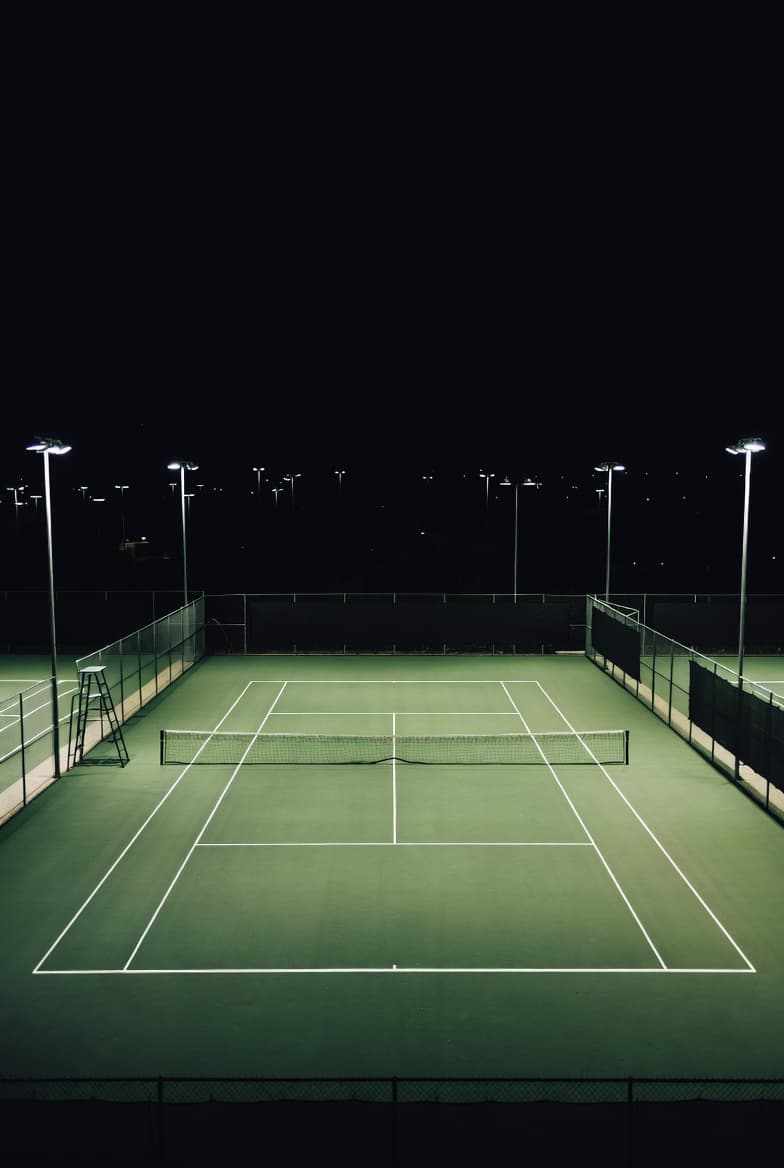
Why Tennis Court Lighting Is a Growing Priority Across the Triangle
Raleigh is one of the fastest-growing metros in the Southeast, and that growth is reshaping the demand for quality recreational infrastructure across Wake County and beyond. Communities in Cary, Apex, Wake Forest, Morrisville, Garner, and Holly Springs are seeing significant investment in parks, athletic complexes, and residential amenities — and tennis courts are a centerpiece of that expansion.
But with more players and more communities competing for court time, the pressure is on facility operators to maximize usable hours. That means reliable, high-performance evening lighting is no longer a luxury — it is a baseline expectation. Aging metal halide systems that deliver inconsistent light levels, slow warm-up times, and frequent lamp failures are quietly limiting the potential of courts that could otherwise generate more revenue, more member satisfaction, and more community benefit.
The transition to commercial LED tennis court lighting is accelerating in markets like Raleigh for good reason: the economics are compelling, the technology is proven, and the performance improvements are immediate.
What Makes Tennis Court Lighting Different — and Why Standards Matter
Tennis court lighting is a specialized discipline within commercial sports lighting. Unlike general area lighting, tennis requires a very specific combination of vertical illuminance (the light that reaches a ball in the air), uniformity across the full playing surface, and glare control that protects both players tracking fast-moving balls and spectators watching from the sidelines.
The Illuminating Engineering Society (IES) and the United States Tennis Association (USTA) both publish recommended foot-candle levels and uniformity ratios that vary by court class — from recreational play to professional competition. Installing undersized or incorrectly aimed fixtures may leave courts dim at the baselines, create distracting hotspots near the net, or generate light spill onto neighboring properties — a real concern in the dense residential neighborhoods and mixed-use developments that define much of the greater Raleigh market.
Key performance benchmarks that define a properly engineered system include:
- Horizontal and vertical foot-candle targets that meet IES Class I through Class V standards depending on use type
- Uniformity ratios that prevent the bright-spot/dark-spot patterns that compromise ball tracking and player safety
- Controlled beam spread that keeps light on the court and off adjacent streets, homes, and natural areas — particularly important in communities with dark-sky ordinances or light trespass codes
- Color rendering index (CRI) of 80 or higher for accurate ball and line visibility under artificial light
- Glare reduction through full-cutoff optics and precise fixture placement — a feature that separates purpose-built tennis lighting from repurposed area flood fixtures
For parks and recreation departments in Raleigh, Durham, and surrounding municipalities, meeting these standards is not just a performance issue — it is often a code compliance requirement tied to permits and public use designations.
The LED Upgrade Case: Energy Savings, Lower Maintenance, and Better Play
The shift from metal halide to LED tennis court lighting is one of the highest-ROI upgrades available to sports facility operators today. Older high-intensity discharge (HID) systems — including metal halide and high-pressure sodium — consume significantly more energy per hour of operation, require 15 to 30 minutes to reach full brightness, and carry lamp replacement costs that compound over time.
Modern LED tennis court floodlights address each of these pain points directly:
- Instant-on operation means lights come up to full output immediately, eliminating the warm-up delays that frustrate players and complicate scheduling
- Energy consumption reductions of 50 to 70 percent compared to equivalent metal halide systems translate directly to lower utility bills month over month
- Rated lifespans of up to 100,000 hours reduce the frequency of maintenance calls, bucket truck visits, and lamp replacement budgets — a significant benefit for facilities that operate courts across multiple locations or manage large outdoor recreation campuses
- Smart controls integration allows facility managers to schedule court lights by time of day, activate courts remotely via app or automation platform, and implement dimming protocols that reduce energy use during low-attendance periods
For HOA communities and multi-use residential properties across neighborhoods in North Raleigh, West Cary, or Clayton, that combination of lower energy cost and reduced maintenance burden is particularly meaningful — property managers are often responsible for dozens of amenities with lean staffing and finite budgets.
For private clubs and sports entertainment venues evaluating a retrofit or new installation, the total cost of ownership picture becomes even stronger when utility rebate opportunities are factored in. Duke Energy Progress, which serves much of the Raleigh metro area, offers commercial energy efficiency programs that can meaningfully offset project costs for qualifying LED upgrades. Navigating those programs — understanding eligibility requirements, documentation needs, and rebate timelines — is where an experienced contractor adds value beyond the installation itself.
Smart Controls: Extending Value Beyond the Fixture
One area where tennis court lighting technology has advanced dramatically in recent years is controls integration. The era of simple on/off timers is giving way to networked lighting control systems that give facility operators real-time visibility into energy use, remote operation capability, and data-driven scheduling tools.
For a multi-court athletic complex or a parks and recreation department managing courts across several Raleigh neighborhoods — from Pullen Park to facilities in Knightdale or Fuquay-Varina — centralized controls mean that a single facilities manager can monitor and adjust lighting across the entire portfolio from a desktop or mobile device.
Relevant capabilities now available in commercial tennis court lighting systems include:
- Occupancy and motion-based activation that brings courts to full brightness when players arrive and reduces output during idle periods
- Time-of-use scheduling aligned with peak and off-peak utility rate windows — a meaningful tool for managing electricity costs in markets with time-varying commercial rates
- Zone-based dimming that allows multi-court facilities to illuminate only the courts in active use while keeping neighboring courts in a low-energy standby state
- Fault detection and alerts that notify maintenance staff when a fixture underperforms, reducing the lag time between failure and repair
These features are especially relevant for private clubs and sports venues whose CFOs and operations leaders are evaluating lighting systems not just as infrastructure, but as managed assets with measurable cost profiles. When a system can generate a monthly energy report, document savings against a pre-retrofit baseline, and support a utility rebate application with logged data, it becomes a financial tool as much as a lighting solution.
A Note on Public-Sector Projects and Cooperative Purchasing
For parks and recreation directors and municipal administrators across Wake, Durham, Johnston, and Chatham counties, procurement compliance is often the first practical hurdle in moving a tennis court lighting project forward. Public entities are required to demonstrate competitive sourcing — and navigating that process can slow down projects or complicate contractor selection.
VOSS works with a range of cooperative purchasing programs that allow eligible public agencies, school districts, and municipal organizations to procure lighting products and services through pre-competed, nationally awarded contracts. Programs such as Sourcewell, Omnia Partners, TIPS, BuyBoard, and AEPA are designed specifically to streamline procurement for government and education clients without sacrificing competitive pricing or compliance integrity.
This is a model that has worked well in other markets. In Council Bluffs, Iowa, for example, Lewis Central Community Schools faced both a constrained budget and a requirement to demonstrate rigorous procurement compliance. VOSS helped the district understand how the Omnia Partners cooperative contract legally satisfied Iowa's competitive bidding requirements — and helped district leadership make the case to voters that LED lighting upgrades could be funded within the existing operating budget, reducing the total bond ask. As Operations Director Jim Ettleman noted: "My experience with Voss Lighting has been fantastic. Their team is attentive and more than competent."
While that project was in a different state, the cooperative purchasing framework is the same — and it is available to eligible organizations in North Carolina today. Raleigh-area municipalities, county recreation departments, and public school systems exploring tennis court lighting upgrades should ask their VOSS representative about whether a cooperative purchasing pathway is available for their project.
VOSS in the Greater Raleigh Market
VOSS has served commercial and institutional clients across North Carolina with full-service electrical, lighting, and controls solutions backed by 85-plus years of industry experience. Our Raleigh branch team understands the regional landscape — the mix of rapidly developing suburban communities, established private clubs, expanding university athletic facilities, and municipal parks systems that characterize the Triangle market.
From single-court HOA retrofits in communities throughout Apex or Morrisville, to multi-court upgrades at athletic clubs in North Raleigh or Durham, to public parks projects in municipalities across Wake County, our team brings the engineering expertise, project management capability, and utility rebate knowledge to deliver systems that perform on day one and continue generating value for years.
We also understand that tennis court lighting projects rarely exist in isolation. Many of our clients in this market are simultaneously evaluating gymnasium LED retrofits, parking lot lighting upgrades, or broader campus energy efficiency programs — all topics covered in depth across our Latest Lighting resource library, including related articles on gymnasium LED retrofits, outdoor parking lot and LED lighting upgrades, and energy audits and rebate navigation for businesses.
Service Availability
While VOSS offers a comprehensive suite of national services, specific capabilities may vary by location. Please contact your local branch to confirm the current availability of specific services, technology solutions, or contracting capabilities in your immediate market.
Talk to Our Raleigh Team About Your Tennis Court Lighting Project
If you manage a tennis facility, recreational complex, HOA campus, or public parks system in the greater Raleigh area and are evaluating a lighting upgrade or new installation, we invite you to connect with our local team. Whether your immediate question is about USTA compliance standards, utility rebate eligibility, smart controls options, or procurement pathways, our Raleigh branch specialists are ready to help you think through the project — before any commitment is made.
VOSS — Raleigh Branch Phone: (919) 779-8777 Toll-Free: (866) 292-0529
The conversation starts with understanding your facility. Reach out to schedule a site consultation or preliminary discussion with a VOSS lighting specialist serving the Triangle and surrounding communities.