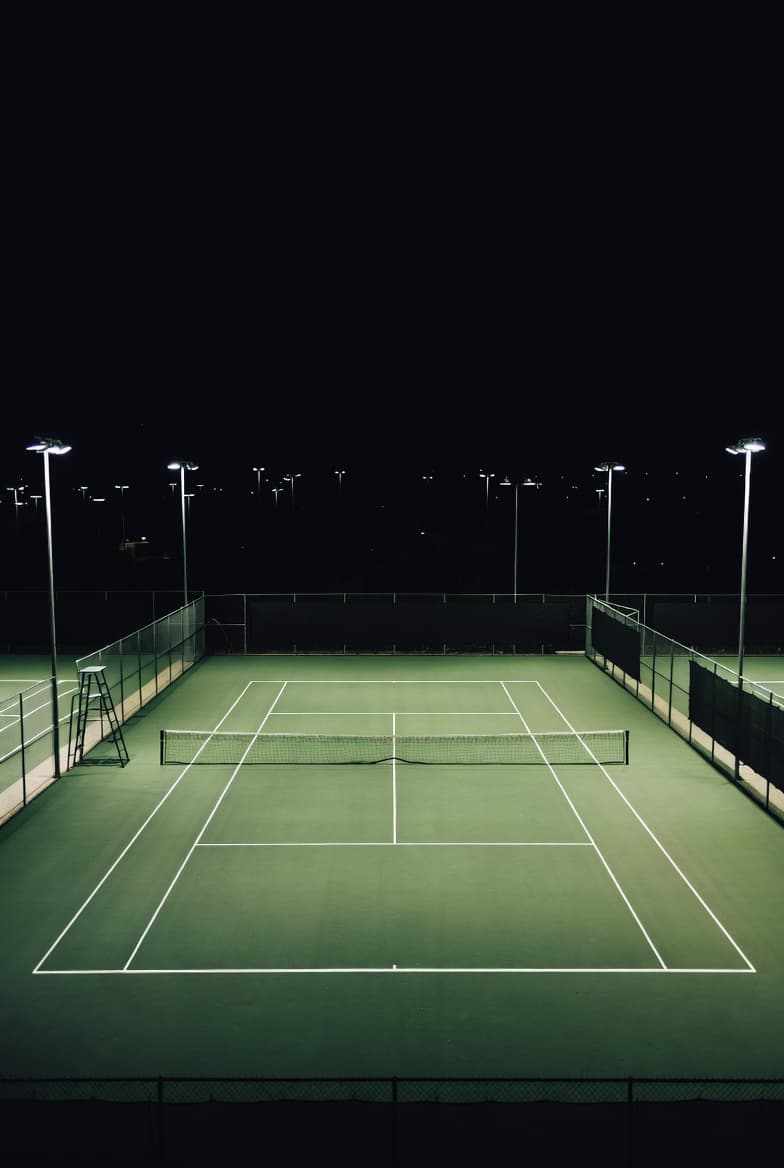
Why Tennis Court Lighting Is a Strategic Investment, Not Just an Upgrade
For facility managers, parks administrators, and club operators across High Point and the greater Piedmont Triad region, tennis court lighting sits at the intersection of player experience, operational efficiency, and long-term capital planning. Yet it's one of the most commonly overlooked infrastructure decisions — often addressed only when fixtures fail, energy bills spike, or a safety concern forces action.
The reality is that well-planned, properly engineered court lighting does far more than keep the lights on after sunset. It expands usable court hours, supports programming revenue, reduces liability exposure, and — when executed with modern LED technology — delivers measurable returns that can justify the investment to even the most budget-conscious CFO or city council.
With High Point's growing recreational and athletic culture, and strong community investment in parks and sports amenities across Guilford County and neighboring Forsyth and Randolph counties, the conversation around court lighting quality has never been more relevant.
The State of Outdoor Tennis Court Lighting Technology
From Metal Halide to LED: A Generational Shift
The majority of outdoor tennis courts built or last upgraded before 2015 are still running on metal halide (MHI) or high-pressure sodium (HPS) fixtures. These legacy systems have several well-documented limitations:
- Slow warm-up and restrike times — Metal halide lamps can take 15–25 minutes to reach full brightness, and if power is interrupted, they must cool before restriking — a serious disruption for evening leagues and events.
- Poor color rendering — Lower Color Rendering Index (CRI) values make it harder for players to track the ball, especially against the sky or a dark court surface.
- Uneven light distribution — Hotspots near pole bases and dark zones near baselines and sidelines are common complaints on older courts, creating inconsistent playing conditions.
- High energy consumption — A single metal halide court lighting system can draw significantly more wattage than its modern LED equivalent, compounding energy costs across multi-court facilities season after season.
Modern commercial LED tennis court systems address all of these pain points. Purpose-built LED sports luminaires for tennis applications are engineered for tight beam control, high uniformity ratios, and CRI values of 70 or above (with 80+ recommended for competitive play), ensuring players and officials can see clearly at every point on the court.
Understanding USTA and IES Lighting Standards
One of the most important — and most misunderstood — aspects of tennis court lighting is standards compliance. The United States Tennis Association (USTA) and the Illuminating Engineering Society (IES) both publish recommended illuminance levels for different classes of play:
- Class I (Professional/Tournament): 125–150+ foot-candles (fc), with high uniformity and low glare ratings required for broadcast.
- Class II (Club/Competitive): 75–100 fc average, suitable for USTA league play and organized competitions.
- Class III (Recreational/Community): 30–50 fc, appropriate for casual play and community recreation programs.
Many aging municipal and HOA court systems were originally installed to Class III standards at best — and have degraded further over time as lamps age and reflectors oxidize. Understanding which classification your facility actually requires (and currently achieves) is the essential first step in any lighting evaluation.
A photometric analysis — a lighting study that models actual foot-candle levels, uniformity ratios, and glare across the court surface — is the professional standard for scoping a new installation or retrofit. This analysis should always precede any fixture selection or procurement decision.
What's Driving the Shift to LED Tennis Court Lighting in North Carolina
Energy Costs and Utility Incentives
Facility operators across the High Point area — from HOA communities near Oak Hollow Lake to multi-sport complexes in the Triad region — are increasingly finding that legacy court lighting systems are a significant line item in their operating budgets. Energy costs for outdoor sports lighting can represent thousands of dollars annually per court, depending on usage hours and rate structures.
LED retrofits typically deliver 50–70% reductions in energy consumption compared to equivalent metal halide systems. For a multi-court facility running evening leagues and weekend programming, those savings translate into a meaningful, recurring reduction in utility spend — often enough to fund the project's return on investment within a few years.
North Carolina utility programs and state-level energy efficiency incentives may offer additional rebate opportunities for qualifying commercial and institutional upgrades. Organizations in Guilford County and the surrounding region — including municipalities, private clubs, and non-profit athletic associations — should work with an experienced contractor who can identify and manage the rebate capture process on their behalf, since utility incentive programs frequently change and require specific documentation to claim successfully.
For public-sector organizations such as the City of High Point Parks and Recreation Department or Guilford County Schools, cooperative purchasing programs like Sourcewell, Omnia Partners, BuyBoard, and TIPS can streamline procurement while satisfying competitive bidding requirements — an important advantage when project timelines are tight or administrative capacity is limited. VOSS has direct experience helping public agencies navigate these programs. In one example, when Lewis Central Community Schools in Iowa faced state-specific competitive bidding requirements on a lighting upgrade project, VOSS worked with the district and its legal counsel to demonstrate that Omnia Partners satisfied Iowa's public procurement standards — ultimately helping the district prove to voters that the project could be funded within existing operating budgets rather than requiring additional bond funding.
Light Pollution, Dark-Sky Compliance, and Neighbor Relations
As residential development continues to expand around High Point, Kernersville, Archdale, and communities throughout Guilford and Randolph counties, light trespass and spill onto adjacent properties has become an increasingly common concern — for municipal parks departments navigating neighbor complaints, HOA boards managing community relations, and private clubs mindful of their community footprint.
Modern LED sports luminaires, when properly specified and aimed, are substantially better at containing light to the playing surface than older flood lamp systems. Features such as full cutoff optics, asymmetric beam distributions, and house-side shields allow designers to maximize on-court illuminance while minimizing spill beyond property lines. Some municipalities are also beginning to adopt dark-sky ordinances that impose specific requirements on new outdoor lighting installations — making compliance-aware design an increasingly important factor from the outset of a project.
Smart Controls: Scheduling, Dimming, and Remote Management
One of the most practical — and financially meaningful — advances in commercial tennis court lighting is the integration of intelligent controls. For facility managers juggling multi-court operations, seasonal programming changes, and reservation-based access, smart controls represent a step change in operational efficiency.
Modern LED court lighting systems can be integrated with:
- Scheduling platforms that automatically adjust lighting based on programming hours, eliminating the cost of lights left on after courts go dark.
- Occupancy-triggered or motion-activated controls that reduce output during low-use periods and restore full brightness when players arrive.
- Remote monitoring and management that allows facility staff to check system status, adjust schedules, and receive fault alerts without a site visit.
- Dimming capabilities that allow lighting levels to be tuned to the actual use case — full competitive levels for league nights, reduced output for casual recreational play — optimizing energy use across the board.
For private clubs, country clubs, and sports entertainment venues in the High Point area evaluating the total cost of ownership of a lighting upgrade, controls integration is often the factor that tips the ROI calculation decisively in favor of action. The combination of energy savings, reduced maintenance calls, and extended lamp life creates a financial case that is difficult to ignore.
Considerations for Different Facility Types
Tennis court lighting projects are not one-size-fits-all, and the right approach varies meaningfully based on the type of facility and its operational priorities.
Municipal and Public Parks: City and county park systems typically prioritize budget justification, procurement compliance, and community equity. Lighting upgrades at public courts in High Point and across Guilford County should be evaluated for utility rebate eligibility and cooperative purchasing program compatibility. ADA-compliant site lighting that supports safe access to courts after dark is also a consideration that public agencies must address.
HOA and Multi-Use Residential Amenities: Property managers at apartment communities and HOA campuses throughout the Triad region are primarily concerned with reducing energy and maintenance costs while keeping residents satisfied. Long-life LED systems with minimal maintenance requirements are a strong fit for these environments, where facilities staff may be limited and after-hours service calls are disruptive.
Private Clubs and Athletic Venues: Country clubs, private athletic clubs, and sports entertainment venues in the High Point and Greensboro corridor are increasingly using premium court lighting — including broadcast-quality illumination and dynamic controls — as a competitive differentiator. For these organizations, lighting is as much a member experience and revenue-generation tool as it is an operating cost.
School and University Athletic Programs: Schools and university facilities across Guilford County and the broader Raleigh region have unique procurement and compliance requirements. LED court lighting upgrades at educational institutions may qualify for cooperative purchasing programs that simplify contracting and ensure competitive pricing.
If you manage a court or multi-court facility and are evaluating a lighting upgrade, related insights from our Gymnasium LED Retrofit & Sports Court Lighting, Pickleball LED Lighting Solutions, and University Sports Field & Stadium LED Lighting Upgrades articles in our Latest Lighting series offer additional context on sports lighting best practices. Our Energy Audits, Incentives, and Rebate Navigation for Businesses article is also a valuable resource for understanding how to approach the financial case for a project.
Service Availability
While VOSS offers a comprehensive suite of national services, specific capabilities may vary by location. Please contact your local branch to confirm the current availability of specific services, technology solutions, or contracting capabilities in your immediate market.
Talk to VOSS About Your Tennis Court Lighting Project
VOSS has been a trusted commercial electrical partner for 85+ years, serving facilities of every size and type — from single-court HOA retrofits to multi-court athletic complexes and competitive tournament venues. Our Raleigh branch serves High Point and communities throughout the Greater Raleigh region, including Greensboro, Winston-Salem, Kernersville, Archdale, Asheboro, and across Guilford, Forsyth, and Randolph counties.
Whether you're in the early stages of evaluating whether your current system meets USTA standards, ready to commission a photometric study, or looking to move a fully scoped project into procurement, we welcome the conversation.
VOSS — Raleigh Branch Phone: (919) 779-8777 Toll-Free: (866) 292-0529
Reach out to schedule a consultation with our team. We'll help you understand what your facility actually needs — and how to get there efficiently, compliantly, and with a clear picture of the financial return.