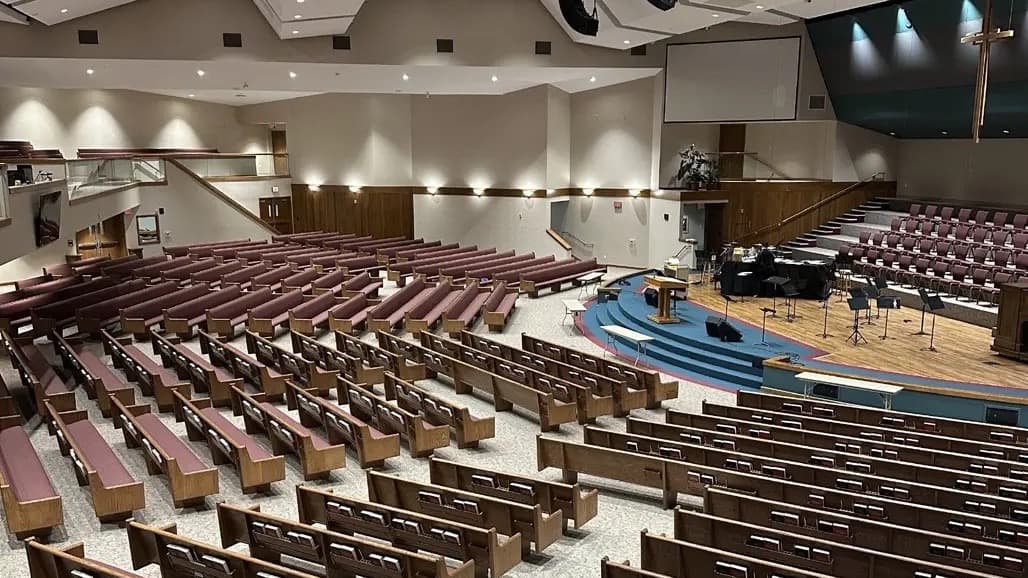
Why Greensboro's Faith Communities Are Rethinking Sanctuary Lighting
Greensboro, North Carolina is home to a rich and deeply rooted faith community. Across the city — from established congregations near Fisher Park and Irving Park to growing churches along Battleground Avenue and out toward High Point and Burlington — houses of worship range from historic sanctuaries with century-old architecture to modern multi-use campuses built within the last decade. What they share, increasingly, is a common set of lighting challenges that are becoming harder to ignore.
Facility managers and operations leaders at these churches are dealing with fixtures that were never designed for today's worship environment. Services are longer and more varied. Livestreaming and video production are now standard expectations at congregations of all sizes. And the cost of climbing scaffolding three or four times a year to replace burned-out bulbs in a 40-foot ceiling is adding up in ways that strain already tight maintenance budgets.
The good news is that the lighting technology available today is dramatically better — and the path to upgrading doesn't have to be overwhelming. Understanding what's driving these challenges, and what practical options exist, is the first step toward a smarter long-term strategy.
The Real Maintenance Burden Churches Face
It's easy to underestimate how much time and money traditional sanctuary lighting consumes. Incandescent, halogen, and fluorescent light sources were never ideal for the demands of a busy church facility — and as these systems age, the burden compounds.
High-ceiling access is the most persistent pain point. When a lamp burns out 30 or 40 feet overhead, replacing it isn't a quick task. It requires scheduling a lift or scaffolding crew, often during the week when the facility is still in use for midweek services, rehearsals, or community events. For many Greensboro-area churches, this is happening multiple times per year across dozens of fixtures.
Aging ballasts and dimmer incompatibility create ongoing headaches. Flickering lights and inconsistent dimming behavior are almost always symptoms of older ballast technology struggling to keep up. Fluorescent systems that once worked well begin to fail unpredictably, and the dimmer controls installed years ago often weren't designed for the more nuanced scene-setting that modern worship services require.
Uneven light levels affect both the congregation and the camera. Poor illumination distribution — bright spots near the chancel, dim zones in the rear pews, or harsh overhead glare — diminishes the worship experience and creates real problems for churches that stream or record services. What looks fine to the naked eye can appear overexposed or muddy on video, making professional-quality lighting consistency more important than many facilities teams initially expect.
Energy costs are quietly significant. An older sanctuary running traditional fixtures during multiple weekly services, plus rehearsals, community events, and administrative hours, can consume a surprising amount of electricity. For churches in the greater Raleigh-Greensboro corridor, where utility rates have continued to climb, lighting represents one of the most addressable line items in an operational energy budget.
What Modern LED Retrofits Actually Deliver
LED technology has matured to the point where it is genuinely transformative for sanctuary environments — not just incrementally better, but categorically different in terms of performance, longevity, and controllability.
Extended lamp life dramatically reduces access requirements. Quality LED fixtures rated for 50,000 hours or more mean that a church installing them today may not need to revisit those high-ceiling fixtures for a decade or longer under typical use. For facilities that have been scheduling lift rentals multiple times per year, this alone represents meaningful savings in both cost and operational disruption.
Color rendering and dimming performance are measurably superior. Modern LED systems can achieve high Color Rendering Index (CRI) scores — meaning colors appear true and natural under the light — and integrate with sophisticated dimming and control systems that allow for precise, repeatable scene presets. A Sunday morning worship service, a candlelight Christmas Eve service, and a weekday funeral can each have their own distinct lighting environment, recalled instantly with a single touch.
Livestream and video quality improves substantially. Consistent, flicker-free, well-distributed illumination is the foundation of professional-looking video. Churches across the Piedmont Triad that have made the transition to LED report that their production teams immediately notice the difference — less post-production correction, more flattering light on the platform, and better audience visibility in wide-angle shots of the congregation.
The transition can be low-disruption. A well-planned retrofit doesn't require a sanctuary to go dark for weeks. Experienced installation teams sequence the work around the church's schedule, prioritizing weekend readiness and minimizing intrusion during active programming. For historic sanctuaries — and Greensboro has a number of them — the retrofit approach preserves existing fixture housings and architectural character while updating the light source and control components.
Cooperative Purchasing: A Practical Option for Eligible Faith Communities
One dimension of the LED upgrade conversation that often surprises church facilities leaders is the availability of cooperative purchasing programs that can simplify procurement significantly.
For faith-based organizations that qualify, programs such as Houston Church COOP and PACE provide pre-negotiated, competitively bid contract vehicles that reduce the administrative burden of sourcing lighting products and installation services. Rather than managing a full competitive bid process independently, eligible organizations can leverage these cooperative contracts to move more efficiently from decision to implementation.
It's worth noting that navigating procurement rules correctly matters — not just for efficiency, but for institutional confidence and accountability. Our experience working with organizations like Lewis Central Community Schools in Iowa demonstrated how cooperative purchasing through Omnia Partners allowed a school district to meet state competitive bidding requirements while accelerating a significant LED retrofit. For churches and faith communities with boards, deacons, or finance committees who need assurance that procurement was handled responsibly, these cooperative vehicles offer a credible and transparent pathway.
If you're unsure whether your organization qualifies or which program is the best fit, our Raleigh branch team can walk you through the options.
Trends Shaping Church Lighting in the Piedmont Triad
Across the greater Greensboro market — and throughout the broader Raleigh–Durham–Greensboro corridor — several converging trends are accelerating the shift toward smarter sanctuary lighting systems.
Livestreaming as a permanent ministry channel. What began as a pandemic-era necessity has become a core part of how many congregations communicate with homebound members, remote viewers, and potential newcomers. Churches from Greensboro proper to nearby communities like Kernersville, Summerfield, and Whitsett are investing in their A/V infrastructure — and lighting is foundational to that investment paying off.
Energy rebate availability from Duke Energy Progress. Greensboro-area facilities served by Duke Energy Progress may have access to commercial lighting rebate programs that offset a portion of LED upgrade costs. Navigating rebate qualification — understanding what fixtures qualify, how to document baseline conditions, and how to submit correctly — is a process where experienced guidance pays dividends. Our sibling article on Utility Lighting Rebates in Raleigh, NC covers this topic in detail for organizations across the region.
Deferred maintenance is becoming harder to justify. With construction and material costs having risen substantially in recent years, church boards and finance committees are increasingly open to capital-efficient strategies that resolve deferred maintenance through operational savings rather than capital campaigns. LED retrofits, particularly when paired with energy rebates and cooperative purchasing, often fit this model well.
Controls integration and smart systems are maturing. The lighting control systems available today — including daylight harvesting, occupancy sensing, and app-based scene management — are more accessible and more reliable than earlier generations. For multi-use church facilities that host everything from Sunday school to community meetings to weddings, programmable control is no longer a luxury; it's a practical operations tool. Our broader content on Commercial LED Lighting Fixtures and Energy Audits, Incentives, and Rebate Navigation for Businesses explores these technologies in more depth.
Service Availability
While VOSS offers a comprehensive suite of national services, specific capabilities may vary by location. Please contact your local branch to confirm the current availability of specific services, technology solutions, or contracting capabilities in your immediate market.
VOSS serves Greensboro and surrounding communities throughout the Piedmont Triad — including High Point, Winston-Salem, Burlington, Kernersville, Asheboro, and Mebane — from our Raleigh branch location.
VOSS Raleigh Branch Phone: (919) 779-8777 Toll-Free: (866) 292-0529
Talk With Our Team About Your Sanctuary
Every church facility is different — different ceiling heights, different fixture inventories, different service schedules, different budget realities. The right starting point isn't a product quote; it's a conversation about what your facility actually needs and what outcomes matter most to your congregation and leadership.
Our Raleigh team works with faith communities across Greensboro, the Piedmont Triad, and the broader greater Raleigh market. We bring 85+ years of experience in commercial lighting and electrical systems, and we understand the unique constraints — architectural, operational, and financial — that come with church facilities.
If flickering fixtures, high-ceiling maintenance costs, or the demands of livestream production are on your facility's radar, we'd welcome the chance to help you think through your options. Reach out to our Raleigh branch to schedule a no-pressure consultation.