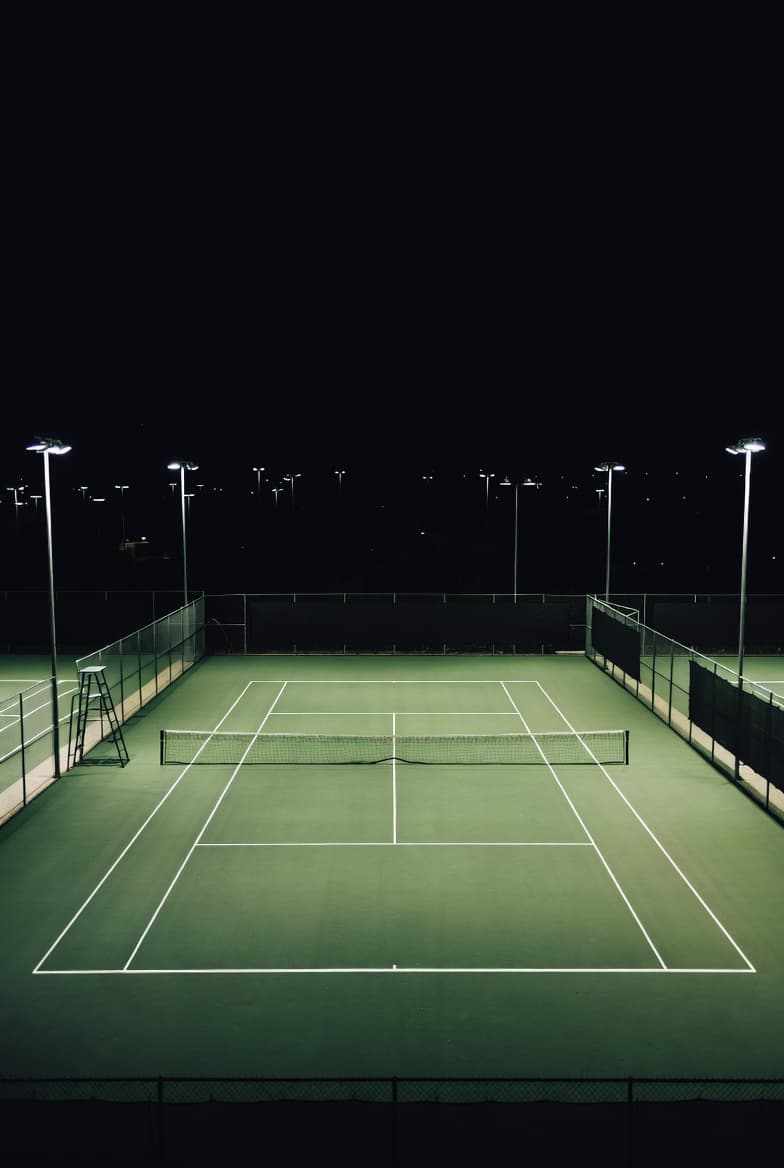
Why Tennis Court Lighting Is a Strategic Investment in Durham
Durham is one of North Carolina's fastest-growing cities, and that growth is reshaping how residents and organizations think about outdoor recreational amenities. From the planned and established neighborhoods of Southpoint and Hope Valley to the athletic facilities serving Duke University, NC Central University, and the broader Research Triangle community, the demand for quality outdoor play space — and the infrastructure to support it — has never been higher.
Tennis courts are a particular focal point. As HOA communities in Durham and surrounding areas like Chapel Hill, Cary, and Morrisville compete for residents, and as parks and recreation departments in Wake and Durham Counties work to expand programming, the quality of court lighting has become a measurable differentiator. Evening leagues, after-school programs, and private club memberships all depend on courts that are safe, well-lit, and compliant with modern standards.
Yet many facilities across the Greater Raleigh region are still operating with outdated metal halide or high-pressure sodium lighting systems that were installed a decade or more ago. These systems are costly to run, difficult to maintain, and increasingly out of step with what players and administrators expect. The shift to LED tennis court lighting isn't a luxury upgrade — it's a practical business decision with documented returns.
The Problem with Outdated Tennis Court Lighting
Before exploring what modern LED systems can do, it's worth understanding why legacy lighting falls short — and why the gap matters for facilities in Durham specifically.
Metal halide and high-pressure sodium fixtures were the industry standard for outdoor sports lighting for decades, and many courts in the Triangle area still rely on them. The problems these systems create are well-documented:
- Uneven light distribution — Hot spots near fixture poles and dim zones along baselines and sidelines make it harder for players to track a fast-moving ball, increasing both eye strain and the risk of injury
- Long warm-up and restrike times — Metal halide lamps can take 15–20 minutes to reach full output, and if they lose power, they must cool completely before restarting — a serious inconvenience for leagues and timed court rentals
- High energy consumption — Legacy fixtures typically operate at 1,000–1,500 watts per lamp, driving substantial utility costs, particularly for facilities running courts into the evening hours
- Light trespass and sky glow — Poorly aimed or aging fixtures scatter light onto adjacent properties and upward into the night sky, creating friction with neighbors and potential conflicts with local ordinances
- Maintenance burden — Lamp replacements are frequent, require specialized labor, and create operational disruptions — a particular pain point for parks and recreation departments managing multiple facilities across Durham and Wake Counties
For facility managers and operations leaders, each of these issues translates directly into cost, liability, or community relations challenges. The good news is that modern LED systems address all of them simultaneously.
How Modern LED Tennis Court Lighting Works — and What It Delivers
LED tennis court lighting has matured significantly over the past decade. Today's commercial-grade systems are engineered specifically for outdoor sports applications, with optics, mounting configurations, and control architectures designed to meet the exacting standards of the United States Tennis Association (USTA) and the Illuminating Engineering Society (IES).
Light Levels and Uniformity
The USTA and IES publish recommended illuminance levels for tennis courts based on the type of play — recreational, club, and competitive. For recreational play, the standard is typically 30 footcandles (fc) at court level; for competitive and televised play, requirements are significantly higher. Uniformity ratios — the relationship between the brightest and dimmest points on the court — are equally important. A court that meets average footcandle targets but has poor uniformity will still produce shadows and glare that affect play quality.
Modern LED fixtures achieve uniformity ratios that legacy systems simply cannot match. With precision-engineered optics and proper pole placement, a well-designed LED system delivers consistent illumination from baseline to baseline, sideline to sideline — including the critical corners and transition zones where older systems typically fall short.
Energy Efficiency and Documented ROI
The energy savings case for LED tennis court lighting is one of the strongest in the commercial lighting industry. Compared to metal halide systems of equivalent output, LED fixtures typically consume 50–70% less energy. For a facility running four courts for four hours per evening, that translates into meaningful reductions on monthly utility bills — savings that compound over the life of the system.
Duke Energy Progress, which serves much of the Durham and Greater Raleigh service territory, offers commercial energy efficiency incentives that can further reduce the net cost of qualifying LED upgrades. Navigating these programs — understanding eligibility, documentation requirements, and application timelines — is where many facilities leave money on the table. Working with a contractor experienced in rebate capture ensures that available incentives are fully leveraged.
Smart Controls: Scheduling, Dimming, and Remote Management
One of the most underappreciated advantages of modern LED tennis court lighting is the integration of intelligent controls. For a private athletic club or multi-court HOA complex, the ability to schedule lighting by court, dim to a lower output during off-peak hours, or shut down remotely via a smartphone interface represents both operational convenience and additional energy savings beyond the fixture efficiency gains alone.
For parks and recreation administrators managing courts across multiple Durham or Wake County locations, centralized lighting controls reduce the staff time required to manage hours of operation and respond to issues. Motion-activated or occupancy-based controls can further reduce waste on courts that see irregular use patterns.
Glare Reduction and Light Trespass Control
Durham's residential neighborhoods and mixed-use developments place outdoor recreational facilities in close proximity to homes, businesses, and sensitive land uses. Precision optics on modern LED sports fixtures direct light downward onto the playing surface rather than upward or outward, dramatically reducing sky glow and light trespass onto adjacent properties.
For facilities near neighborhoods in areas like Woodcroft, Northgate, or the communities along NC-54 toward Chapel Hill, this is more than an aesthetic concern — it's a neighbor relations and compliance issue that well-designed LED systems resolve at the design stage.
What to Look for in a Tennis Court Lighting Contractor
Not all commercial electrical contractors have meaningful experience with outdoor sports lighting. Tennis courts present a unique set of design and installation challenges — pole placement relative to court orientation, wire management for multi-court arrays, coordination with existing irrigation and hardscape infrastructure, and the sequencing of work to minimize disruption to active programming.
When evaluating contractors for a tennis court lighting project in Durham or the surrounding Triangle area, facilities should look for:
- Demonstrated experience with USTA and IES lighting standards — not just general commercial lighting knowledge, but specific familiarity with the footcandle, uniformity, and glare criteria that govern tennis court illumination
- Turnkey project delivery capability — from lighting design and permitting through installation, controls integration, and rebate documentation — so that project management doesn't fall on the facilities team
- Experience with public-sector procurement — for municipalities and parks departments in Durham and Wake Counties, the ability to deliver through cooperative purchasing programs like Sourcewell, OMNIA Partners, BuyBoard, or TIPS simplifies the procurement process and ensures compliance with competitive bidding requirements
- A track record of rebate navigation — identifying, documenting, and successfully capturing utility incentives requires both technical knowledge and administrative follow-through
VOSS has delivered commercial lighting projects for educational institutions, athletic facilities, and public-sector clients across the country. Our work with Lewis Central Community Schools in Iowa illustrates how VOSS helps organizations navigate both the financial and procurement complexities of large lighting upgrades — in that case, helping district leadership demonstrate that LED upgrades could be funded within the existing operating budget, contributing to a successful bond referendum and full project delivery through the OMNIA Partners cooperative purchasing contract.
For public parks and recreation departments in Durham, Wake County, or the municipalities of Chapel Hill, Morrisville, and Apex, cooperative purchasing programs available through VOSS provide a straightforward path to competitively procured, code-compliant tennis court lighting upgrades without a separate formal bid process.
Tennis Court Lighting Applications Across the Greater Raleigh Region
Durham's diverse mix of recreational and athletic facilities creates demand for tennis court lighting solutions across several distinct property types:
HOA and Multi-Use Residential Communities — Apartment communities and homeowner associations throughout Durham, Cary, and Morrisville increasingly view tennis court amenities as a retention and leasing tool. Well-lit courts that enable evening play extend the utility of the amenity and reduce the energy cost burden on association budgets.
Municipal and County Parks — Durham Parks and Recreation and Wake County Parks manage a substantial inventory of public tennis courts. Aging lighting systems at these facilities drive up maintenance costs and limit programming hours. LED upgrades with smart controls can extend court availability while reducing per-hour operating costs.
Private Athletic Clubs and Country Clubs — Private clubs in the Triangle area serve members who expect facility quality consistent with their membership investment. Tennis court lighting that meets competitive standards, integrates with court management systems, and projects a premium aesthetic is a meaningful amenity differentiator.
School and University Athletic Facilities — Durham Public Schools, the schools of Chapel Hill-Carrboro City Schools, and the university athletic programs throughout the Research Triangle operate tennis facilities that require compliance with applicable standards and long-term cost management. LED systems with manufacturer warranties and low maintenance profiles align with both operational and budget planning requirements.
Service Availability
While VOSS offers a comprehensive suite of national services, specific capabilities may vary by location. Please contact your local branch to confirm the current availability of specific services, technology solutions, or contracting capabilities in your immediate market.
Connect with VOSS in Durham and the Greater Raleigh Area
If your facility is evaluating a tennis court lighting upgrade, retrofit, or new installation in Durham, Chapel Hill, Cary, Morrisville, Apex, or anywhere across the Greater Raleigh region, we welcome the conversation. Our team can walk through the design considerations, energy savings potential, available utility incentives, and procurement options relevant to your specific situation — with no obligation and no pressure.
VOSS — Raleigh Branch
Phone: (919) 779-8777 Toll-Free: (866) 292-0529
Our Lighting, Electrical, Controls, and Energy teams are ready to help you plan a tennis court lighting project that delivers lasting value — for your players, your budget, and your community.
For related reading, explore our articles on Pickleball LED Lighting Solutions, Gymnasium LED Retrofit and Sports Court Lighting, and Utility Lighting Rebates in Raleigh, NC — all part of VOSS's Latest Lighting content series.