Why Durham and the Greater Raleigh Region Are Investing in Better Baseball Lighting
Durham, NC has a proud baseball identity. Home to the Durham Bulls — one of Minor League Baseball's most iconic franchises — and surrounded by communities like Chapel Hill, Cary, Apex, and Morrisville with thriving youth athletic programs, the Triangle region takes its baseball seriously at every level. From Recreation & Parks fields in Research Triangle Park–adjacent communities to high school complexes in Wake and Orange Counties, the demand for safe, high-performance athletic lighting is growing alongside the region's population, which continues to rank among the fastest-growing metros in the United States.
That growth is putting pressure on aging infrastructure. Across Durham and the broader Greater Raleigh market, many baseball and softball fields still operate under outdated metal halide or high-pressure sodium (HPS) lighting systems — technology that struggles to deliver consistent illumination, burns energy inefficiently, and requires costly maintenance. As municipalities, school districts, and private operators look for smarter ways to stretch capital and operational budgets, LED lighting upgrades have become one of the most compelling investments in sports facility management.
This article explores what facility managers, parks directors, school administrators, and athletic directors across the Durham–Raleigh corridor need to know about modern LED baseball lighting — and why this is the right moment to act.
The Technical Case: What Makes LED Different on a Baseball Field
Baseball and softball lighting is among the most technically demanding categories in sports illumination. Unlike a flat court or a rectangular field, a baseball diamond creates asymmetric lighting challenges: the infield demands uniform, shadow-free coverage at close range, while the outfield and warning track require consistent horizontal and vertical illuminance across a much larger, curved area. Depth perception for batters, visibility for outfielders tracking fly balls, and glare management for fans are all variables that a well-engineered LED system must address simultaneously.
Key technical advantages of modern LED baseball lighting include:
- Uniform Light Distribution — Advanced photometric design eliminates hot spots and dark zones across the infield, outfield, and foul territory, improving safety and playability for athletes at every level
- Superior Color Rendering — LED systems offer significantly higher Color Rendering Index (CRI) values than legacy metal halide fixtures, meaning the ball is easier to track against the sky and the field surface appears more natural — a meaningful improvement for players and broadcast cameras alike
- Instant-On Performance — LED lighting reaches full output immediately, with no warm-up or re-strike delay — critical for managing rain delays, late-start games, and broadcast windows
- Precision Beam Control — Modern LED optics allow lighting designers to direct light exactly where it is needed and reduce spill light onto neighboring residential areas, roads, or adjacent fields — a growing concern in dense suburban communities across Wake and Durham Counties
- Dimming and Controls Integration — LED systems are fully compatible with smart controls platforms, enabling facility operators to program lighting scenes for practice, game play, and post-game cleanup, and to reduce output during non-peak hours for additional energy savings
For facilities pursuing compliance with NCAA, NFHS, USA Baseball, or USA Softball standards — or those aiming to attract tournament and showcase events — a properly designed LED system is no longer optional. It is the baseline expectation.
Energy and Financial Realities for Triangle-Area Facility Operators
Across the Greater Raleigh market, facility managers and budget-conscious administrators are asking a consistent question: what does this actually cost, and when does it pay back? The financial case for LED sports lighting has matured considerably over the past decade, and for baseball and softball applications, the numbers are compelling.
LED fixtures typically consume 50–70% less energy than the metal halide systems they replace. For a field that operates several nights per week across a full spring and fall season — and potentially year-round for competitive programs — that reduction translates directly into lower utility bills. Duke Energy Progress, the primary utility serving the Durham and Raleigh areas, offers commercial and institutional customers access to energy efficiency incentive programs that can further reduce the net cost of an LED upgrade project.
Beyond energy savings, LED technology dramatically reduces maintenance burden. Metal halide lamps require regular group relamping cycles and have a well-documented failure rate as they age. LED systems, by contrast, are rated for tens of thousands of operating hours with minimal lumen degradation — meaning fewer service interruptions, less staff time on maintenance, and fewer emergency calls when a lamp fails mid-game.
For public agencies — including Durham Parks, Recreation and Community Development, and athletic departments within Durham Public Schools, Chapel Hill–Carrboro City Schools, or Wake County Public Schools — cooperative purchasing programs such as Sourcewell, Omnia Partners, TIPS, BuyBoard, and AEPA can provide a compliant, cost-effective procurement pathway for lighting projects without the time and administrative burden of a standalone competitive bid process. These nationally awarded contracts are designed to meet state procurement requirements and give public-sector organizations access to pre-vetted pricing and vendors.
From Page, AZ to Durham, NC: Proven LED Baseball Lighting Results
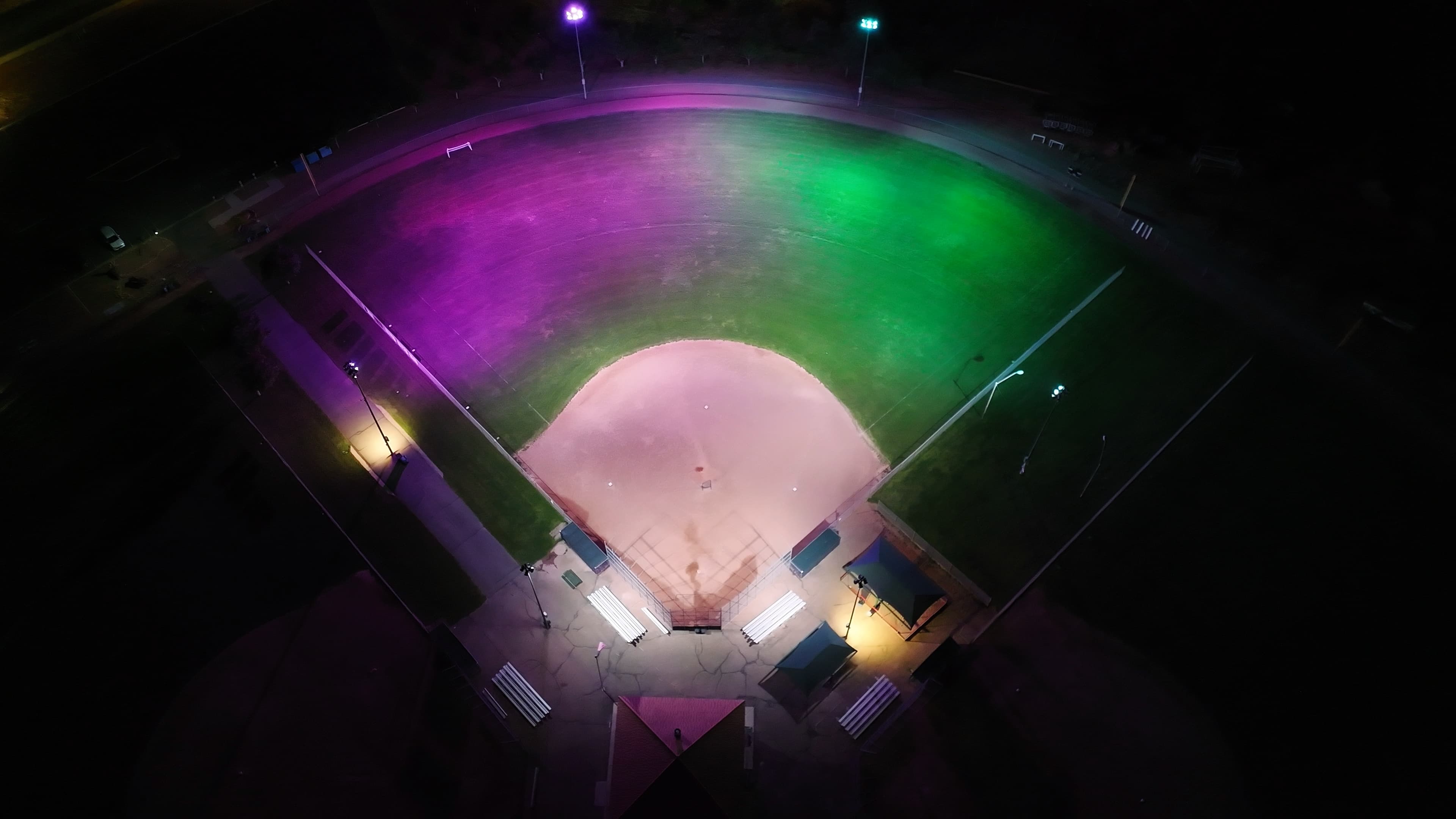
One of the most instructive examples of what a well-executed LED baseball lighting project looks like comes from Page, Arizona — a community where VOSS delivered a complete LED lighting solution for a baseball facility that transformed the nighttime experience for players and fans alike. The project demonstrates how LED technology, when properly engineered and installed, meets the dual mandate of performance and efficiency: improved on-field visibility and significant reductions in energy consumption.
That same methodology — precise photometric design, pole placement optimized for the specific field geometry, and full integration with controls — is what VOSS brings to every project, whether it is a single Little League field in a Durham neighborhood park or a multi-diamond complex serving a high school or collegiate program in the Triangle.
The lesson from projects like Page is straightforward: the gap between a competent lighting installation and a truly optimized one is significant. Facilities that invest in engineered design upfront see better player outcomes, fewer glare complaints from neighbors, and longer-lasting performance from their systems.
Considerations for Durham-Area Facility Types
The Greater Raleigh and Durham market includes a wide range of baseball and softball facility types, each with its own set of priorities:
Municipal and County Parks Fields Durham, Wake, and Orange County parks departments manage large inventories of athletic fields — many of which were lit under capital programs from the 1990s and early 2000s. For these operators, the priorities are cost management, compliance with safety standards, and minimizing the maintenance burden on parks staff. LED retrofits funded through energy savings or cooperative purchasing contracts allow parks departments to modernize infrastructure without waiting for a capital bond cycle.
High School and Collegiate Athletic Programs With schools across Durham, Cary, Morrisville, Raleigh, and Chapel Hill competing in NCHSAA athletics, and programs at institutions like North Carolina Central University and Duke University setting high standards for athletic facilities, LED lighting upgrades are increasingly tied to recruiting, competitive positioning, and broadcast readiness. Schools and universities should evaluate systems against governing body illuminance standards early in the planning process.
Youth Recreational and Travel Ball Leagues The Triangle region is a hub for competitive youth baseball and softball. Organizations operating multi-field complexes for travel tournaments need lighting that can handle back-to-back game schedules across multiple diamonds, with controls sophisticated enough to manage each field independently. LED systems with smart controls platforms are ideally suited to this use case.
Private and Semi-Professional Venues For commercial operators and organizations hosting showcase events or semi-professional leagues, LED lighting is directly tied to the ability to attract events, extend the playing season into evening hours, and provide a broadcast-quality environment.
For all of these contexts, the design process starts the same way: a thorough site assessment, photometric modeling tailored to the field dimensions and use case, and a project plan that accounts for existing infrastructure, electrical service capacity, and local permitting requirements.
Related Resources from VOSS
If your interest in sports and athletic facility lighting extends beyond the baseball diamond, VOSS has developed thought leadership resources on adjacent topics that may be relevant to facility operators across the Durham–Raleigh region. Readers managing multi-use athletic complexes may find value in exploring our content on Pickleball LED Lighting Solutions, Tennis Court Lighting and Energy Solutions, and LED Gymnasium Lighting Solutions, all available in the Latest Lighting section. Facility and operations leaders navigating broader energy strategy questions may also benefit from reviewing our guidance on Energy Audits, Incentives, and Rebate Navigation for Businesses and Utility Lighting Rebates Raleigh NC.
Service Availability
While VOSS offers a comprehensive suite of national services, specific capabilities may vary by location. Please contact your local branch to confirm the current availability of specific services, technology solutions, or contracting capabilities in your immediate market.
Talk to VOSS About Your Baseball Lighting Project in Durham
If you manage a baseball or softball facility anywhere in the Durham–Raleigh region — from a neighborhood recreation field to a multi-diamond tournament complex — and you are evaluating your lighting options, VOSS is ready to start the conversation. Our local team understands the regulatory landscape, utility incentive programs, and competitive dynamics of the Triangle market, and we bring the engineering depth and project management experience to deliver results at any scale.
VOSS Lighting — Raleigh Branch
Phone: (919) 779-8777 Toll-Free: (866) 292-0529
Reach out to schedule a site consultation or photometric assessment. We will help you understand what a modernized LED lighting system could mean for your facility — in performance, in energy savings, and in the experience you deliver to every player and fan who walks through your gates.