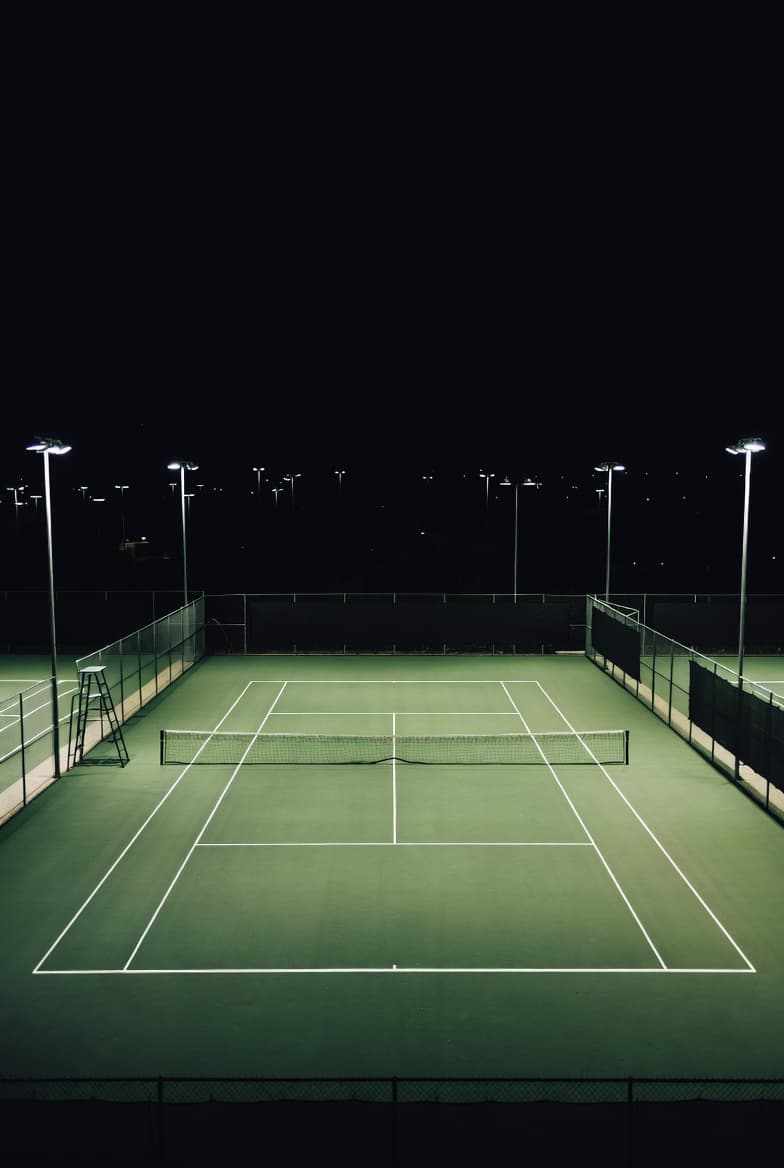
The State of Tennis Court Lighting in Chapel Hill and the Greater Triangle
Chapel Hill sits at the heart of one of the most educated, active, and economically dynamic regions in the United States. The Research Triangle — anchored by Chapel Hill, Raleigh, Durham, and Cary — is home to a dense network of universities, research institutions, private athletic clubs, municipal park systems, and HOA communities that collectively maintain hundreds of outdoor recreational amenities, including tennis courts.
That concentration of active users creates real pressure on facility operators. Tennis courts in Chapel Hill, Carrboro, Hillsborough, and the surrounding Orange County communities are in use from early morning through late evening, particularly during the academic year when UNC-affiliated players, club leagues, and community recreation programs overlap. Outdated lighting infrastructure — much of it original metal halide or high-pressure sodium systems installed decades ago — increasingly struggles to keep pace with the demands of modern play and the energy efficiency expectations of today's property owners and municipal budget offices.
The good news: the technology available today is dramatically better than what most existing courts are running, and the financial case for upgrading has never been stronger.
What Modern LED Tennis Court Lighting Actually Delivers
Understanding the difference between legacy sports lighting and current LED systems is essential for any facility manager or parks administrator evaluating an upgrade. This isn't simply a lamp swap — it's a fundamental shift in how light is engineered, delivered, and managed across a court surface.
Uniformity and Glare Control
One of the most common complaints from players on older courts is inconsistent light — bright spots near the poles, shadowed areas near the baselines, and glare that makes it difficult to track a high ball against the sky. Modern LED tennis court fixtures are engineered with precision optics that distribute light evenly across the entire court surface, including sidelines and back courts. Glare shields and directional control further reduce the visual interference that affects player performance and spectator comfort.
The IES (Illuminating Engineering Society) and USTA both publish specific foot-candle and uniformity ratio standards for tennis court illumination at various levels of play — from recreational to tournament-quality. Ensuring compliance with these standards is not just about aesthetics; it directly affects player safety and, for competitive venues, eligibility to host sanctioned events.
Energy Efficiency and Operating Cost Reduction
Metal halide systems — still the most common legacy technology on older tennis courts throughout the Chapel Hill area — are energy-intensive by design. They consume significantly more wattage than equivalent LED alternatives, require lengthy warm-up and restrike cycles, and degrade in light output over time even before lamp failure. LED systems, by contrast, deliver consistent output over a far longer lifespan, with documented energy savings of 50–70% compared to metal halide in comparable sports lighting applications.
For a private club or multi-court HOA facility running courts several nights per week, that reduction in energy consumption translates to meaningful operating cost savings over time — and those savings can often be accelerated through utility rebates available to commercial and institutional customers in North Carolina.
Smart Controls and Scheduling
A lighting system is only as efficient as how it's managed. Modern LED sports lighting can be paired with smart controls that enable scheduled on/off times, dimming for off-peak use, occupancy-based activation, and remote monitoring via web-based dashboards. For a parks and recreation department managing multiple facilities across Chapel Hill and Orange County, centralized control reduces staff burden and ensures lights aren't running unnecessarily during off-hours — a common source of wasted energy in municipal park systems.
For private clubs and sports entertainment venues, scheduling controls also open revenue opportunities: courts can be priced and reserved by time block, with lighting automatically activated and deactivated based on reservation status.
Long Lifespan and Reduced Maintenance
LED fixtures rated for sports applications are designed to operate for up to 100,000 hours with minimal lumen depreciation. That's a fundamentally different maintenance profile than metal halide, which requires periodic relamping, ballast replacement, and warm-up management. For a property or facilities manager responsible for an HOA campus or multi-use recreational complex, fewer service calls and longer replacement cycles mean less disruption, lower maintenance costs, and a more predictable budget.
The Financial Case: Rebates, ROI, and Total Cost of Ownership
For CFOs and operations leaders at private clubs, sports complexes, or large HOA communities evaluating a tennis court lighting retrofit, the conversation almost always starts with total cost of ownership — not just the upfront investment, but the full financial picture over a 10- to 15-year horizon.
That picture typically includes:
- Energy savings from reduced wattage and smarter control
- Reduced maintenance costs from longer lamp and fixture life
- Utility rebates available through Duke Energy Progress and other providers serving the Chapel Hill and Greater Raleigh market, which can significantly offset initial project costs
- Potential revenue uplift from extended evening court hours and improved facility appeal
Navigating utility rebate programs can be complex — each program has its own application process, qualifying fixture requirements, and documentation standards. Working with a contractor experienced in rebate management ensures that eligible savings are captured correctly and that the application process doesn't create delays or compliance issues. Our related article on utility lighting rebates in Raleigh, NC explores this topic in greater depth and is a useful companion read for any facility evaluating an upgrade.
For public-sector organizations — including Chapel Hill-Carrboro City Schools, Orange County Parks and Recreation, and other municipal or county entities — cooperative purchasing programs such as Omnia Partners, Sourcewell, BuyBoard, and TIPS can streamline procurement while satisfying competitive bidding requirements. This is particularly valuable for parks departments and school districts that need a compliant, efficient path to upgrading lighting infrastructure without the administrative burden of a standalone RFP process. Our work with Lewis Central Community Schools in Iowa is a useful illustration of how cooperative purchasing can solve both compliance and budget challenges simultaneously — the district used the Omnia Partners contract to demonstrate responsible stewardship to voters while proceeding with a lighting upgrade funded through operating budget savings rather than bond funds.
Considerations Specific to Chapel Hill and the Greater Triangle
Chapel Hill's community values — environmental stewardship, thoughtful development, and quality of life — are reflected in how local facilities approach infrastructure upgrades. Several factors are particularly relevant for tennis court lighting projects in this market:
Dark Sky and Light Trespass Compliance
Chapel Hill and surrounding communities are increasingly attentive to light pollution. Municipal ordinances and HOA covenants in many parts of Orange County and the Triangle restrict light spillover onto adjacent properties and set limits on upward-directed light. Modern LED sports lighting systems with precision optics and full-cutoff fixtures are well-suited to meeting these requirements — but fixture selection and pole placement must be engineered with compliance in mind from the start, not retrofitted after the fact.
Seasonal and Academic Calendar Demand
Chapel Hill's calendar is shaped in part by the University of North Carolina academic year, which drives spikes in recreational tennis participation during fall, spring, and summer sessions. Municipal parks, private clubs, and community facilities throughout the area experience similar patterns. Smart lighting controls that allow facility operators to adjust schedules seasonally — reducing hours during lower-demand periods — can further optimize energy performance.
Multi-Court and Multi-Use Facility Complexity
Many facilities in the Chapel Hill, Cary, Morrisville, and Durham corridor manage tennis courts alongside pickleball, basketball, and other outdoor amenities. Lighting these mixed-use environments requires careful coordination of pole heights, fixture aiming, and light zones to prevent one court's lighting from affecting adjacent courts or spaces. A turnkey contractor with sports lighting engineering experience can design a unified system that serves all courts efficiently rather than treating each as an isolated project.
Why Facility Leaders Partner with VOSS
VOSS brings more than 85 years of commercial electrical expertise to sports lighting projects of every scale — from single-court HOA retrofits in Carrboro to multi-court athletic complexes serving institutional clients across the Greater Raleigh region. Our Raleigh branch serves Chapel Hill, Durham, Cary, Hillsborough, Apex, Wake Forest, and surrounding communities throughout the Triangle.
What distinguishes our approach:
- Turnkey project delivery — from initial lighting design and fixture specification through installation, controls integration, and utility rebate management
- USTA and IES compliance expertise — ensuring your courts meet applicable illumination standards for recreational, club, or competitive play
- Smart controls integration — scheduling, dimming, and remote monitoring systems that reduce operating costs and staff burden
- Cooperative purchasing access — Omnia Partners, Sourcewell, BuyBoard, TIPS, and other programs available to qualifying public-sector organizations
- Utility rebate navigation — identifying, documenting, and submitting incentive applications through Duke Energy Progress and other applicable programs
If tennis court lighting is part of a broader outdoor amenity upgrade, our related articles on pickleball LED lighting solutions, parking lot and outdoor LED lighting upgrades, and campus parking lot and outdoor LED lighting safety solutions offer additional context on how these systems can be coordinated across a property for maximum efficiency.
Service Availability
While VOSS offers a comprehensive suite of national services, specific capabilities may vary by location. Please contact your local branch to confirm the current availability of specific services, technology solutions, or contracting capabilities in your immediate market.
Talk to Our Raleigh Team About Your Tennis Court Lighting Project
If you manage a tennis facility in Chapel Hill, Carrboro, Durham, Cary, or anywhere across the Greater Triangle and are evaluating a lighting upgrade or new installation, we'd welcome the opportunity to discuss what a project like yours typically involves — the right questions to ask, the standards to design toward, and how to structure a project that delivers lasting value.
Our Raleigh branch serves the full Triangle region and is available to conduct site assessments, provide lighting design consultations, and help your team build a business case for moving forward.
VOSS Raleigh Branch
Phone: (919) 779-8777 Toll-Free: (866) 292-0529