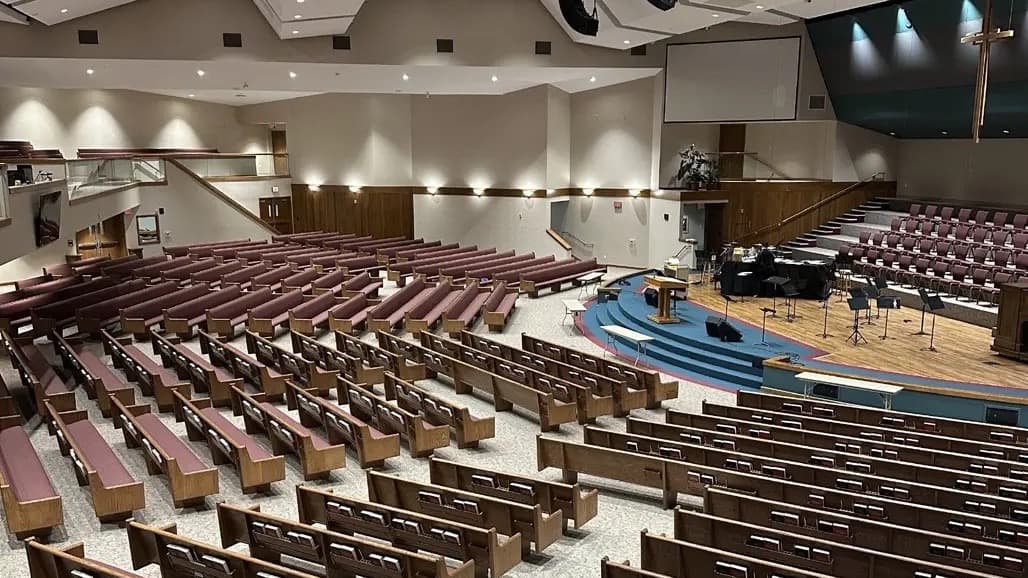
Why Chapel Hill Churches Are Rethinking Their Sanctuary Lighting
Chapel Hill is home to a remarkably active faith community. From historic congregations near Franklin Street to growing churches serving the surrounding communities of Carrboro, Hillsborough, Durham, and Pittsboro, houses of worship here serve thousands of congregants every week — and their facilities are expected to perform accordingly.
But aging sanctuary lighting tells a different story. Across the Greater Raleigh region, church facility managers are navigating a growing list of maintenance headaches: incandescent and halogen fixtures that burn out far too quickly, elevated ceilings that require expensive lifts or scaffolding for every bulb change, flickering caused by failing ballasts, and light levels that simply aren't adequate for modern worship — including the livestreaming and video production that many congregations now rely on to reach members near and far.
The good news is that lighting technology has advanced dramatically, and the path forward is clearer than it's ever been. This article explores what facility managers at Chapel Hill-area churches need to know about sanctuary lighting maintenance, LED retrofit options, and how modern lighting systems can reduce operational burden while elevating the worship experience.
The Real Cost of Deferred Sanctuary Lighting Maintenance
It's easy to treat lighting maintenance as a low-priority line item — until a bulb burns out during a Sunday morning service, or a flickering fixture becomes a distraction during a wedding or memorial. For church facility managers and operations leaders, the true cost of aging lighting goes well beyond the price of a replacement bulb.
Consider what's actually at stake:
- Scaffolding and lift rental costs can add up quickly when chandeliers or high-ceiling fixtures require professional access multiple times per year
- Aging ballasts in fluorescent systems cause flickering, humming, and premature lamp failure — and in many cases, compatible replacement ballasts are becoming harder to source as regulations phase out older fluorescent technology
- Uneven light distribution creates safety concerns in aisles and stairwells, reduces visibility for congregants reading materials, and produces unflattering or inconsistent video quality for livestreams
- Rising energy costs from inefficient incandescent or halogen fixtures can quietly drain a tight facilities budget year after year
North Carolina's ongoing utility environment makes this even more relevant. Duke Energy Progress, which serves much of the Chapel Hill and Greater Raleigh area, has offered commercial lighting incentive programs that can meaningfully offset the upfront cost of LED upgrades — meaning delay isn't just inconvenient, it's potentially leaving money on the table.
For context, it's also worth noting that North Carolina has been moving in line with broader national trends around phasing out inefficient lamp types. Church facility managers who haven't yet evaluated their fluorescent or incandescent inventories should do so proactively. Our sibling article on Fluorescent Tube Bans and LED Lighting Rebates covers this topic in depth and is worth reviewing alongside your sanctuary lighting assessment.
What Makes Sanctuary Lighting Uniquely Challenging
Church sanctuaries aren't like office buildings or retail spaces. They present a distinct set of constraints that require specialized knowledge and a thoughtful approach:
Architectural and aesthetic sensitivity. Many Chapel Hill-area congregations worship in historic or architecturally significant buildings. Lighting changes must respect the character of the space — whether that means integrating LED sources into existing decorative fixtures or carefully selecting color temperatures that complement wood tones, stained glass, and traditional finishes.
Variable use cases. A sanctuary must serve Sunday morning worship, Wednesday evening programming, choir rehearsals, community events, weddings, funerals, and increasingly, livestreamed or recorded services. A single static lighting setup rarely serves all of these well. Scenes, zones, and dimming capability matter enormously.
Access challenges. Vaulted ceilings, choir lofts, balconies, and ornate chandeliers make routine bulb replacement genuinely difficult and costly. The best upgrade strategies extend lamp life dramatically — reducing how often access is even needed.
Budget realities. Faith communities operate on tighter margins than commercial properties. Facility managers must make a compelling case for capital investment, and the math has to work. Fortunately, LED retrofits in sanctuary environments frequently deliver payback periods that make the conversation straightforward.
Minimal disruption requirements. Services can't be interrupted. Installations must be planned around the congregation's schedule — often evenings, weekdays, or phased across multiple weekends.
LED Retrofits: A Practical Path for Chapel Hill Congregations
Modern LED technology has made sanctuary lighting upgrades more accessible, more affordable, and more effective than ever before. For facility managers evaluating their options, here's what a well-planned retrofit typically delivers:
- Dramatic reduction in maintenance frequency — quality LED sources rated for 50,000+ hours mean years between replacements, not months
- Improved light quality — consistent color rendering, better uniformity across the sanctuary floor and platform, and color temperature options that suit the warmth of traditional worship spaces
- Dimming and scene control — integrated control systems allow staff to program lighting scenes for different service types at the touch of a button, without manual fixture adjustments
- Energy savings — LED fixtures typically consume 50–75% less energy than the incandescent or halogen sources they replace, with measurable impact on monthly utility bills
- Rebate eligibility — Duke Energy Progress incentive programs and other utility rebate pathways can offset a meaningful portion of project costs for qualifying upgrades
For congregations in Chapel Hill, Carrboro, Durham, and surrounding communities, these aren't theoretical benefits — they reflect what's being implemented across comparable faith communities throughout the Greater Raleigh region and nationwide.
It's also worth noting that faith-based organizations may qualify for cooperative purchasing programs that simplify the procurement process. Houston Church COOP is one example of a nationally available cooperative purchasing vehicle specifically designed for churches and religious organizations, providing access to pre-competitively bid pricing without the need for a separate bidding process. For larger congregations with more formal procurement requirements, programs such as Sourcewell, TIPS, and Omnia Partners are also available to eligible organizations.
The value of cooperative purchasing extends beyond price. As demonstrated in VOSS's work with Lewis Central Community Schools in Iowa — where cooperative purchasing through Omnia Partners helped a district navigate complex state procurement requirements while funding lighting upgrades entirely within their operating budget — these programs can be transformative for organizations managing tight financial constraints. Faith communities face similar pressures, and the same procurement discipline applies.
Trends Shaping Church Lighting in the Greater Raleigh Region
The lighting decisions Chapel Hill congregations make today will shape their facilities for the next two to three decades. Several trends are worth understanding as you evaluate your options:
Livestreaming is now a baseline expectation. Since 2020, a significant share of faith communities have invested in video production capabilities. Lighting designed for the human eye in the room often performs poorly on camera — producing hot spots, shadows, or color inconsistency that undermines production quality. Modern sanctuary lighting design accounts for both in-person and on-camera performance simultaneously.
Smart controls are becoming standard. Programmable dimming systems, occupancy sensing, and scene presets are no longer luxury add-ons. They're practical tools that reduce energy consumption, extend fixture life, and simplify operations for small volunteer or part-time facilities teams.
Sustainability matters to congregations. Many Chapel Hill and Triangle-area faith communities have made explicit commitments to environmental stewardship. LED upgrades are one of the most tangible, measurable ways a congregation can reduce its carbon footprint — a point that resonates with members and leadership alike.
Phased approaches are viable. Not every congregation can fund a full sanctuary overhaul in a single budget cycle. Well-structured phased retrofit plans allow churches to start with the highest-impact areas — platform lighting, chandeliers, or aisle fixtures — and expand over time as budgets allow, without disrupting the overall system plan.
For more context on rebate programs available to facilities in this region, our Utility Lighting Rebates Raleigh NC article provides a helpful overview of what's currently accessible to commercial and institutional properties across the Triangle.
Service Availability
While VOSS offers a comprehensive suite of national services, specific capabilities may vary by location. Please contact your local branch to confirm the current availability of specific services, technology solutions, or contracting capabilities in your immediate market.
Talk to a Lighting Specialist at Our Raleigh Branch
If your Chapel Hill, Carrboro, Durham, or Hillsborough congregation is dealing with flickering fixtures, frequent maintenance calls, inconsistent light quality, or simply wondering whether an LED upgrade makes financial sense right now, we'd welcome the conversation.
VOSS's Raleigh branch serves faith communities across the Greater Raleigh region and brings the resources of a national organization with the responsiveness of a local team. We're happy to walk through your facility's current situation, discuss what a phased or full retrofit might look like, and help you understand what rebate or cooperative purchasing programs may be available to your congregation.
VOSS Lighting — Raleigh Branch
Phone: (919) 779-8777 Toll-Free: (866) 292-0529
Reach out to schedule a no-obligation conversation with a lighting specialist who understands the unique demands of sanctuary environments.