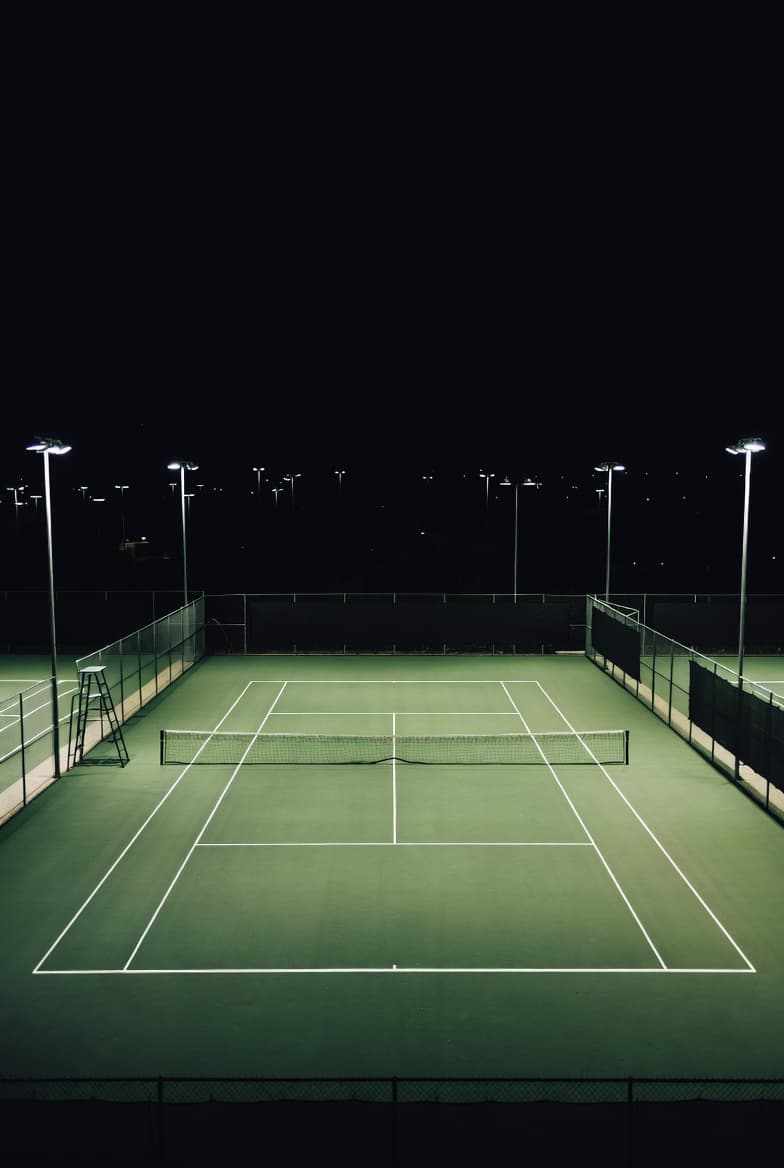
Why Tennis Court Lighting Is a Strategic Priority in Cary, NC
Cary is one of the fastest-growing municipalities in the Southeast, and its investment in recreational infrastructure reflects that trajectory. With a population approaching 180,000 and a community culture that strongly values outdoor amenities, the demand for high-quality tennis court facilities — and the lighting systems that keep them usable after sunset — has never been higher. From the master-planned HOA communities of West Cary and Morrisville to the public parks managed by the Town of Cary's award-winning Parks, Recreation & Cultural Resources department, well-lit tennis courts are a quality-of-life asset that directly affects property values, membership retention, and community satisfaction.
Across the Greater Raleigh area — including Apex, Holly Springs, Fuquay-Varina, Wake Forest, and Chapel Hill — facility managers and parks directors are navigating the same challenge: aging metal halide or high-pressure sodium lighting systems that consume excessive energy, require frequent maintenance, and fall short of modern player experience standards. The shift to LED tennis court lighting isn't just a trend — it's becoming the baseline expectation for any facility that takes its courts seriously.
Understanding what drives this shift, and what a well-executed upgrade looks like, is the first step toward making a sound investment decision.
The Problem with Older Tennis Court Lighting Systems
Metal halide fixtures dominated outdoor sports lighting for decades because they were an improvement over what came before. Today, however, they represent a significant liability for facilities that care about performance, cost control, and long-term sustainability.
Here's what facility managers across Cary and the Wake County region are dealing with when they maintain aging tennis court lighting:
- Inconsistent illumination: Metal halide and high-pressure sodium systems develop hot spots and shadow zones over time as lamps age and reflectors degrade. Players tracking a fast-moving ball under uneven light face both performance and safety challenges.
- High energy consumption: Older systems can consume two to three times the energy of a modern LED equivalent, a meaningful operating cost for any facility running multiple courts several nights per week throughout the spring, summer, and fall seasons that define North Carolina's outdoor tennis calendar.
- Long warm-up and restrike times: Metal halide fixtures require 15–20 minutes to reach full output after being switched on — and if power is interrupted, they must cool before restriking. LED systems deliver instant-on illumination with no delay.
- Escalating maintenance costs: Lamp replacements, ballast failures, and fixture cleaning cycles add up quickly across a multi-court installation. LED fixtures, by contrast, are rated for up to 100,000 operating hours with dramatically reduced maintenance burden.
- Light trespass and glare concerns: Older fixtures were not engineered for precise optical control. In Cary's dense residential and mixed-use neighborhoods, light spilling beyond court boundaries can trigger neighbor complaints and, in some cases, code compliance issues.
For parks directors managing public courts, HOA managers overseeing community amenities, and private club operators accountable to members and owners, these aren't abstract concerns — they translate directly to budget pressures, service complaints, and deferred capital investment.
What Modern LED Tennis Court Lighting Actually Delivers
The evolution of LED sports lighting technology has been rapid, and today's purpose-built tennis court LED systems are a fundamentally different product category than the early LED retrofits that gave some facilities pause a decade ago. Here's what the current generation of commercial-grade LED tennis court lighting is engineered to provide.
USTA and IES Compliance
The United States Tennis Association (USTA) and the Illuminating Engineering Society (IES) publish specific foot-candle recommendations for tennis court illumination based on the level of play — from recreational use to competitive and broadcast-quality events. A properly designed LED system is photometrically engineered to those standards, with uniform light distribution across the entire court surface, including sidelines and baselines where tracking a low ball in poor light is most difficult.
For facilities in Cary that host USTA league play, junior development programs, or competitive club events, meeting these standards is not optional — it's a prerequisite for player satisfaction and event credibility.
Energy Savings with Documented ROI
Modern LED tennis court fixtures typically deliver 50–70% reductions in energy consumption compared to metal halide systems of equivalent output. For a multi-court facility operating courts four to five nights per week across a nine-month outdoor season, that reduction translates to meaningful utility savings year after year. Facilities that pair their LED upgrade with smart controls — automated scheduling, motion sensing, and dimming capabilities — can push those savings even further by ensuring lights run only when courts are occupied and only at the output level the situation requires.
Duke Energy, which serves much of the Cary and Wake County market, offers commercial utility rebate programs for qualifying energy efficiency upgrades. Capturing those rebates at the time of project completion reduces net project cost and accelerates payback timelines — a calculation that carries significant weight in both public-sector budget justifications and private-sector ROI analyses.
Smart Controls and Scheduling Integration
One of the most meaningful differentiators between a basic LED swap and a thoughtfully engineered tennis court lighting system is controls integration. Modern systems can be configured with court-by-court scheduling, occupancy-based dimming, remote monitoring, and smartphone or web-based management platforms. For a parks and recreation department managing courts across multiple Cary park locations, centralized controls mean administrators can manage lighting schedules remotely, receive alerts for system anomalies, and ensure courts aren't burning energy unnecessarily during off-hours.
For private clubs and sports entertainment venues, smart controls also enable revenue-generating features — courts can be set to illuminate automatically when a reservation is made, and to power down at the end of a booked session, creating a tighter connection between court usage and operational cost.
Glare Control and Dark-Sky Compliance
Modern LED tennis court optics are engineered with precise beam cutoffs that keep light on the playing surface and out of adjacent spaces. This is particularly relevant in Cary, where residential communities often border park and recreational facilities. Fixtures designed for minimal upward light waste and controlled horizontal spill address both dark-sky ordinance considerations and neighbor relations — an increasingly important factor as communities across the Triangle region grow denser.
Considerations for Different Types of Facilities in the Greater Raleigh Market
Tennis court lighting projects in the Cary area span a wide range of facility types, and the right approach depends on the specific context, regulatory environment, and operational goals of each organization.
HOA and Multi-Use Residential Communities: Cary's master-planned communities — many of which include multiple tennis courts as central amenity features — are a natural fit for LED retrofits. Property managers and HOA boards focused on keeping assessment budgets in check benefit from the reduced maintenance costs and energy savings that LED systems deliver, while residents enjoy improved court quality and extended usable hours. Long-life LED fixtures also reduce the logistical burden of lamp replacement at facilities that may not have dedicated maintenance staff on-site.
Municipal Parks and Recreation Facilities: The Town of Cary operates a well-regarded parks system that draws residents from across Wake County. Parks directors overseeing tennis court lighting projects must navigate public-sector procurement requirements, budget cycles, and community expectations around dark-sky compliance and ADA accessibility. Cooperative purchasing programs — including TIPS, Sourcewell, Omnia Partners, BuyBoard, and others — offer eligible public agencies a compliant path to procuring lighting services without a separate competitive bid process, streamlining project timelines and administrative burden. VOSS has direct experience helping public-sector clients navigate these frameworks, as demonstrated in our work with Lewis Central Community Schools in Iowa, where we helped the district leverage Omnia Partners to meet state competitive bidding requirements while funding LED upgrades entirely from their operating budget — reducing the amount of bond funding the district needed to request.
Private Athletic Clubs and Country Clubs: Facilities in and around Cary's affluent communities — from the private clubs near Prestonwood and MacGregor Downs to sports complexes serving the broader Research Triangle area — often have the highest performance expectations and the most nuanced ROI requirements. For a CFO or VP of Operations evaluating a tennis court lighting retrofit, the conversation is about total cost of ownership: what does the system cost to operate annually, how do utility rebates reduce first-year net cost, what is the expected maintenance savings over a 10-year horizon, and does the system support the member experience the club is committed to delivering? These are questions VOSS is equipped to answer with photometric analysis, detailed energy modeling, and a project execution process designed for minimal disruption to active courts.
Schools and Universities: Academic institutions across Wake County — including those in Cary, Morrisville, and the broader Raleigh-Durham corridor — operate tennis programs ranging from varsity high school teams to collegiate competitive play. Athletic directors and facilities managers at these institutions are often juggling capital project priorities and may not have deep familiarity with sports lighting specifications. A contractor who can handle design, permitting, installation, rebate management, and controls programming as a single turnkey engagement reduces administrative complexity and ensures accountability at every stage.
What to Look for in a Tennis Court Lighting Contractor
Not every electrical contractor has the experience or technical depth to execute a sports lighting project correctly. Tennis court lighting involves photometric design, structural loading assessments for pole placement, electrical infrastructure upgrades, controls integration, and — for public-sector projects — compliance with prevailing wage and procurement regulations. Choosing the wrong partner can mean a system that technically works but fails to meet USTA standards, creates glare complaints, or leaves rebate money uncaptured.
When evaluating a tennis court lighting contractor for your Cary or Greater Raleigh facility, consider the following:
- Photometric design capability: Can the contractor produce and interpret a lighting layout that demonstrates compliance with IES and USTA foot-candle requirements before installation begins?
- LED product knowledge: Does the contractor have established relationships with commercial-grade sports lighting manufacturers, and can they explain the optical and thermal performance differences between product tiers?
- Rebate and incentive management: Does the contractor have experience navigating utility rebate programs — including Duke Energy's commercial efficiency incentives — and will they manage the paperwork on your behalf?
- Controls integration experience: Can the contractor design and commission a controls system that meets your scheduling, dimming, and remote management requirements?
- Public-sector procurement experience: For parks departments, schools, and municipal facilities, can the contractor demonstrate familiarity with cooperative purchasing programs and prevailing wage compliance?
- Project track record: Does the contractor have a documented history of delivering sports lighting projects on schedule and to specification, with references from comparable facility types?
These are the standards VOSS holds itself to on every project, whether it's a two-court HOA retrofit in Cary or a multi-court athletic complex serving the broader Triangle region.
Service Availability
While VOSS offers a comprehensive suite of national services, specific capabilities may vary by location. Please contact your local branch to confirm the current availability of specific services, technology solutions, or contracting capabilities in your immediate market.
Connect with VOSS in Cary and the Greater Raleigh Area
If you're responsible for tennis court facilities in Cary, Apex, Morrisville, Holly Springs, Wake Forest, Fuquay-Varina, or anywhere across the Greater Raleigh market, VOSS's local Raleigh branch is ready to discuss your project. Whether you're in the early stages of evaluating an LED upgrade, navigating a capital budget cycle, or ready to move forward with a design and installation engagement, our team can provide the technical guidance and project experience your facility deserves.
For readers interested in related topics, our Latest Lighting section covers adjacent areas including Gymnasium LED Retrofit & Sports Court Lighting, Pickleball LED Lighting Solutions, Parking Lot and Outdoor LED Lighting Upgrades, and utility rebate navigation — all relevant reading for facility managers overseeing comprehensive outdoor amenity programs.
VOSS – Raleigh Branch
Phone: (919) 779-8777 Toll-Free: (866) 292-0529
We invite you to reach out for a consultative conversation about how LED tennis court lighting can improve performance, reduce operating costs, and support the long-term goals of your facility.