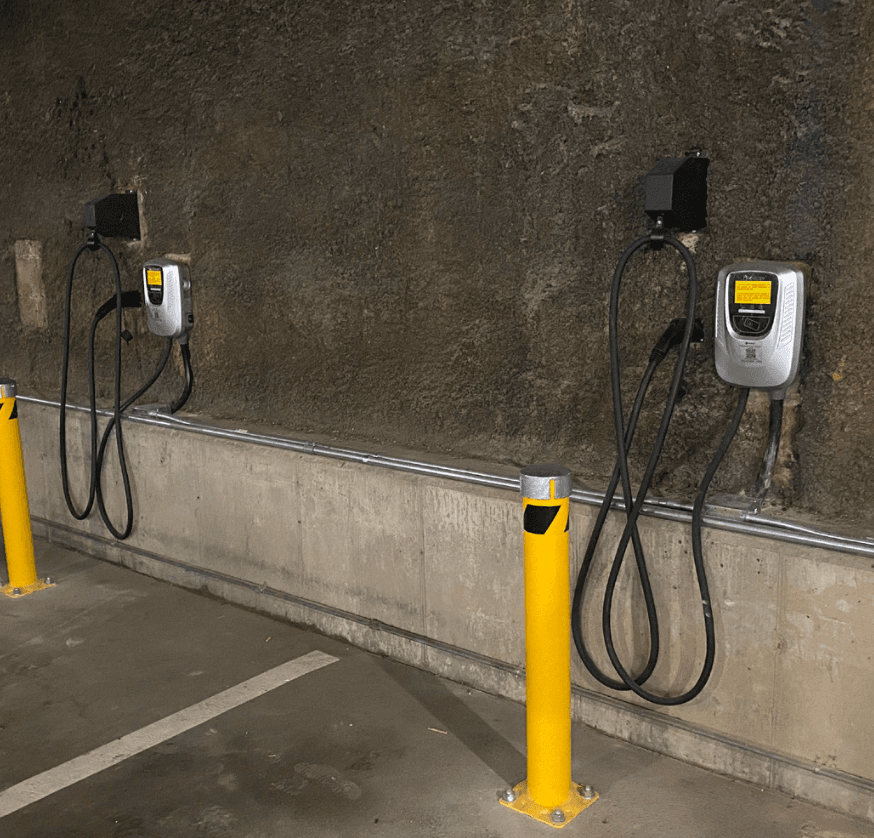
Why Tempe Businesses Are Moving on EV Charging Now
Tempe sits at the heart of one of the fastest-growing metropolitan economies in the United States. With nearly 192,000 residents, a dense concentration of technology employers, major university operations, a thriving retail and hospitality corridor along Mill Avenue and Tempe Marketplace, and a busy commercial real estate market stretching into Chandler, Mesa, Scottsdale, and Gilbert, the demand for commercial EV charging infrastructure in this market is not theoretical — it is already here.
Arizona consistently ranks among the top states for EV adoption, and the Greater Phoenix metro is leading that charge. Employees arriving at Tempe office parks, shoppers pulling into retail centers, and fleet vehicles returning to distribution yards all increasingly represent EV drivers looking for a reliable charge. For facility managers, property owners, and finance leaders, the question is no longer whether to invest in commercial EV charging infrastructure — it is how to do so strategically and cost-effectively.
A critical timing factor: The federal 30C Alternative Fuel Vehicle Refueling Property Credit, which covers 30% of qualified equipment and installation costs for commercial EV chargers — up to $100,000 per item — applies only to property placed in service by June 30, 2026. Organizations that delay risk forfeiting one of the most substantial incentives available.
Understanding the Rebate and Incentive Landscape for Arizona Businesses
One of the most compelling reasons to act now is the layered system of financial incentives available to Arizona businesses. Navigating these programs requires expertise — and leaving money on the table is a real risk for organizations without a knowledgeable contractor guiding the process.
Federal Incentives
- The Federal 30C Alternative Fuel Vehicle Refueling Property Credit covers 30% of qualified equipment and installation costs for commercial EV chargers, with per-item maximums up to $100,000. Properties located in designated low-income or rural areas may qualify for enhanced benefits. Installations must be operational before June 30, 2026, to qualify.
- The Inflation Reduction Act (IRA) and NEVI Formula Program create additional funding pathways — particularly relevant for fleet operators, public agencies, and properties located along designated alternative fuel corridors in the Phoenix metro area.
State and Utility Programs
- Arizona Public Service (APS) and Salt River Project (SRP) both serve commercial customers across Tempe and the surrounding East Valley. Both utilities have historically offered EV infrastructure incentives, demand response programs, and rate structures that can meaningfully affect the total cost of ownership for commercial charging installations. Our team monitors these programs actively and can identify which apply to your specific facility and utility account.
LEED and ESG Considerations
- Commercial EV charging infrastructure can contribute to LEED certification credits under the Transportation category, making it a practical tool for sustainability and ESG managers seeking measurable, reportable environmental impact. For organizations with corporate carbon reduction commitments or investor-facing ESG reporting obligations, EV charging infrastructure represents a visible, quantifiable step forward.
Public Sector and Cooperative Purchasing
- For Tempe-area municipalities, school districts, and state agencies — including those connected to Arizona State University's expansive footprint in the city — procurement does not have to be complicated. VOSS holds an approved Arizona state contract, and eligible organizations can also access our services through cooperative purchasing programs including Sourcewell, TIPS, BuyBoard, Omnia Partners, AEPA, PACE, and others. These vehicles streamline procurement, ensure compliance, and eliminate the need for a competitive bid process.
What Commercial EV Charging Installation Actually Involves
Many facility managers and property owners underestimate the scope of a commercial EV charging project — and many overestimate the disruption. The reality is that a well-planned installation, managed by an experienced electrical contractor, is a structured and predictable process. Here is what a professional, end-to-end engagement looks like:
1. Electrical Capacity Assessment Before a single charger is selected, a qualified electrician must evaluate your facility's existing electrical infrastructure. Tempe commercial properties — particularly older office buildings, retail centers built before the EV era, and multifamily developments in communities like South Tempe and the Kyrene corridor — often require panel upgrades or load management strategies to support Level 2 or DC fast charging without triggering costly demand charges.
2. Site Design and Equipment Selection Not all EV charging equipment is equal. Level 2 commercial chargers (240V) are the standard for workplace parking, employee amenities, and tenant-facing installations. DC fast chargers are appropriate for high-traffic retail, hospitality, and public-access applications. The right mix depends on your facility's use case, dwell time patterns, electrical capacity, and long-term scalability goals.
3. Permitting and Utility Coordination Commercial EV charging installations in Tempe and across Maricopa County require building permits, electrical inspections, and — in many cases — utility notification or interconnection agreements. Managing this process with APS, SRP, or the City of Tempe's permitting office takes time and expertise. An experienced contractor handles this on your behalf, keeping projects on schedule.
4. Installation and Commissioning Physical installation includes conduit and wiring runs, panel work, mounting, network connectivity for smart charging systems, and final commissioning and testing. Minimizing disruption to daily operations — especially in active retail, healthcare, or office environments — requires careful scheduling and a contractor who communicates clearly throughout.
5. Ongoing Support and Maintenance Commercial EV charging infrastructure is a long-term asset. Uptime reliability matters — both for employee satisfaction and for revenue-generating public or tenant charging scenarios. Ongoing maintenance, firmware updates, and rapid response to equipment issues are part of responsible ownership.
Strategic Considerations for Tempe's Key Commercial Sectors
The Greater Phoenix metro's economic diversity means EV charging infrastructure looks different depending on the sector. Tempe's commercial landscape includes major technology and financial services employers, a robust hospitality and entertainment district, light industrial and logistics operations near the I-10 and US-60 corridors, and one of the most active commercial real estate development pipelines in the Southwest.
Office and Corporate Campus Properties Workplace EV charging is increasingly a talent attraction and retention tool. As major employers compete for skilled workers across the Phoenix metro, providing Level 2 chargers in employee parking structures signals a forward-thinking culture — and satisfies a growing number of EV-driving employees who factor charging access into their daily commute decisions.
Retail, Hospitality, and Mixed-Use Developments Properties along Tempe's retail corridors — including areas near Tempe Marketplace, ASU's Research Park, and the South Tempe commercial district — benefit from EV charging as a dwell-time extender. Shoppers and diners who plug in stay longer. DC fast chargers at high-traffic retail locations can also generate direct revenue through pay-per-use billing, creating an ancillary income stream for property owners.
Multifamily and Commercial Real Estate Arizona's EV-ready building codes and the growing expectation among premium tenants for charging amenities are reshaping what Class A multifamily and commercial properties must offer to compete. Developers and property managers building or repositioning assets in Tempe, Chandler, Scottsdale, or Mesa should be planning EV infrastructure at the design stage — retrofitting is always more expensive than building in conduit and panel capacity from the start.
Fleet Operators Organizations managing commercial vehicle fleets — from last-mile delivery to municipal service vehicles — face a distinct set of challenges around depot charging, load management, and shift-based charging schedules. Fleet EV charging infrastructure requires careful electrical planning and, in many cases, smart energy management integration to avoid peak demand penalties.
Why VOSS | A Partner Who Manages the Complexity
VOSS has been delivering electrical solutions to commercial, industrial, and institutional clients for more than 85 years. Our Phoenix branch serves the entire Greater Phoenix metro — including Tempe, Scottsdale, Mesa, Chandler, Gilbert, Peoria, and Glendale — with the full range of capabilities required for a professional commercial EV charging station installation.
What sets our approach apart is accountability. We are not a charger vendor or a rebate consultant — we are a licensed electrical contractor who manages every phase of your project: capacity assessment, equipment specification, rebate identification, permitting, utility coordination, installation, and ongoing support. You work with one partner, not a fragmented chain of vendors.
Our team stays current on the evolving incentive landscape — including federal 30C credits, IRA provisions, APS and SRP utility programs, and state-level opportunities — so your organization captures every available dollar. And for facilities managers who cannot afford extended downtime or operational disruption, our installation planning process is built around your schedule, not ours.
For readers exploring related energy topics, our article on Maximize ROI with Commercial LED Lighting Rebates in Dallas, TX and Energy Audits, Incentives, and Rebate Navigation for Businesses — both part of this content series — offer additional context on how rebate stacking and energy audits can complement an EV charging investment strategy. Our piece on EV Chargers: Unlocking Profitability for Businesses explores the revenue-generation dimension in greater depth.
Service Availability
While VOSS offers a comprehensive suite of national services, specific capabilities may vary by location. Please contact your local branch to confirm the current availability of specific services, technology solutions, or contracting capabilities in your immediate market.
Talk to Our Phoenix Team About Your Facility
Whether you are evaluating EV charging for the first time, working against the June 2026 federal incentive deadline, or ready to move forward on a multi-property deployment across the Greater Phoenix area, our team is here to help you think it through — without pressure and without oversimplification.
Contact our Phoenix branch to schedule a consultation:
Phone: (602) 340-9500 Toll-Free: (800) 788-8676
We serve Tempe and the surrounding communities of Scottsdale, Mesa, Chandler, Gilbert, Peoria, Glendale, and the broader Maricopa County region.