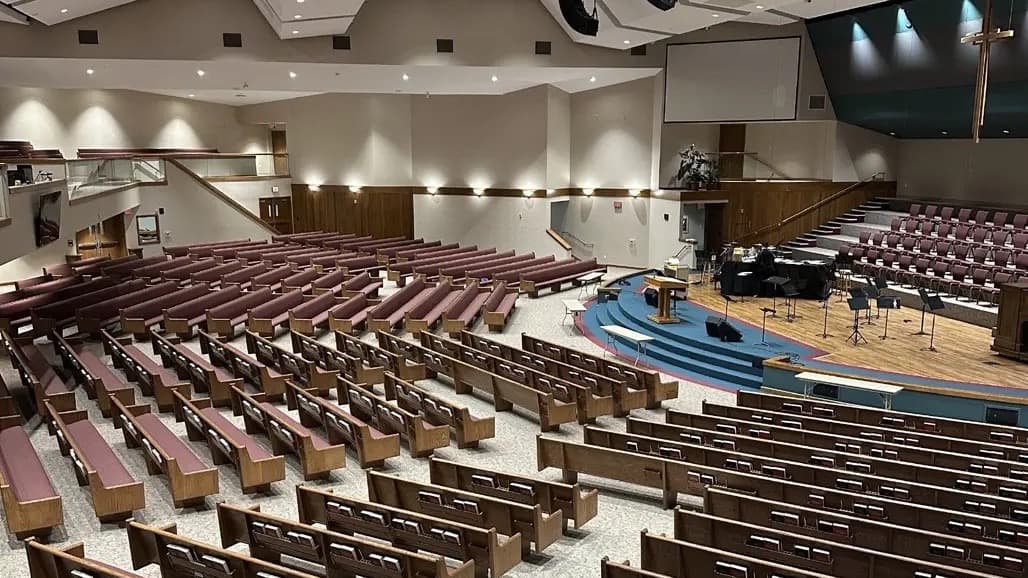
Why Sanctuary Lighting Deserves More Attention Than It Gets
For most congregations in Tempe and the greater Phoenix area, lighting is an afterthought — until it becomes a problem. A flickering spotlight during Sunday service, a burned-out fixture above the choir loft, or washed-out video on a livestream feed can quietly undermine the worship experience that church leadership has worked hard to cultivate.
The Greater Phoenix metro is home to a dense and growing faith community. From Tempe's established congregations near Arizona State University to newer multi-site churches serving the surrounding communities of Mesa, Chandler, and Scottsdale, the region's houses of worship vary enormously in age, architecture, and facility complexity. What they share is a common set of lighting challenges — and a growing recognition that those challenges have real, solvable answers.
This article explores what church facility managers and operations leaders across the Tempe area should know about modern sanctuary lighting: what's driving the shift toward LED, what makes church environments uniquely demanding, and how to approach an upgrade with minimal disruption to your congregation.
The Unique Demands of Church Sanctuary Lighting
Churches are not typical commercial buildings, and sanctuary lighting is not a typical maintenance category. Several factors make it distinctly complex:
High, difficult-to-access fixture locations. Many sanctuaries — particularly older ones with vaulted ceilings, decorative trusses, or architectural soffits — require scaffolding or aerial lifts just to change a bulb. In the dry, high-heat climate of the Phoenix Valley, traditional incandescent and halogen lamps fail faster, meaning these access events happen more frequently than they would in cooler regions.
Aging infrastructure and ballast failures. Fluorescent fixtures installed in the 1990s and early 2000s are reaching the end of their service lives across the region. Ballast failures produce the flickering and dimming that facility managers hear about from pastors, worship directors, and congregants alike. In many cases, replacing the ballast is only a temporary fix — the fixture itself is due for retirement.
The livestream and media production factor. The growth of online worship — accelerated dramatically in recent years — has raised the stakes for lighting quality in ways that older systems were never designed to meet. Cameras are unforgiving: uneven light levels, harsh shadows, and color temperature mismatches that look acceptable to the human eye can render poorly on video. Churches investing in broadcast-quality media need lighting that supports that mission.
Historic and aesthetic constraints. Several congregations in the Tempe and central Phoenix area occupy architecturally significant or historically sensitive buildings. Any lighting upgrade in these spaces must balance modern performance with preservation of character — a challenge that requires experienced, thoughtful planning.
Budget and schedule sensitivity. Church facilities operate on faith-based budgets with limited capital reserves and staff. Upgrades must be phased thoughtfully, minimize disruption to weekly services and special events, and deliver tangible returns that leadership can communicate to their boards and congregations.
What LED Technology Actually Changes for Churches
The shift from traditional light sources to LED is well established in commercial and industrial settings, but its impact on church sanctuaries is particularly meaningful — and worth understanding clearly.
Dramatically longer lamp life. Quality LED lamps and fixtures are rated for 50,000 hours or more of operation — compared to 1,000–2,000 hours for incandescent bulbs and 10,000–15,000 hours for fluorescent tubes. For a sanctuary that runs lights for services, rehearsals, events, and building use throughout the week, this translates to years between replacements rather than months. For churches with high, hard-to-reach fixtures, this is transformative.
Lower energy consumption. LED fixtures typically consume 50–75% less energy than the incandescent or halogen sources they replace. In Arizona's climate, where air conditioning costs are already significant, reducing heat output from lighting fixtures carries a secondary benefit — less thermal load means HVAC systems work less hard. For churches in Tempe and across the East Valley, this is a meaningful operational consideration.
Better light quality and control. Modern LED systems offer precise color temperature tuning, high color rendering index (CRI) values that make colors appear natural and vibrant, and dimming capability that integrates cleanly with contemporary worship production workflows. Dimming systems can be programmed to set moods for different service types — traditional worship, contemporary services, intimate prayer gatherings — and recalled with a single command.
Reduced maintenance labor. Every hour a facilities volunteer or staff member spends arranging lift rentals, sourcing lamps, and climbing to replace bulbs is an hour not spent on ministry. LED upgrades directly reduce that burden.
Trends Shaping Church Lighting in the Phoenix Metro
A few developments are accelerating the pace of LED adoption among faith communities across the Greater Phoenix area:
The Arizona fluorescent lamp phase-out. Federal and state-level regulatory changes are restricting the manufacture and sale of certain fluorescent lamp types. For churches still operating T12 or T8 fluorescent fixtures — common in fellowship halls, classrooms, and administrative areas adjacent to the sanctuary — this creates a practical urgency. Replacement supplies are becoming harder to source, and now is the time to plan rather than scramble.
Utility incentive programs. Arizona Public Service (APS) and Salt River Project (SRP) both offer energy efficiency incentive programs that can offset the upfront cost of qualifying LED upgrades. While program terms and eligibility requirements vary and change periodically, churches that take the time to understand available incentives before proceeding with a project can significantly improve their return on investment. Working with an experienced contractor familiar with local utility programs is an important step in that planning process. For more detail on navigating rebate opportunities, the "Maximize ROI with Commercial LED Lighting Rebates in Dallas, TX" article in this series offers useful framing on the rebate planning process, with parallel lessons applicable to Arizona markets.
Multi-site church complexity. The Phoenix metro — including Tempe, Mesa, Gilbert, Chandler, and surrounding communities — is home to several large, multi-campus congregations. These organizations face an added layer of complexity: maintaining consistent lighting standards across multiple facilities, coordinating upgrade schedules that don't conflict with each other, and working with a single contractor who can manage the full scope. National experience with church properties is a real differentiator in this context.
Cooperative purchasing options for public-adjacent organizations. For faith-based organizations that qualify for cooperative purchasing programs, there are practical procurement pathways worth knowing about. VOSS participates in several cooperative purchasing vehicles — including Houston Church COOP, Sourcewell, BuyBoard, and TIPS — that can simplify procurement for eligible organizations. Additionally, VOSS holds an approved state contract in Arizona, which can be relevant for faith-based organizations with public sector affiliations or those seeking compliant procurement processes.
What a Thoughtful Upgrade Process Looks Like
Church facility managers across Tempe and the East Valley increasingly ask the same question: where do we start? The answer begins not with a product selection, but with an honest assessment of the current state of the facility.
A professional lighting assessment should document existing fixture types, lamp sources, age of ballasts, current energy consumption, and areas of known performance issues. It should also account for the sanctuary's physical characteristics — ceiling heights, access constraints, architectural features, and the needs of any media or production systems in use.
From that baseline, an upgrade plan can be built around priorities: Which areas create the most maintenance burden? Where are congregants or staff experiencing the most frustration? What are the facility's upcoming capital budget cycles? Are there rebate application deadlines that should shape project timing?
Implementation should be sequenced to protect the congregation's experience. Weekend services, holiday events, and special observances like Easter and Christmas Eve — among the highest-attendance moments on any church calendar — should be clearly flagged as blackout periods for active construction. Experienced contractors plan around these dates from the outset, not as an afterthought.
The result of a well-executed upgrade is not just better lighting. It's a facility that operates more reliably, costs less to run, and requires less staff attention — freeing leadership to focus on mission rather than maintenance.
Service Availability
While VOSS offers a comprehensive suite of national services, specific capabilities may vary by location. Please contact your local branch to confirm the current availability of specific services, technology solutions, or contracting capabilities in your immediate market.
Talk Through Your Sanctuary Lighting Challenges With Our Team
If your congregation in Tempe, Mesa, Chandler, Scottsdale, or anywhere across the Greater Phoenix area is dealing with aging fixtures, frequent maintenance calls, or lighting that no longer serves your worship and media needs, we'd welcome the conversation.
VOSS has served church properties across the country for more than 85 years, and our Phoenix team brings that national expertise to local projects — with an understanding of Arizona's climate, utility landscape, and the unique demands of faith community facilities.
VOSS — Phoenix Branch
Phone: (602) 340-9500 Toll-Free: (800) 788-8676
Reach out to start a consultative conversation about what a lighting assessment and upgrade could look like for your facility. There's no obligation — just an honest look at your building and a clear picture of your options.