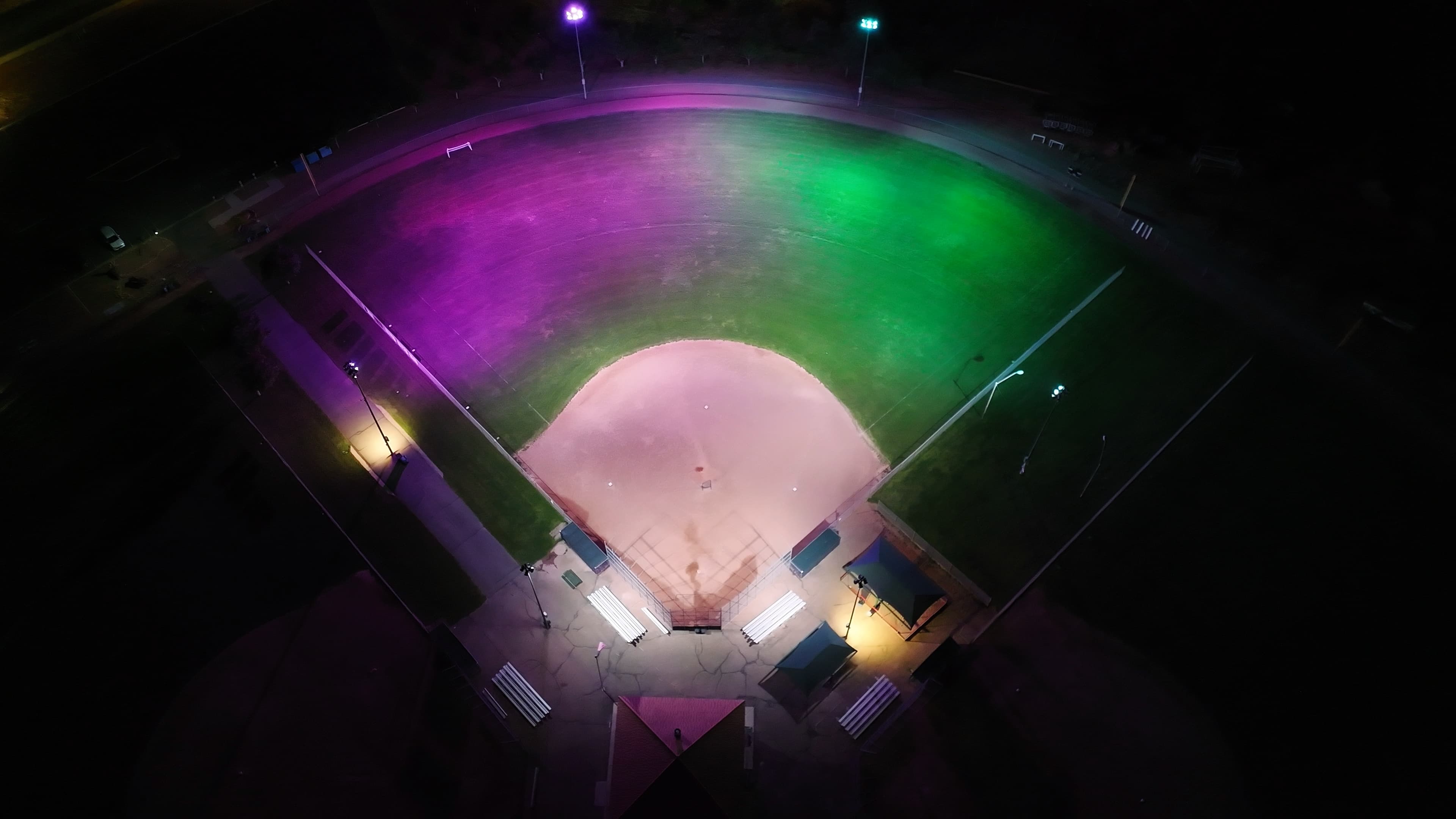
Why Baseball Lighting Deserves More Than a One-Size-Fits-All Approach
Baseball is one of the most lighting-sensitive sports in existence. The geometry of the game — a batter tracking a 90+ mph pitch, an outfielder reading a fly ball against the night sky, an infielder reacting to a grounder in the gap — demands illumination that is uniform, glare-controlled, and precisely engineered for the dimensions of the field. Generic industrial fixtures simply don't meet that bar.
In Tempe and across the Greater Phoenix metro, baseball and softball are woven into the community's identity. From youth recreation leagues at neighborhood parks to collegiate competition at Arizona State University's Packard Stadium, and the spring training culture that draws professional organizations to the region each year, this market has a deep and active relationship with the sport. Facilities serving that culture — whether in Tempe, Mesa, Chandler, Scottsdale, or Gilbert — deserve lighting that reflects that seriousness of purpose.
The good news: advances in LED sports lighting technology have made it possible for facilities of nearly any budget to achieve professional-grade performance. Understanding what's changed — and what to look for in a lighting partner — is the starting point for any successful project.
The State of LED Sports Lighting: What Facility Managers Should Know
The transition from metal halide and high-pressure sodium (HPS) systems to LED has fundamentally changed what's achievable on a baseball or softball field. Here's what the industry has learned over the last decade of widespread adoption:
Uniformity is the most important metric — and the hardest to achieve. Light levels (measured in foot-candles) matter, but uniformity ratios matter more. A field with bright spots near the poles and dark zones in the gaps creates visual inconsistency that affects player performance and safety. High-quality LED designs use photometric modeling to optimize pole placement, fixture aiming angles, and beam distribution before a single product ships to the job site. When evaluating a lighting proposal, ask to see the photometric study — not just the average foot-candle count.
Glare control is non-negotiable. Poorly aimed or under-shielded fixtures create glare that directly impairs a batter's ability to pick up the ball out of the pitcher's hand — one of the most critical visual tasks in all of sport. LED systems engineered for baseball feature precision optics and backlight/uplight/glare (BUG) ratings that protect players, not just satisfy code minimums.
Energy savings are real — and substantial. LED sports lighting systems typically consume 50–70% less energy than the metal halide systems they replace, depending on fixture age and wattage. For a community park field running 20–25 hours of night use per week across a season, those savings translate into meaningful reductions in operating costs year over year. In Arizona's climate, where summer temperatures drive utility rates and demand charges upward, efficient lighting has an outsized financial impact.
Controls multiply the value. Modern LED sports lighting systems are designed to integrate with advanced controls — scheduling, dimming, occupancy sensing, and remote management platforms. A facility can run warm-up at 50% intensity, ramp to full competition output at game time, and shut down automatically at curfew. For multi-field complexes in communities like Tempe, Mesa, or Chandler, centralized controls can dramatically reduce after-hours energy waste and simplify staff operations.
Proven in the Field: Lessons from Page, AZ
One of the most instructive proof points for baseball LED lighting in Arizona comes from a project VOSS completed in Page, AZ — a community where reliable, high-performance athletic lighting directly serves local youth and recreational programs.
That project demonstrated how a disciplined engineering approach — combining proper photometric design, appropriate fixture selection, and careful installation — can deliver a playing environment that meets governing body standards while meaningfully reducing operating costs for the facility owner. It also reinforced a critical lesson: the long-term value of a sports lighting project is determined not just by the fixture, but by the expertise of the team that designs and installs it.
For public parks and recreation departments across Arizona — including those managing fields in Tempe, Guadalupe, Ahwatukee, or communities throughout Maricopa County — that combination of design precision and installation experience is what separates a successful project from a costly retrofit a few years down the road.
What Baseball and Softball Facilities in the Greater Phoenix Area Should Be Evaluating Now
Tempe's position within the Greater Phoenix metro places its facilities in a competitive landscape. Athletic programs at the youth, high school, collegiate, and amateur levels all compete for players, families, and community support. Facility quality — including lighting — is increasingly a differentiator for scheduling, recruitment, and revenue generation through tournaments and rental programs.
Here are the key questions facility managers and operations leaders in the region should be asking:
- Is your current system meeting league or governing body standards? Little League, NFHS, NCAA, and professional organizations each publish specific foot-candle and uniformity requirements by field classification. Many older systems no longer comply — and non-compliance creates liability exposure.
- What is your actual cost per hour of operation? Most facility managers don't have a precise figure. A lighting audit — which VOSS can provide — will establish baseline energy consumption and project the savings available through an LED upgrade.
- Are your controls working for you or against you? Lights left on after games, manual switching that depends on staff availability, and no remote monitoring capability are all common cost leaks at community and collegiate facilities.
- Does your system support broadcast or high-speed video? As more youth and amateur leagues incorporate video replay and livestreaming, flicker-free LED systems with high Color Rendering Index (CRI) values become increasingly important. Arizona's active spring training and collegiate baseball community has set a high bar for what players and families expect.
For facilities exploring upgrades, it's also worth noting that Arizona state agencies and qualifying public organizations can access VOSS' products and services through approved state contracts, streamlining procurement and ensuring compliance. Eligible organizations may also leverage cooperative purchasing programs — including Sourcewell, TIPS, BuyBoard, Omnia Partners, and others — to simplify the contracting process and access pre-negotiated pricing.
How VOSS Approaches Baseball Lighting Projects
VOSS is a full-service commercial electrical contractor with 85+ years of experience and a national footprint that includes a dedicated Phoenix branch serving Tempe and the surrounding Greater Phoenix metro. Our approach to baseball and softball lighting projects reflects the complexity the sport demands:
- Photometric design first — Every project begins with a detailed lighting study that maps foot-candle levels, uniformity ratios, and glare metrics across every zone of the field before equipment is specified
- Standards compliance built in — We design to the applicable standards for your field classification and intended use, whether that's recreational youth play or competitive intercollegiate competition
- Controls integration — Where appropriate, we incorporate scheduling, dimming, and remote management systems that reduce operating costs and simplify facility management
- Full project delivery — From design through installation, commissioning, and post-installation support, VOSS manages the entire project — no hand-offs to unfamiliar subcontractors
- Energy incentive navigation — Our team is experienced in identifying and capturing available utility rebates and incentives to improve project economics
This breadth of capability is why facility managers at parks, school districts, municipalities, and private complexes throughout Tempe, Mesa, Scottsdale, Chandler, Gilbert, and the broader Maricopa County region turn to VOSS for sports lighting projects of every scale.
For readers exploring related topics, our Latest Lighting section covers adjacent subjects including LED gymnasium lighting solutions, pickleball and tennis court lighting, outdoor LED lighting upgrades, and energy audits and rebate navigation for businesses — all relevant for multi-use athletic and recreation facilities.
Service Availability
While VOSS offers a comprehensive suite of national services, specific capabilities may vary by location. Please contact your local branch to confirm the current availability of specific services, technology solutions, or contracting capabilities in your immediate market.
Start the Conversation with VOSS in Phoenix
If your facility is evaluating a baseball or softball lighting upgrade — or if you're simply trying to understand what your options are — the best first step is a conversation with an expert who knows your market, your climate, and the standards your facility needs to meet.
Our Phoenix branch serves Tempe and communities throughout the Greater Phoenix metro, including Mesa, Chandler, Scottsdale, Gilbert, Glendale, Peoria, and beyond.
VOSS — Phoenix Branch
Phone: (602) 340-9500 Toll-Free: (800) 788-8676
We'd welcome the opportunity to review your current system, walk through your project goals, and share how other facilities in Arizona have successfully navigated the upgrade process. Reach out to our Phoenix team to schedule a consultation.