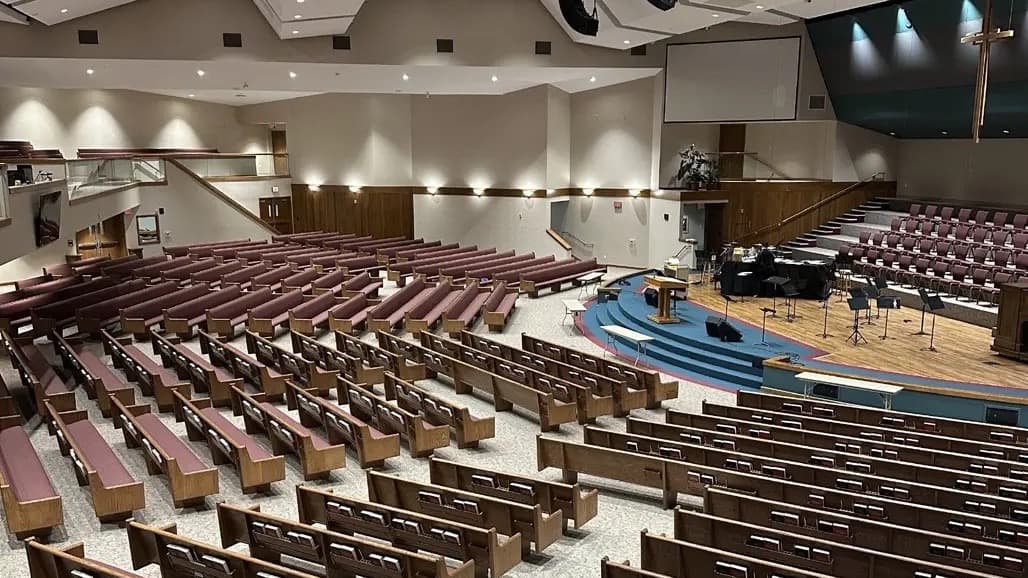
Why Sanctuary Lighting Is a Growing Priority for Scottsdale Churches
Across Scottsdale and the broader Greater Phoenix metro — from Tempe and Chandler to Mesa, Gilbert, and Paradise Valley — churches of every size and denomination are confronting the same operational reality: the lighting systems that served their sanctuaries for decades are struggling to keep pace with modern expectations.
Arizona's intense sun and heat accelerate the degradation of traditional incandescent, halogen, and fluorescent fixtures, shortening bulb life and increasing the frequency of replacements. Add the region's rising electricity rates, the growing prevalence of church livestreaming ministries, and the challenge of maintaining fixtures mounted 30, 40, or even 60 feet overhead, and sanctuary lighting has become one of the most pressing facility management challenges for houses of worship in the Valley.
This isn't just a maintenance issue — it's a worship experience issue. Poor or inconsistent lighting affects how congregants engage during services, how a sanctuary reads on camera, and how safely people move through the space during evening events. Understanding the scope of the problem is the first step toward solving it strategically.
The Most Common Sanctuary Lighting Problems Facility Managers Face
Church facility directors and maintenance supervisors in Scottsdale frequently encounter a predictable set of lighting challenges. Recognizing these patterns can help your team prioritize where to act first.
Frequent Bulb Failures in Hard-to-Reach Fixtures High-ceiling sanctuaries — whether in a traditional cathedral design or a modern worship hall — require lifts or scaffolding every time a bulb fails. In Arizona's heat, conventional bulbs burn out faster than manufacturer estimates suggest, meaning some facilities are scheduling costly aerial access work multiple times per year. Every lift rental, every crew hour spent on a ladder, and every service disruption adds up.
Aging Ballasts and Dimming Incompatibility Fluorescent and older HID systems rely on ballasts that wear out over time. As ballasts age, you see the telltale symptoms: flickering lights mid-service, slow startups, inconsistent color output, and dimmers that no longer respond predictably. Replacing ballasts one at a time is an expensive, reactive strategy — and it delays the inevitable.
Uneven Light Levels Across the Sanctuary Many older lighting designs create "hot spots" near the altar or stage while leaving pews, aisles, and balconies underlit. This creates safety concerns, particularly for older congregants navigating the space during evening services. It also presents a significant challenge for churches that broadcast services online, where uneven illumination translates directly to poor video quality.
Rising Energy Costs Arizona Public Service (APS) and Salt River Project (SRP) customers across the Valley have seen energy costs rise steadily in recent years. For a large sanctuary running traditional lighting for multiple services per week, plus rehearsals, community events, and rental bookings, electricity consumption from the lighting system alone can be substantial.
How LED Retrofits Address These Challenges — And What the Transition Looks Like
LED technology has matured significantly, and today's commercial-grade LED fixtures are purpose-built for the demanding requirements of sanctuary environments. Here's what a thoughtful retrofit strategy addresses:
Extended Lamp Life Dramatically Reduces Maintenance Frequency High-quality LED lamps are rated for 50,000 hours or more — compared to 1,000–2,000 hours for incandescent bulbs and 8,000–15,000 hours for fluorescent. For a church sanctuary, this can mean going from multiple aerial access events per year to one scheduled inspection every several years. That shift in maintenance rhythm is transformative for small facilities teams.
Dimming Control and Scene Programming Modern LED systems are fully compatible with dimming controls and can be programmed to support multiple preset "scenes" — bright and even for Sunday morning services, warmer and more intimate for evening worship, and optimized contrast settings for livestream production. This flexibility is particularly valuable for multi-use sanctuaries that also host weddings, concerts, and community events.
Improved Color Rendering for Worship and Video LED fixtures with high Color Rendering Index (CRI) ratings — typically 90+ for sanctuary-grade products — reproduce colors more accurately and faithfully. Choir robes, banners, floral arrangements, and the faces of speakers all look truer under high-CRI light. For churches streaming services to congregants at home or broadcasting to online audiences, this improvement in visual quality is immediately noticeable.
Energy Efficiency Gains LED fixtures typically consume 50–75% less energy than the incandescent and halogen systems they replace, and meaningfully less than fluorescent as well. For Scottsdale congregations served by APS or SRP, this translates to real reductions in monthly utility bills — savings that can be redirected toward ministry programs, building maintenance, or capital reserves.
Low-Disruption Installation A professionally managed retrofit is designed around your church's schedule, not the contractor's convenience. Work can be staged across off-peak hours, weekday windows, and planned breaks in the worship calendar to avoid disrupting Sunday services, Wednesday programs, or seasonal events. Historic sanctuaries with architectural constraints — ornate ceilings, plaster details, custom fixtures — require additional planning, but experienced contractors know how to work within those parameters without compromising the building's character.
What Scottsdale-Area Faith Communities Should Know Before Starting a Project
Whether your congregation is in the Scottsdale Airpark corridor, South Scottsdale near the Tempe border, or in the newer growth communities along the Loop 101 in North Scottsdale, a few planning considerations apply universally.
Audit Before You Commit A lighting audit should precede any purchasing or installation decision. The audit documents your current fixture inventory, wattage, hours of operation, and control system compatibility. It gives your team — and any vendor you work with — a factual baseline from which to calculate projected savings, identify the highest-priority replacements, and phase the work intelligently if budget requires it.
Understand Your Utility Rebate Opportunities Both APS and SRP offer commercial lighting rebate programs that can meaningfully offset the cost of a qualifying LED retrofit. Navigating rebate applications, documentation requirements, and pre-approval processes takes expertise, but the payoff is worth it. Facilities that skip this step often leave significant incentive money unclaimed. VOSS' article on energy audits, incentives, and rebate navigation covers this topic in depth and is worth reviewing alongside this one.
Plan for the Control System, Not Just the Fixtures One of the most common missteps in sanctuary lighting upgrades is selecting LED fixtures without fully planning the control system. Will you want dimming? Scene presets? Integration with your AV or livestream setup? Occupancy sensing for ancillary spaces like fellowship halls and offices? Answering these questions upfront ensures the system you install today can grow with your congregation's needs.
Consider the Full Facility, Not Just the Sanctuary The sanctuary is typically the highest-impact space, but it's rarely the only opportunity. Lobbies, fellowship halls, classrooms, restrooms, parking lots, and exterior walkways all benefit from LED upgrades — and addressing them together in a phased plan is more cost-effective than treating each as a separate project. Our related articles on parking lot and outdoor LED lighting upgrades and energy-efficient church lighting upgrades explore these adjacent opportunities.
A Note for Public and Nonprofit Organizations on Procurement
For faith-based organizations, nonprofits, and any public-sector facilities in the Greater Phoenix area exploring lighting upgrades, cooperative purchasing programs can simplify procurement and ensure competitive pricing without a lengthy bidding process. VOSS participates in several cooperative purchasing vehicles relevant to Arizona organizations, including AEPA, BuyBoard, TIPS, Sourcewell, Omnia Partners, PACE, and the Houston Church COOP — the last of which is designed specifically for houses of worship.
Additionally, VOSS holds an approved state contract in Arizona, making it straightforward for state agencies and qualifying entities to access our products and services in compliance with procurement requirements.
For church business administrators and finance committees navigating the approval process for a lighting project, these programs can significantly reduce procurement friction and accelerate project timelines.
Service Availability
While VOSS offers a comprehensive suite of national services, specific capabilities may vary by location. Please contact your local branch to confirm the current availability of specific services, technology solutions, or contracting capabilities in your immediate market.
Connect with VOSS in Scottsdale and the Greater Phoenix Area
VOSS serves houses of worship throughout Scottsdale, Phoenix, Tempe, Mesa, Chandler, Gilbert, Peoria, Glendale, Surprise, and communities across the Greater Phoenix metro. Our Phoenix branch team understands the unique demands of Arizona facilities — from the heat load challenges that affect fixture selection to the utility programs available through APS and SRP.
If your sanctuary is experiencing flickering lights, frequent bulb failures, rising energy bills, or simply hasn't had a lighting review in the past several years, we'd welcome the opportunity to walk through the space with you and share what we're seeing across similar facilities in the Valley.
VOSS — Phoenix Branch
Phone: (602) 340-9500 Toll-Free: (800) 788-8676
Reach out to schedule a no-obligation lighting consultation. We'll bring the expertise — you bring the questions.