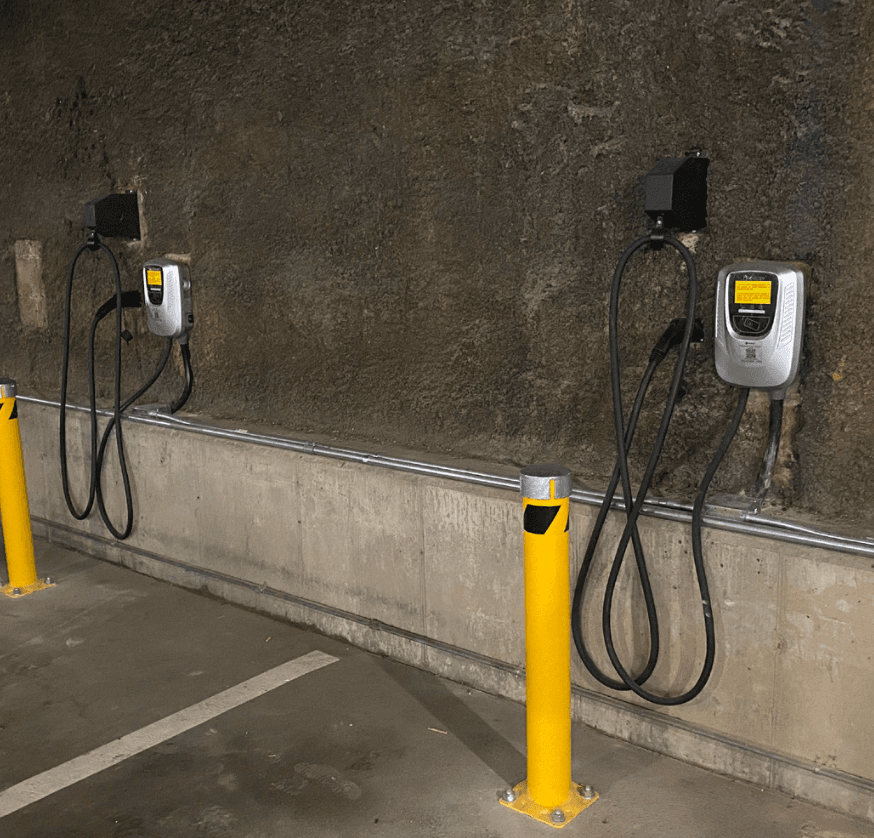
Why Mesa and Greater Phoenix Are at the Center of the Commercial EV Charging Conversation
Arizona is one of the top EV adoption states in the nation, and the Greater Phoenix metro — including Mesa, Tempe, Chandler, Gilbert, Scottsdale, and the East Valley communities — is leading that charge. With Mesa's population surpassing 517,000 and continuing to grow, the city is home to a dense mix of corporate campuses, healthcare facilities, retail centers, industrial parks, multifamily developments, and municipal properties — all of which are now grappling with the same question: when and how do we add EV charging infrastructure?
The answer is no longer a distant planning item. EV registrations in Arizona have accelerated sharply, and employers, property managers, and public agencies across the Phoenix metro are fielding requests for workplace charging from employees and tenants alike. Meanwhile, developers are watching as EV-ready infrastructure becomes a differentiating amenity — not a bonus, but an expectation — in commercial real estate leasing decisions.
Understanding how commercial EV charging station installation works, what incentives are available right now, and what separates a well-executed deployment from a costly misstep is the starting point for every organization considering this investment.
The Incentive Landscape: Federal Credits, Utility Programs, and the 2026 Deadline
For facilities managers, CFOs, and sustainability leaders evaluating the business case for commercial EV charging, the financial picture is more favorable today than it may ever be again. A combination of federal tax credits, utility rebate programs, and state-level incentives has created a compelling window — but several of these programs carry hard expiration dates that demand attention now.
Federal 30C Alternative Fuel Vehicle Refueling Property Credit
The most significant incentive currently available is the federal 30C tax credit, which covers 30% of qualified commercial EV charger equipment and installation costs, with maximums of up to $100,000 per charging unit. In designated low-income or rural areas, the credit can be even more substantial. Critically, property must be placed in service by June 30, 2026 to qualify. That means equipment must be operational — not simply ordered or in progress — before that deadline.
For a finance leader evaluating payback period and total cost of ownership, this single credit can meaningfully compress the timeline for ROI. An organization deploying multiple Level 2 commercial chargers across a parking facility in Mesa could offset a substantial portion of upfront capital costs — but only if installation is completed in time.
Inflation Reduction Act and NEVI Program Context
The broader Inflation Reduction Act (IRA) extended and expanded EV infrastructure incentives through a suite of programs. The National Electric Vehicle Infrastructure (NEVI) program also continues to fund corridor and public charging buildout, with downstream effects on employer and commercial property charging demand — as more drivers rely on EVs for daily commutes and fleet operations, the infrastructure expectation at workplaces and retail destinations rises accordingly.
Arizona Utility Rebate Programs
Organizations in Mesa and the surrounding East Valley should also engage directly with their utility provider regarding available rebate and incentive programs for commercial EVSE (Electric Vehicle Supply Equipment) installation. Utility programs in the Arizona market have historically offered both equipment rebates and demand charge management support — critical considerations given that high-power EV charging can affect a facility's peak demand profile and utility billing structure. A qualified electrical contractor should assess not just the physical installation, but the load impact and potential rate optimization strategies before a single charger is energized.
For Public-Sector and Educational Organizations in Arizona
Mesa is home to a significant number of municipal facilities, school districts, and higher education institutions — including Mesa Community College and nearby Arizona State University's Polytechnic Campus in Mesa. Public agencies and educational institutions in Arizona can access VOSS products and services through an approved Arizona state contract, ensuring procurement compliance without the need for a separate competitive bid process. Eligible organizations may also leverage cooperative purchasing programs including Sourcewell, TIPS, BuyBoard, Omnia Partners, AEPA, and others — streamlining the path from decision to deployment.
What Commercial EV Charging Installation Actually Involves
One of the most common misconceptions among facility managers and property owners is that installing EV chargers is simply a matter of mounting hardware and running a cable. In reality, a well-executed commercial EV charging deployment requires a coordinated sequence of technical, logistical, and regulatory steps — and skipping any one of them creates downstream problems.
Electrical Capacity Assessment
Before any charger is specified or ordered, a licensed electrical contractor must evaluate whether the existing service infrastructure can support the load. A single Level 2 commercial charger typically draws 7.2 to 19.2 kW. A fleet charging installation or a multi-port public charging array can demand significantly more. In many older commercial buildings across Mesa, Tempe, and Chandler, service panel upgrades, transformer coordination with the utility, and circuit capacity work are necessary prerequisites — and these factors directly affect project cost, timeline, and incentive eligibility.
Site Design and Charger Selection
Level 2 EVSE (typically 208–240V AC) is the most common solution for employee parking, workplace charging, multifamily properties, and retail destinations where vehicles dwell for one or more hours. DC Fast Chargers (DCFC) are appropriate for high-throughput public access locations, fleet return depots, or hospitality properties where rapid turnaround is a priority. The right solution depends on the use case, available electrical capacity, projected utilization, and budget — not simply on what a charger manufacturer's sales sheet recommends.
Permitting, Utility Coordination, and Compliance
Commercial EV charger installations in Mesa and across Maricopa County require permits, inspections, and in many cases direct coordination with the utility for service upgrades or new service connections. A contractor unfamiliar with local authority having jurisdiction (AHJ) requirements, or without established utility relationships, can add weeks or months to a project timeline. VOSS manages this coordination as part of every engagement — one point of accountability from design through final inspection.
Smart Energy Management Integration
Modern commercial EVSE platforms offer networked management capabilities: remote monitoring, usage reporting, access control, billing functionality, and demand response integration. For a CFO exploring revenue generation through tenant or visitor charging, or for a sustainability manager tracking carbon reduction and ESG metrics, the software layer of an EV charging deployment is as important as the hardware. Load management features can also help facilities avoid demand charge spikes — a meaningful operational consideration in Arizona's hot climate, where HVAC and EV charging loads can compound during peak hours.
What This Means for Different Stakeholders in Mesa-Area Organizations
For Facilities Managers: The complexity of a commercial EV charging deployment — capacity assessment, utility coordination, permitting, installation, and commissioning — argues strongly for a single turnkey contractor rather than a piecemeal approach. The risk of misalignment between an EV charger vendor, a general contractor, and an electrical sub is real, and it tends to surface at the worst possible moment: during inspection, or when a load calculation error requires expensive rework. A full-service electrical contractor with deep experience in commercial infrastructure can own the entire scope.
For Finance Leaders: The 30C federal tax credit expiration on June 30, 2026 is a hard deadline with real dollar consequences. Organizations that have been deferring EV charging decisions should be modeling the incentive-adjusted cost of action now versus the full cost of deployment after the credit expires. Beyond the initial incentive, the question of whether charging infrastructure can generate ancillary revenue — through tenant billing, visitor charging fees, or utility demand response participation — is worth exploring as part of a complete financial model.
For Sustainability and ESG Managers: Commercial EV charging infrastructure is a recognized contributor to LEED certification and a reportable element of many ESG frameworks. In the Greater Phoenix market, where corporate sustainability commitments are increasingly visible among major employers in technology, healthcare, and advanced manufacturing, EV charging is both a genuine emissions reduction tool and a stakeholder-facing demonstration of intent. The ability to report measurable data — charging sessions, kWh delivered, estimated CO2 avoided — depends on deploying networked, data-capable EVSE from the outset.
For Commercial Real Estate Developers and Property Managers: Across Mesa, Gilbert, Chandler, and Scottsdale, tenant expectations around EV charging amenities have shifted. What was a differentiator two years ago is becoming table stakes in Class A commercial leasing. Arizona's building code landscape is also evolving, with EV-ready conduit requirements increasingly embedded in new construction standards. For owners managing portfolio-wide deployments across multiple properties in the East Valley, a contractor with national reach, standardized processes, and scalable delivery capability is a meaningful advantage over local-only providers.
Connecting EV Charging to the Broader Energy and Lighting Picture
Commercial EV charging doesn't exist in isolation — it's one component of a broader energy infrastructure strategy. Organizations that have already undertaken LED lighting upgrades, lighting controls modernization, or energy audits are well positioned to layer EV charging into an integrated approach to energy management. Related topics explored in this content series — including LED lighting rebates, energy audits and incentive navigation, and unlocking profitability through EV chargers — offer useful context for organizations thinking holistically about their facilities' energy future.
The intersection of lighting efficiency, demand management, and EV charging load is particularly relevant in Arizona, where summer cooling loads and EV charging schedules can create peak demand challenges that smart controls and load management strategies can help mitigate.
Service Availability
While VOSS offers a comprehensive suite of national services, specific capabilities may vary by location. Please contact your local branch to confirm the current availability of specific services, technology solutions, or contracting capabilities in your immediate market.
Talk to VOSS About Your Mesa or East Valley EV Charging Project
VOSS has been a trusted electrical contractor for over 85 years, and our Phoenix branch serves commercial, industrial, institutional, and municipal customers throughout Mesa, Tempe, Chandler, Gilbert, Scottsdale, Glendale, and the broader Greater Phoenix metro. Whether you are in the early planning stages of an EV charging deployment, actively evaluating rebate programs before the 2026 deadline, or managing a portfolio-wide rollout across multiple East Valley properties, we welcome the conversation.
Our team can assess your facility's electrical capacity, identify applicable incentive programs, manage permitting and utility coordination, and deliver a completed, code-compliant installation — with the expertise and accountability of a single, experienced partner.
VOSS — Phoenix Branch
Phone: (602) 340-9500 Toll-Free: (800) 788-8676