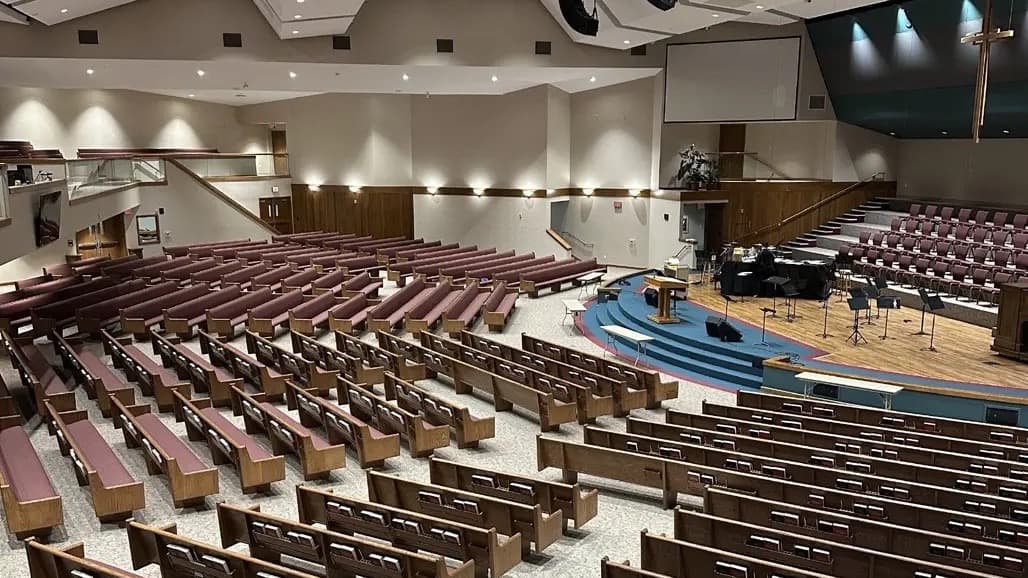
Why Sanctuary Lighting Is a Growing Challenge for Mesa-Area Churches
Mesa is one of the fastest-growing cities in the United States — and with a population exceeding 517,000, it is home to a remarkably active and diverse faith community. From historic congregations near downtown Mesa and the Mesa Arizona Temple corridor to newer and rapidly expanding campuses in Queen Creek, Gilbert, Chandler, and Tempe, houses of worship across the East Valley are navigating an increasingly complex facility management landscape.
Sanctuary lighting sits at the heart of that challenge. Church buildings are among the most demanding lighting environments of any facility type: high vaulted ceilings, irregular worship schedules, dramatic shifts in natural light from Arizona's intense sun, and the dual demand for both reverent atmosphere and high-quality illumination for video streaming or recorded services. In Arizona's desert climate, heat generated by outdated incandescent, halogen, and fluorescent fixtures compounds already-high cooling loads — driving up energy costs year-round and accelerating fixture degradation.
For facility managers and maintenance teams already stretched thin, these are not minor inconveniences. They are operational and financial pressures that compound over time.
The Common Pain Points Facility Managers Recognize Immediately
If you manage a church facility in Mesa or the surrounding East Valley communities, several challenges likely feel familiar:
- Frequent bulb burnout in high-ceiling fixtures. Traditional light sources in sanctuaries with 20-, 30-, or even 40-foot ceilings require lifts or scaffolding for every replacement — a costly, time-consuming, and safety-intensive process that can disrupt the sanctuary several times a year.
- Flickering, dimming, or color inconsistency. Aging ballasts and dimmers that were never designed to work together create unpredictable lighting behavior. This is especially problematic during services, livestreams, or special events where consistent illumination is essential.
- Uneven light distribution. Sanctuaries designed decades ago often have lighting plans that leave certain areas — choir lofts, altars, side aisles, or overflow seating — poorly lit, creating safety concerns and an uncomfortable experience for congregants.
- Rising energy costs. Arizona's summer heat means churches already run HVAC systems at full capacity for much of the year. Fixtures that generate significant heat add to that load, creating a dual energy burden that LED technology directly addresses.
- Difficulty managing atmosphere and ambiance. Many congregations want the ability to transition lighting from quiet pre-service settings to full-brightness worship to a softer environment for prayer or memorial services — a capability that older systems simply cannot deliver without significant effort.
Understanding these pain points is the first step. The more important question is: what does a thoughtful, well-executed lighting upgrade actually look like for a house of worship?
LED Retrofits and Lighting Controls: What Modern Church Upgrades Involve
The conversation around church sanctuary lighting has evolved considerably in recent years. What was once a straightforward bulb-swap decision is now a more nuanced discussion involving fixture selection, dimming compatibility, color temperature, control systems, and long-term maintenance planning.
LED technology is now the clear standard for sanctuary environments. Modern LED fixtures designed for high-ceiling applications offer lamp lives of 50,000 hours or more — dramatically reducing the frequency of access lifts, minimizing disruption to the facility, and lowering the total cost of ownership over a decade or longer. For Arizona churches dealing with relentless summer heat, the reduction in fixture heat output is not just an energy benefit; it is a meaningful reduction in HVAC demand during peak cooling months.
Dimming and control systems have become equally important to the conversation. Today's lighting control platforms allow facility managers to create and recall preset "scenes" — a full-brightness setting for Sunday services, a warmer and dimmer setting for midweek prayer, a high-contrast configuration for livestreamed events. These presets can be triggered with a single button press or even automated on a schedule, reducing the operational burden on staff and volunteers who manage the space week to week.
Color temperature selection is a subtler but important design consideration. Sanctuary environments benefit from careful tuning of color temperature — warmer tones (2700K–3000K) tend to support a reverent, contemplative atmosphere, while cooler temperatures (3500K–4000K) improve visibility for reading and detail work. Some facilities are now implementing tunable white fixtures that allow color temperature to shift dynamically throughout a service.
Fixture access and installation planning is a practical consideration that separates knowledgeable contractors from generalist electricians. Historic sanctuaries, particularly those in older Mesa neighborhoods or landmark congregations, may have architectural features — ornate plasterwork, stained glass, original woodwork — that require careful coordination. Even newer facilities often have acoustic or structural ceiling components that complicate standard retrofit approaches. Experience with these environments matters.
Broader Trends Shaping Church Lighting Investment in the Phoenix Region
Several converging trends are making this a particularly relevant moment for East Valley congregations to evaluate their lighting infrastructure:
Fluorescent phase-outs are accelerating. Regulatory action at the federal level has significantly curtailed the production and availability of linear fluorescent lamps, and many states are moving further. Facilities that still rely on T8 or T12 fluorescent fixtures should be planning proactively — waiting for fixtures to fail creates operational emergencies and limits options. For context, our article on Fluorescent Tube Bans and LED Lighting Rebates provides a useful overview of the regulatory landscape and what it means for facility planning.
Utility rebate programs can offset upgrade costs meaning for qualifying facilities. Arizona utility providers periodically offer incentive programs for commercial and institutional customers making energy-efficiency improvements, including lighting. Navigating these programs — understanding eligibility, documentation requirements, and application timing — is a skill set in itself. Our article on Energy Audits, Incentives, and Rebate Navigation for Businesses explores this topic in depth.
Cooperative purchasing programs offer a practical path for eligible organizations. Churches and faith-based organizations that participate in cooperative purchasing networks can access pre-negotiated pricing and streamlined procurement — reducing administrative burden and often improving project economics. VOSS is an approved vendor through several nationally recognized cooperative purchasing programs, including Houston Church COOP, Sourcewell, TIPS, BuyBoard, and others. For Arizona public institutions and agencies, VOSS also holds an approved Arizona state contract that supports compliant procurement for government and education-adjacent facilities.
Livestreaming and media ministry have raised the bar for illumination quality. The growth of online worship — accelerated significantly during recent years — has made lighting a media production concern, not just a facilities concern. Cameras are far less forgiving than the human eye when it comes to uneven light levels, hot spots, or color rendering inconsistency. Churches investing in media capability without addressing their lighting often find that new cameras and equipment fail to deliver the video quality they expected.
What to Look for in a Church Lighting Partner
Selecting the right contractor for a sanctuary lighting project involves more than comparing bids. Facility managers and church administrators in Mesa should consider a few key criteria:
- Experience in ecclesiastical and institutional environments. Church sanctuaries are not standard commercial spaces. A contractor who has worked across a range of house-of-worship facility types — large multisite campuses, historic single-building congregations, school-affiliated chapels — will bring practical knowledge that generalists simply cannot replicate.
- Turnkey capability. The most effective upgrades coordinate electrical work, fixture procurement, controls programming, and commissioning under a single point of accountability. Fragmented project management leads to delays and gaps.
- Low-disruption scheduling. Sanctuaries are in active use throughout the week. A skilled contractor plans installations around worship schedules, special events, and community programming to minimize the impact on the congregation.
- Long-term support. Lighting systems require periodic maintenance, firmware updates for controls platforms, and occasional reconfiguration as a congregation's needs evolve. A contractor with a local branch presence — not just a project team that moves on — provides continuity.
- Energy and rebate expertise. The best partners do not just install fixtures; they help clients understand what incentive programs may apply, what documentation to gather, and how to position a project for maximum financial benefit.
Service Availability
While VOSS offers a comprehensive suite of national services, specific capabilities may vary by location. Please contact your local branch to confirm the current availability of specific services, technology solutions, or contracting capabilities in your immediate market.
Start the Conversation with VOSS in Mesa and the Greater Phoenix Area
VOSS has served commercial and institutional clients across the United States for more than 85 years. Our Phoenix branch supports houses of worship, facilities managers, and operations leaders throughout Mesa, Gilbert, Chandler, Tempe, Scottsdale, Glendale, and the broader East Valley with lighting maintenance, LED retrofit projects, and controls integration.
If your congregation is navigating aging fixtures, rising energy costs, or the need for better control over your sanctuary environment, we welcome the opportunity to talk through what a well-executed upgrade could look like for your specific facility — without obligation.
VOSS Lighting — Phoenix Branch
Phone: (602) 340-9500 Toll-Free: (800) 788-8676
Reach out to schedule a facility consultation with our local team. We are here to help you make a well-informed decision for your congregation and your facility budget.