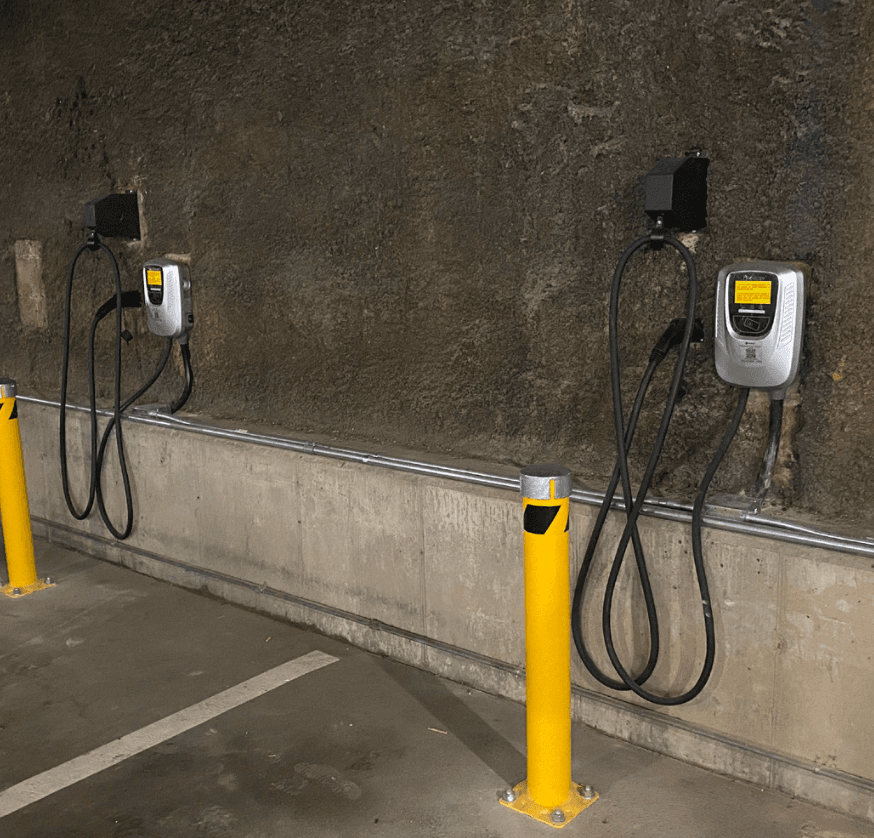
Why Greater Phoenix Is at the Center of the Commercial EV Charging Conversation
Arizona consistently ranks among the top states for electric vehicle adoption, and the Greater Phoenix metro — encompassing Scottsdale, Tempe, Mesa, Chandler, Gilbert, Glendale, Peoria, and the East Valley — reflects that momentum in a big way. The region's year-round driving climate, expanding highway network, and rapid commercial development make it a natural fit for accelerating EV infrastructure investment.
For facility managers, property owners, and business leaders across Maricopa County, this isn't a distant trend — it's an operational reality arriving in parking lots and fleet yards right now. Employees are showing up in EVs. Tenants are requesting chargers as a lease condition. Fleet operators are piloting electric vehicles ahead of broader transitions. The question is no longer whether to invest in commercial EV charging infrastructure — it's how to do it efficiently, cost-effectively, and with the right partner.
This article explores the key decisions, incentive opportunities, and strategic considerations that Phoenix-area organizations need to understand before moving forward.
The Rebate Window Is Open — But It Won't Stay That Way
One of the most underappreciated aspects of commercial EV charging station installation right now is the scale of available financial incentives — and the urgency attached to some of the most significant ones.
Federal 30C Tax Credit (Alternative Fuel Vehicle Refueling Property Credit) Under current law, commercial EV chargers placed in service by June 30, 2026 may qualify for a federal tax credit worth 30% of qualified equipment and installation costs, with maximums up to $100,000 per unit. For properties located in designated low-income or rural areas, the credit can be even more substantial. This deadline is real — equipment must be operational, not merely ordered or contracted, to qualify.
IRA and NEVI Program Funding The Inflation Reduction Act and the National Electric Vehicle Infrastructure (NEVI) program continue to shape the funding landscape for commercial and public EV charging. Arizona has been active in deploying NEVI corridor funding, which creates downstream opportunities for businesses along key routes and in high-traffic commercial zones throughout the Phoenix metro.
Utility Incentive Programs Arizona Public Service (APS) and Salt River Project (SRP) — the two dominant utilities serving the Greater Phoenix area — have both offered demand management and commercial EV charging incentive programs. These programs can offset equipment costs, installation costs, or both, and they frequently change in scope and availability. Working with an experienced commercial EVSE installation contractor who monitors these programs in real time is essential to capturing maximum value.
For CFOs and Finance Leaders: The combination of federal tax credits, utility rebates, and potential revenue from tenant or public billing can meaningfully compress the payback period on a commercial EV charging investment. Total cost of ownership analysis should account for all three — and a qualified electrical contractor can help model realistic scenarios based on your specific site and usage profile.
What Commercial EV Charging Installation Actually Involves
Many organizations underestimate the scope of a commercial EV charging project — and that gap between expectation and reality is where projects get delayed, over-budget, or non-compliant. Here is what a well-executed installation actually requires:
Electrical Capacity Assessment
Before a single charger is mounted, a licensed electrical contractor must evaluate your facility's existing electrical infrastructure. Level 2 commercial EV chargers typically require a dedicated 208–240V circuit, and a facility deploying multiple chargers may need panel upgrades, transformer upgrades, or service entrance modifications. In high-demand deployments — such as fleet charging or DC fast charger (DCFC) installations — this becomes even more complex.
Phoenix-area facilities, particularly older commercial buildings in downtown Phoenix, Tempe, and Scottsdale's central core, often face capacity constraints that require utility coordination before installation can begin. Newer developments in Chandler, Gilbert, and North Scottsdale may have more headroom but still require engineering review.
Permitting and Utility Coordination
Commercial EV charging installations in Arizona require permits from the local authority having jurisdiction (AHJ), and utility interconnection coordination is frequently required when service upgrades are involved. Navigating this process without experienced contractor support is a common source of costly delays.
Equipment Selection and Site Design
The right equipment strategy depends on use case. Employee parking and workplace EV charging solutions typically call for Level 2 EVSE (Electric Vehicle Supply Equipment), while retail, hospitality, or public-access applications may justify DC fast chargers. Multifamily properties in communities like Tempe, Mesa, and Glendale present their own design challenges around shared electrical systems and metering.
Smart charging technology — which enables load management, remote monitoring, and usage reporting — is increasingly standard in commercial deployments and essential for organizations with sustainability reporting obligations.
Installation, Commissioning, and Ongoing Support
A turnkey commercial electric vehicle charging contractor manages everything from trench work and conduit installation to panel work, charger mounting, network commissioning, and final inspection. Ongoing support — including preventive maintenance and uptime monitoring — protects the investment and ensures reliable access for users.
EV Charging as a Strategic Asset: Perspectives by Stakeholder
The business case for commercial EV charging infrastructure in Greater Phoenix looks different depending on your role — but the underlying logic is consistent: this is infrastructure that serves your people, your tenants, your fleet, and your organization's long-term positioning.
Facilities Directors and Operations Leaders are often most focused on implementation: How disruptive is the installation? How long does it take? What happens if a charger goes down? Working with a single, accountable contractor who manages permitting, utility coordination, and installation eliminates the finger-pointing that comes from multi-vendor projects and gives facilities teams a clear point of contact from site assessment through commissioning.
CFOs and Finance Leaders in the Phoenix metro — across industries from healthcare and higher education to commercial real estate and logistics — are increasingly treating EV charging not just as a cost center but as a potential revenue source. Networked chargers allow businesses and property owners to charge tenants or the public for electricity consumed, creating an ongoing revenue stream that offsets operating costs. Combined with available federal and utility incentives, the financial math is more compelling than many assume.
Sustainability and ESG Managers at Arizona-based corporations, universities, and institutional organizations will find that commercial EV charging infrastructure contributes to multiple sustainability frameworks — including LEED credit eligibility, Scope 3 emissions reduction, and corporate carbon commitments. As ESG reporting requirements intensify, having documented, quantifiable EV charging deployment data becomes a reporting asset, not just an amenity.
Commercial Real Estate Developers and Property Managers across the Phoenix metro are navigating a shifting tenant landscape in which EV charging amenity is moving from differentiator to baseline expectation. In competitive submarkets like Scottsdale's Camelback Corridor, Tempe's Mill Avenue district, and Chandler's Price Road Corridor, properties without EV charging infrastructure are increasingly at a disadvantage. Arizona's evolving building code landscape — including EV-ready requirements for new construction — means that proactive developers are getting ahead of mandates rather than reacting to them.
The Broader Energy Picture: EV Charging Within a Smarter Facility Strategy
Commercial EV charging doesn't exist in isolation. For organizations already exploring LED lighting upgrades, energy audits, solar, or controls and automation — topics covered elsewhere in VOSS's Latest Lighting resource series — EV charging infrastructure is a natural extension of a broader energy optimization strategy.
Facilities that have already upgraded to LED lighting and implemented smart controls, for example, may have freed up electrical capacity that makes EV charging deployment more straightforward. Energy audits can identify whether capacity upgrades needed for EV charging can be bundled with other efficiency improvements for greater cost efficiency. For Phoenix-area businesses interested in the intersection of solar and EV charging, the region's exceptional solar resource makes the combination particularly compelling — and VOSS's broader energy and technology capabilities can support an integrated approach.
Organizations interested in LED lighting rebates available in the Phoenix market, or in understanding the full landscape of utility incentive programs in Arizona, may find VOSS's related resources on LED lighting rebates and energy audits and incentive navigation useful context for framing a comprehensive energy investment strategy.
A Note for Public-Sector and Institutional Organizations in Arizona
For Arizona state agencies, municipalities, school districts, universities, and other public-sector organizations across Maricopa County and the broader Phoenix metro, procurement compliance is a real consideration in any capital project.
VOSS holds an approved state contract in Arizona, allowing eligible state agencies to access VOSS products and services through a compliant, pre-negotiated vehicle. Additionally, VOSS participates in a broad range of cooperative purchasing programs — including Sourcewell, BuyBoard, TIPS, AEPA, Omnia Partners, PACE, and others — that are available to qualifying public agencies, school districts, and nonprofit organizations. These programs simplify procurement, ensure compliance, and can accelerate project timelines by eliminating the need for a standalone bid process.
For public institutions in Phoenix, Tempe, Mesa, Scottsdale, and across Maricopa County exploring commercial EV charging station installation for government fleets, employee parking, or public-access charging, cooperative purchasing represents a practical and efficient path forward.
Service Availability
While VOSS offers a comprehensive suite of national services, specific capabilities may vary by location. Please contact your local branch to confirm the current availability of specific services, technology solutions, or contracting capabilities in your immediate market.
Talk with VOSS About Your Phoenix-Area EV Charging Project
The Greater Phoenix metro is moving fast on EV infrastructure — and the incentive window to maximize federal and utility rebates is narrowing. Whether you're evaluating a single-site installation in Scottsdale or a portfolio-wide deployment across the East Valley, VOSS brings the electrical expertise, utility relationships, and project management experience to help you move from planning to operational chargers efficiently and with confidence.
We invite facilities leaders, finance executives, sustainability managers, and property developers across Greater Phoenix to connect with our local team for a no-obligation conversation about your specific situation — your facility's electrical capacity, your rebate eligibility, and what a realistic installation timeline looks like.
VOSS — Phoenix Branch Phone: (602) 340-9500 Toll-Free: (800) 788-8676