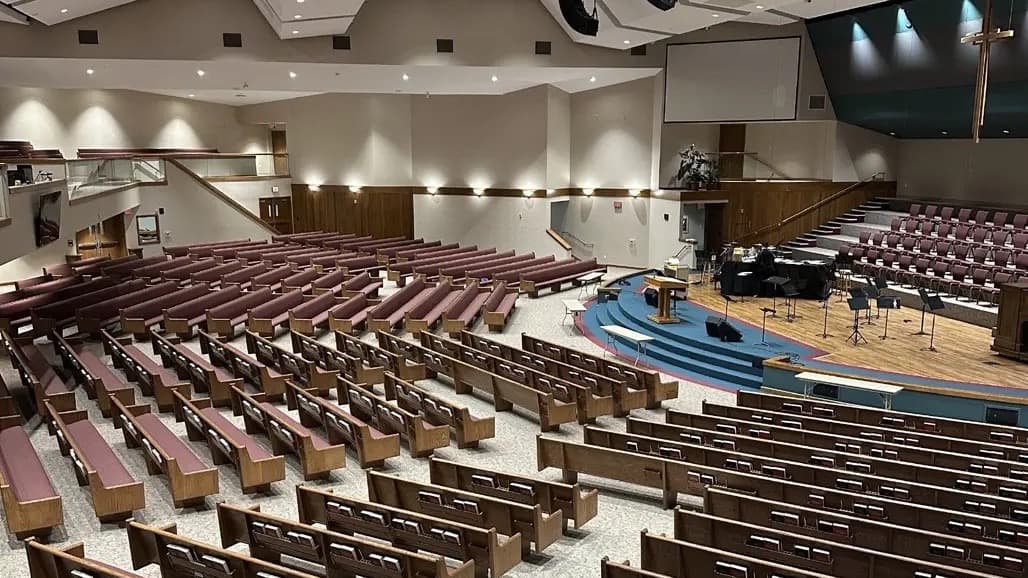
Why Sanctuary Lighting Is a Growing Priority for Phoenix-Area Churches
Greater Phoenix is home to one of the most active and fast-growing faith communities in the American Southwest. From large megachurch campuses in Scottsdale, Gilbert, and Chandler to historic congregations in downtown Phoenix and Tempe, and neighborhood houses of worship across Mesa, Glendale, Peoria, and Surprise — the region's churches span an enormous range of building ages, architectural styles, and facility complexities.
What many of these congregations share, however, is a common set of lighting challenges that quietly erode the worship experience and strain maintenance budgets year after year. Vaulted ceilings require lifts or scaffolding every time a bulb fails. Aging fluorescent or halogen systems produce uneven, unflattering light. Ballasts flicker and fail. And with Arizona's intense summer heat already pushing utility costs higher, inefficient lighting fixtures are an expense that no church finance committee can afford to overlook.
This article explores the trends, technologies, and practical considerations shaping how faith communities in Greater Phoenix are approaching sanctuary lighting today — and what facility managers and church leaders should know before planning their next upgrade.
The Hidden Cost of "Maintaining" Outdated Sanctuary Lighting
For many church facility managers, lighting maintenance is a constant, low-grade burden rather than a one-time project. The reality of managing incandescent, halogen, or older fluorescent fixtures in a sanctuary environment includes:
- Frequent relamping cycles — Traditional bulbs in elevated fixtures can fail multiple times per year, requiring lift equipment, labor time, and interruption to the facility's schedule
- Ballast failures and flickering — Aging ballast technology is one of the leading causes of service calls in commercial religious facilities; incompatible dimmers compound the problem
- Uneven illumination — Poor light distribution creates safety concerns for congregants navigating pews and aisles, and creates serious challenges for churches that livestream or record services — an increasingly common practice across the Phoenix metro
- Rising energy costs — Arizona Public Service (APS) and Salt River Project (SRP) serve the majority of churches across Maricopa County, and energy costs in the desert Southwest are particularly acute during summer months when cooling loads are already high; inefficient lighting adds meaningfully to that burden
The cumulative cost of these issues — labor, replacement parts, energy waste, and lost operational hours — often exceeds what a well-planned LED upgrade would cost over the same period. Yet many church leaders continue deferring action because the upfront scope feels uncertain. Understanding the full picture changes that calculus.
What Makes Church Sanctuary Lighting Uniquely Challenging
Not all commercial lighting upgrades are created equal. Church sanctuaries present a set of facility conditions that set them apart from office buildings, retail spaces, or warehouses — and that require a contractor with specific experience to navigate effectively.
Architectural complexity is one of the defining challenges. Many sanctuaries — whether they're century-old stone churches in central Phoenix or contemporary worship centers in the East Valley suburbs — feature soaring ceilings, decorative trusses, stained glass, and custom millwork. Fixture placement, beam angles, and color temperature choices all have a significant impact on how the space feels during worship, and a one-size-fits-all approach can result in lighting that is technically functional but aesthetically wrong for the environment.
Access and scheduling constraints add another layer of difficulty. Unlike an office building where work can happen after hours on weekdays, churches often have services, programs, or community events scheduled throughout the week. Coordinating access for lift equipment — especially in sanctuaries with permanent seating or fixed pews — requires careful project planning and a contractor who understands the operational rhythms of a faith community.
Historic or preservation considerations apply to a meaningful subset of Phoenix-area churches, particularly older congregations in neighborhoods like the historic districts of central Phoenix or surrounding communities like Tempe and Chandler. Fixture selection and installation methods must respect existing architectural fabric, sometimes requiring custom solutions rather than off-the-shelf retrofits.
Dimming and control integration is an increasingly important consideration as more churches invest in multimedia production environments. Lighting that flickers during video recording, or that cannot be smoothly controlled during worship transitions, undermines significant investments in audiovisual technology.
The LED Upgrade Opportunity: What Phoenix Churches Should Know
The transition to LED technology in sanctuary environments has matured considerably over the past decade. Early LED products were sometimes criticized for producing harsh, cold light that felt inappropriate for worship spaces. Today's commercial-grade LED fixtures offer a wide range of color temperatures, excellent color rendering, and smooth dimming performance — making them genuinely well-suited to the sanctuary environment.
For Greater Phoenix churches, the case for LED upgrades rests on several practical pillars:
- Dramatically reduced relamping frequency — Quality LED fixtures are rated for tens of thousands of hours of operation, meaning the scaffolding-and-bulb-replacement cycle that burdens many facility teams can be reduced from several times per year to once per decade or longer
- Energy savings in a high-cost utility environment — Both APS and SRP offer rebate programs for commercial customers who upgrade to qualifying LED fixtures; these incentives can meaningfully offset project costs and accelerate payback timelines
- Improved light quality for worship and streaming — Modern LED systems can be tuned for color temperature and intensity, providing consistent, flattering illumination that serves both in-person congregants and remote viewers equally well
- Simplified controls — Contemporary LED dimming systems are compatible with a range of control platforms, allowing worship teams to set scenes for different service formats — spoken word, music, candlelight, full-audience — with a single preset
It is worth noting that Arizona utility rebate programs and eligibility requirements evolve regularly. Working with an experienced contractor who actively tracks these programs is an important part of maximizing project value. VOSS' article on Maximize ROI with Commercial LED Lighting Rebates in Dallas, TX explores the rebate landscape in detail, and our Energy Audits, Incentives, and Rebate Navigation for Businesses resource provides a broader framework applicable to Arizona markets as well.
Considerations for Church Facility Managers Planning an Upgrade
Whether your congregation is in Scottsdale, Queen Creek, Avondale, or the Ahwatukee Foothills, the planning process for a sanctuary lighting upgrade follows a similar set of best practices. Facility managers and church leadership teams should consider the following as they evaluate the path forward:
Start with a lighting assessment. Before specifying any products, a qualified contractor should evaluate existing fixture types, wiring conditions, dimmer compatibility, and light levels throughout the sanctuary. This assessment forms the foundation of a specification that will actually perform as expected.
Define the use cases. A sanctuary used exclusively for traditional worship has different lighting needs than a multipurpose space that hosts concerts, theatrical productions, community events, or televised services. Getting specific about how the space is used — and how that may evolve — shapes every subsequent decision.
Plan around the congregation's schedule. The best upgrade plans account for blackout dates (major holidays, special services, community events) and identify windows when access is feasible. Experienced church lighting contractors build these constraints into their project timelines from the start.
Evaluate the full system, not just the fixtures. Ballasts, wiring, control systems, and emergency egress lighting are all part of the sanctuary's electrical ecosystem. A fixture-only swap that ignores aging wiring or incompatible controls may solve one problem while creating others.
Consider ongoing maintenance from day one. The best LED systems are not just energy-efficient — they are also designed for long-term maintainability. Fixture selection, access planning, and control system documentation all contribute to a facility that is genuinely easier to manage for years after installation.
A Note for Public-Sector and Eligible Organizations
While sanctuary lighting upgrades are most commonly associated with private faith communities, Greater Phoenix is also home to publicly funded facilities — including chapels and assembly spaces in government buildings, universities, and community institutions — where the same lighting challenges apply. Arizona state agencies can access VOSS' products and services through approved state contracts, ensuring full compliance and competitive value.
Eligible organizations across the region may also access VOSS' services through a range of cooperative purchasing programs, including Sourcewell, TIPS, BuyBoard, AEPA, Omnia Partners, PACE, Nebraska ESU Co-Op, and the Houston Church COOP — a particularly relevant option for faith communities exploring group purchasing benefits. These programs streamline procurement and reduce administrative burden without sacrificing quality or service.
Service Availability
While VOSS offers a comprehensive suite of national services, specific capabilities may vary by location. Please contact your local branch to confirm the current availability of specific services, technology solutions, or contracting capabilities in your immediate market.
Connect With VOSS in Greater Phoenix
VOSS has been a trusted partner for commercial and institutional facilities across the United States for more than 85 years. Our Phoenix branch team works with churches and faith communities throughout Maricopa County — including Phoenix, Scottsdale, Tempe, Mesa, Gilbert, Chandler, Glendale, Peoria, Surprise, Avondale, and surrounding communities — to plan and execute lighting upgrades that respect both the architecture and the mission of each facility.
If your congregation is dealing with persistent maintenance challenges, rising energy costs, or a sanctuary lighting system that simply isn't serving your worship experience as well as it should, we invite you to start a conversation with our local team. There is no obligation — just a practical discussion about what's possible for your facility.
VOSS — Phoenix Branch
Phone: (602) 340-9500 Toll-Free: (800) 788-8676