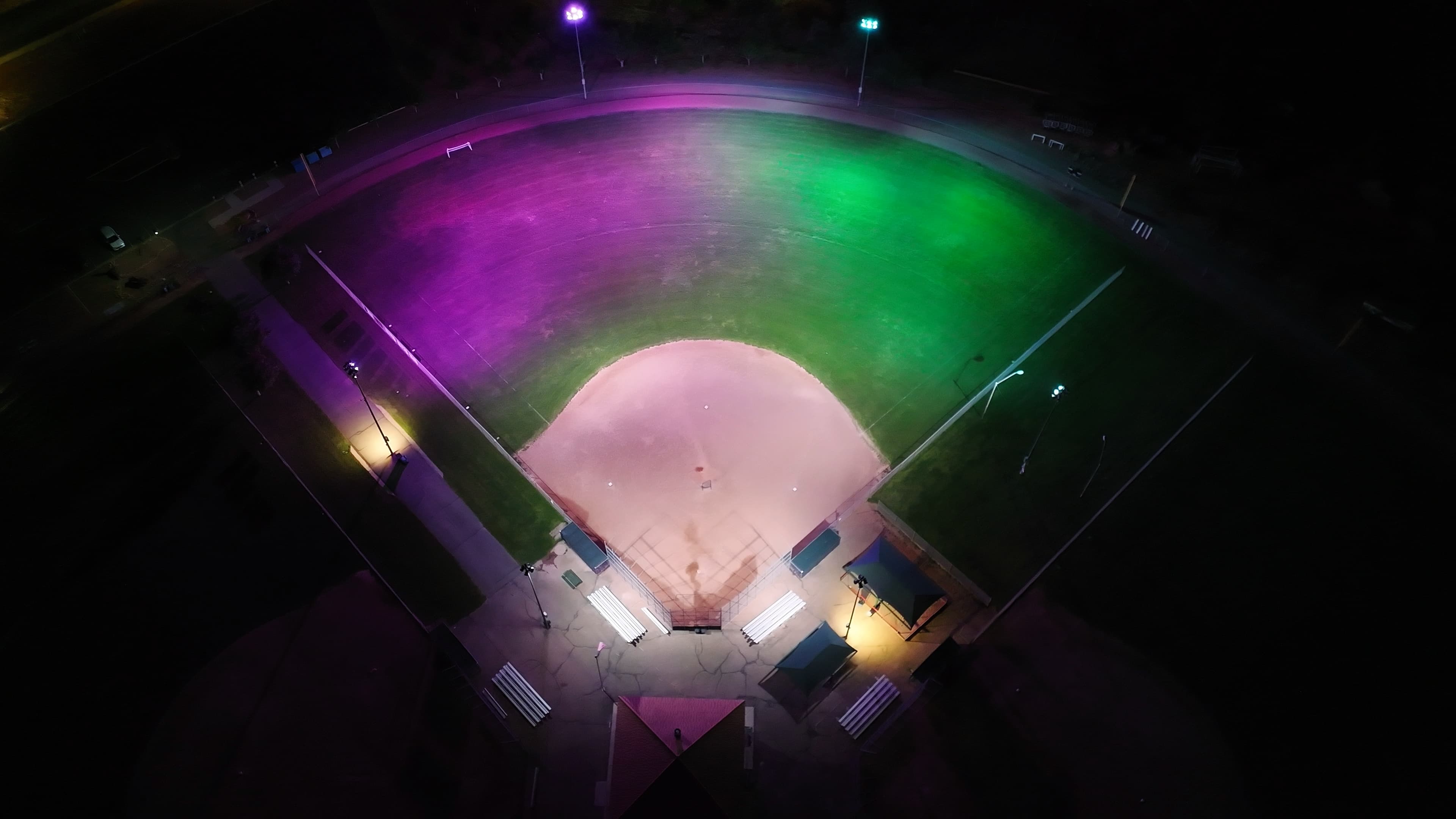
Why Baseball Lighting Matters More Than You Think in the Phoenix Market
Greater Phoenix is one of the most active baseball markets in the country — and not just because of the Arizona Diamondbacks or the region's role as home to Cactus League Spring Training. Across communities like Mesa, Scottsdale, Chandler, Gilbert, Tempe, Peoria, Surprise, and Glendale, thousands of youth, recreational, high school, and collegiate players take the field every week. Many of those games are played under the lights.
That makes baseball field lighting a legitimate infrastructure issue for parks and recreation departments, school districts, municipal governments, and private athletic facility operators across the Valley. Yet a significant number of fields in the Phoenix metro area still rely on aging metal halide or high-pressure sodium (HPS) systems — technology that was state-of-the-art decades ago but is now expensive to operate, difficult to maintain, and poorly matched to the visual demands of modern baseball.
The good news: LED sports lighting has matured dramatically, and the case for upgrading is stronger than ever — both financially and operationally. As a trusted partner for facilities across Arizona, VOSS is well-positioned to help Phoenix-area organizations understand what a thoughtful, well-engineered lighting upgrade actually looks like.
What Makes Baseball Lighting Uniquely Challenging
Not all sports lighting is created equal, and baseball presents some of the most complex illumination challenges in the athletic world. Understanding those challenges is the first step toward making smart decisions about your facility.
The geometry of the game demands precision. Unlike a rectangular basketball court or soccer pitch, a baseball diamond features multiple distinct zones — the infield, outfield, warning track, foul territory, and bullpens — each with different visual requirements. A batter tracking a fastball from the pitcher's mound needs consistent, glare-free light at a very specific angle. An outfielder ranging back toward the warning track needs uniform coverage that doesn't drop off near the fence. Poor pole placement or inadequate photometric design can create shadows that compromise safety and player performance.
Glare control is non-negotiable. For batters, outfielders tracking fly balls, and even umpires making close calls, visual glare is more than a nuisance — it's a safety hazard. Professional-grade LED systems address this through precision optics and targeted beam control that direct light where it's needed without spilling it where it isn't.
Broadcast and streaming standards are evolving. High school and collegiate programs across the Phoenix area are increasingly live-streaming games, and even youth leagues often use video for player development. LED systems optimized for high-definition broadcast environments — with appropriate color rendering and minimal flicker — are becoming a baseline expectation, not a luxury upgrade.
Energy costs in Arizona are real. With APS and SRP serving the bulk of the Valley, facility operators know that running traditional sports lighting systems during evening hours adds up quickly. Legacy metal halide systems are notoriously energy-intensive, and their long warm-up and cool-down cycles mean you're paying for energy even before and after games.
The LED Advantage: What Facilities in the Valley Are Gaining
Organizations across Greater Phoenix that have upgraded to LED sports lighting consistently report benefits across several dimensions. Here's what the technology actually delivers — and why it matters in the Arizona context.
Dramatic energy reduction. LED fixtures consume significantly less electricity than equivalent metal halide systems — in many retrofit applications, the reduction is substantial enough to generate meaningful payback through energy savings alone. For parks and recreation departments managing multiple fields across Chandler, Gilbert, or Surprise, that math scales quickly.
Uniform, consistent light quality. Modern LED systems for baseball produce consistent footcandle levels across the entire playing surface, reducing the hot spots and dark zones that characterize older systems. Photometric modeling — performed before a single pole is set — ensures the design meets or exceeds Illuminating Engineering Society (IES) recommendations and any applicable league standards, whether that's Little League International, NFHS, or NCAA specifications.
Instant-on performance. LED lighting reaches full output immediately — no warm-up period, no waiting 15 minutes after a rain delay for the lights to restrike. In a market where evening monsoon activity can disrupt summer game schedules, this is a practical operational advantage.
Dramatically reduced maintenance burden. Metal halide lamps degrade over time and require regular replacement — a significant expense for any multi-field complex. LED fixtures carry rated lifespans that are dramatically longer, reducing both lamp replacement costs and the labor associated with accessing poles and fixtures. For municipal parks departments stretched thin, that's not a minor consideration.
Controls integration for smarter operations. Contemporary sports lighting systems can integrate with sophisticated controls platforms — enabling scheduled on/off cycles, remote monitoring, dimming for practice versus game scenarios, and even occupancy-based automation. This kind of integration connects naturally to the broader conversation around smart facility management that many Phoenix-area organizations are already having.
Proof in Practice: The Page, AZ Baseball Project
One of the most instructive examples of what a well-executed baseball LED lighting project looks like comes from Page, Arizona — a community in northern Arizona where VOSS delivered a complete LED lighting solution for a baseball facility.
The Page project illustrates a principle that applies equally to a youth park in Peoria or a high school complex in Mesa: the quality of the outcome depends almost entirely on the quality of the engineering that precedes installation. Proper photometric design, appropriate pole height and placement, fixture selection matched to the specific field dimensions, and careful attention to glare control are what separate a genuinely high-performing system from one that merely checks a box.
At Page, VOSS managed the project from initial design through installation and commissioning — the same full-service approach the team brings to every baseball and softball lighting engagement, regardless of scale.
Considerations for Different Facility Types Across Greater Phoenix
The Phoenix metro area encompasses an enormous range of baseball and softball facilities, each with its own operational context, budget constraints, and stakeholder priorities. A few observations worth considering:
Municipal parks and recreation departments in communities like Tempe, Goodyear, Avondale, and Maricopa often manage multiple fields within a single complex. A coordinated multi-field upgrade — designed holistically rather than field by field — typically delivers better outcomes and stronger financial returns. Public agencies in Arizona may also have access to VOSS' state contract, streamlining the procurement process and ensuring compliance with public purchasing requirements. Eligible organizations can also explore cooperative purchasing programs including Sourcewell, BuyBoard, TIPS, AEPA, Omnia Partners, and PACE as efficient pathways to project execution.
School districts across the East Valley, West Valley, and throughout the metro are facing the same energy cost pressures as other public entities. High school baseball and softball programs that rely on evening game schedules particularly benefit from LED upgrades, both for the operational savings and for the improved player and spectator experience. VOSS' experience with educational facilities — and familiarity with Arizona's cooperative purchasing landscape — makes these conversations straightforward.
Private and semi-private athletic facilities, including training academies, travel ball complexes, and community sports organizations, often prioritize the player experience and the ability to accommodate broadcast or streaming production. These operators benefit from LED systems with high color rendering and flicker-free performance, paired with controls that allow flexible scheduling across multiple fields.
Collegiate and professional-level venues in the Phoenix area have their own performance benchmarks — often driven by governing body standards or broadcast partner requirements. At this level, photometric precision and controls sophistication are paramount.
How This Connects to the Broader Lighting Conversation
Baseball field lighting doesn't exist in isolation. Organizations evaluating a field lighting upgrade are often simultaneously thinking about parking lot and outdoor LED upgrades, energy audits and incentive navigation, or broader facility controls and smart systems initiatives. The VOSS Latest Lighting resource section addresses many of these adjacent topics — including LED outdoor lighting, energy-efficient upgrades, utility rebates in Arizona, and sports-specific solutions for pickleball, tennis, gymnasiums, and football stadiums — providing a useful framework for facilities thinking about their lighting infrastructure holistically rather than project by project.
Understanding available utility incentives — including programs available through Arizona utilities — can also meaningfully affect the financial picture of a field lighting upgrade. It's worth having that conversation early in the planning process.
Service Availability
While VOSS offers a comprehensive suite of national services, specific capabilities may vary by location. Please contact your local branch to confirm the current availability of specific services, technology solutions, or contracting capabilities in your immediate market.
Talk to VOSS About Your Phoenix-Area Baseball Facility
Whether you're managing a community park in Surprise, a high school complex in Chandler, a travel ball facility in Scottsdale, or a larger venue anywhere across the Valley, VOSS' Phoenix team is ready to have a straightforward, consultative conversation about what a well-engineered LED lighting upgrade could mean for your facility.
Our local team brings 85+ years of full-service electrical contracting expertise to every engagement — and the knowledge to navigate Arizona's procurement landscape, utility incentive programs, and sport-specific lighting standards.
VOSS — Phoenix Branch
Phone: (602) 340-9500 Toll-Free: (800) 788-8676
Reach out to start a conversation about your facility's lighting goals. There's no obligation — just a practical discussion about what's possible, what it takes, and what it costs to play ball under better light.