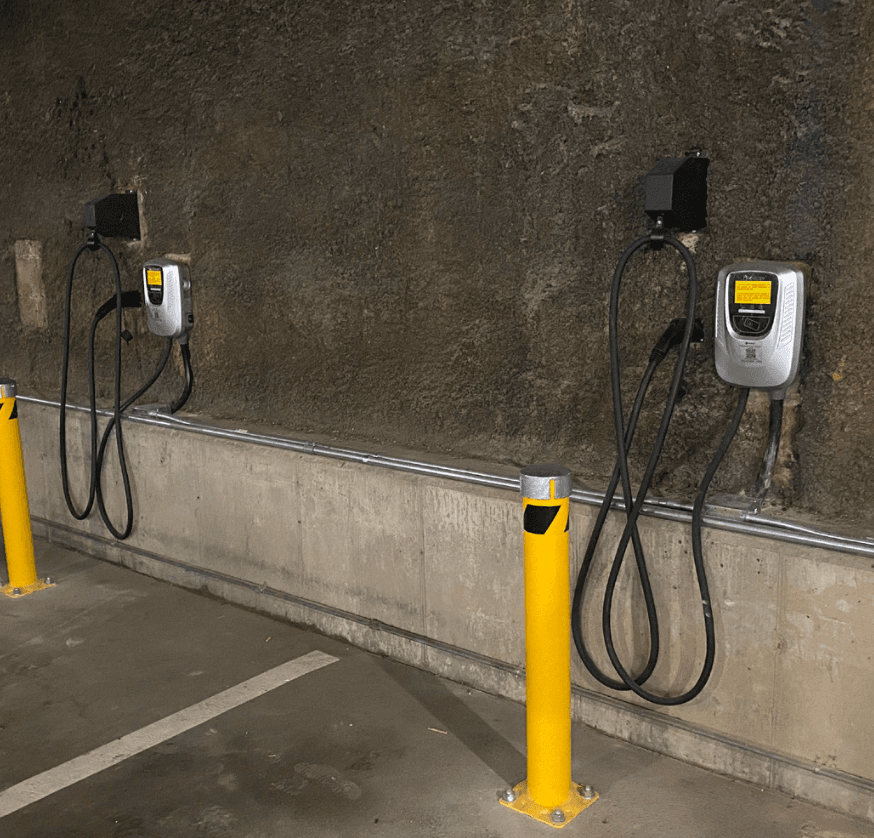
Why Commercial EV Charging Is a Priority for Chandler, AZ Businesses Right Now
Chandler is one of the fastest-growing cities in the United States — a 281,000-person innovation hub at the heart of Greater Phoenix's technology corridor. With a dense concentration of corporate campuses, advanced manufacturing facilities, retail centers, multifamily developments, and mixed-use projects stretching from Downtown Chandler through the Price Road Corridor and into neighboring Tempe, Gilbert, Mesa, and Scottsdale, the demand for workplace and commercial EV charging infrastructure has never been stronger.
Arizona is among the top states for EV adoption growth, and the vehicles are showing up in employee parking lots, retail destinations, and fleet yards across Maricopa County every day. For facility managers, finance leaders, sustainability directors, and commercial real estate professionals in the Chandler area, the question is no longer whether to install commercial EV charging stations — it's how to do it efficiently, cost-effectively, and at the right scale.
This article explores what decision-makers in the Greater Phoenix market need to understand about commercial electric vehicle charging infrastructure in 2024 and beyond: the incentive landscape, the planning considerations, the business case, and the path to a successful deployment.
The Incentive Window Is Real — and It Has a Deadline
One of the most important things finance leaders and business owners in Chandler should know right now: significant federal incentives for commercial EV charging are available, but they are time-sensitive.
The Federal 30C Alternative Fuel Vehicle Refueling Property Credit allows businesses to claim 30% of qualified equipment and installation costs for commercial EV chargers — with maximums up to $100,000 per item. Properties located in qualifying low-income or rural census tracts may be eligible for enhanced credit amounts. To qualify, the charging equipment must be placed in service by June 30, 2026. That deadline is closer than it appears when you factor in the typical timeline for electrical capacity assessment, design, permitting, utility coordination, and installation.
Beyond the federal 30C credit, Chandler businesses may also have access to:
- Arizona utility incentive programs — APS and SRP, the primary electric utilities serving Maricopa County, have offered demand response and EV infrastructure programs for commercial customers. Availability and amounts vary, so engaging a contractor early to identify current offerings is essential.
- State-level incentives and fleet programs — Arizona has historically supported clean transportation initiatives, and programs change frequently as federal infrastructure funding flows through state agencies.
- The federal NEVI program — while primarily targeted at corridor-level DC fast charging, the National Electric Vehicle Infrastructure program is shaping where public charging investment goes in Arizona, influencing where private investment makes the most strategic sense.
For CFOs and VP-level finance leaders evaluating EV charging ROI, the combination of the 30C credit, utility rebates, and the potential to generate ancillary revenue through fee-based charging for tenants or customers can meaningfully reduce payback periods. The key is identifying all available programs before the project design is finalized — not after.
What Facilities Managers in Greater Phoenix Need to Know About Planning and Execution
For a Director of Facilities or Operations Manager overseeing commercial properties in Chandler, Tempe, Gilbert, or Scottsdale, the complexity of a commercial EV charging project extends well beyond simply mounting a charger on a wall. A successful deployment requires:
Electrical Capacity Assessment Most commercial properties were not originally designed to support significant EV charging loads. Before any equipment is specified, a qualified electrical contractor must evaluate existing service capacity, panel availability, conduit routing, and whether a utility service upgrade is required. Skipping this step — or underestimating future demand — leads to costly redesigns and stranded infrastructure.
Load Management and Smart Controls For facilities with multiple chargers or high-demand tenants, intelligent load management systems can distribute available electrical capacity across chargers dynamically, maximizing throughput without triggering expensive demand charges on the utility bill. This is especially relevant for corporate campuses, large retail centers, and multifamily communities across the East Valley.
Permitting and Utility Coordination Commercial EVSE installation in Arizona requires permits, inspections, and — in cases involving service upgrades — coordination with APS or SRP. This process involves timelines, documentation, and utility-specific requirements that an experienced electrical contractor manages on behalf of the owner. Delays at this stage are one of the most common reasons projects miss incentive deadlines.
Scalability and Future-Proofing Installing conduit and panel capacity for future charger expansion during the initial build — sometimes called "EV-ready" or "make-ready" infrastructure — dramatically reduces the cost of adding chargers later. Facilities managers responsible for multi-site portfolios across Chandler, Mesa, Gilbert, and beyond should plan for phased deployment from day one.
A turnkey electrical contractor who manages assessment, design, permitting, utility coordination, installation, and post-installation support eliminates the hand-off risks that arise when these responsibilities are split across multiple vendors.
EV Charging as a Sustainability and ESG Asset in the Phoenix Market
For sustainability managers and ESG leaders at Chandler-area corporations and institutions, commercial EV charging infrastructure is no longer just an amenity — it is a measurable, reportable component of an organization's carbon reduction and environmental commitment strategy.
Key considerations for ESG-focused decision-makers include:
- Scope 3 emissions reduction — Supporting employee EV adoption through workplace charging directly reduces commute-related emissions in your organization's value chain, a metric increasingly scrutinized in ESG reporting frameworks.
- LEED credit eligibility — Commercial properties pursuing LEED certification can earn credits under the Transportation category for providing EV charging infrastructure. New construction and major renovation projects in Chandler's active development pipeline should assess this opportunity early in design.
- Green fleet transition support — Organizations managing vehicle fleets in the Greater Phoenix area are under growing pressure to electrify. Fleet EV charging station installation requires a different infrastructure approach than employee or public charging, with dedicated circuits, higher-amperage equipment, and often overnight charging cycles that can be optimized for off-peak utility rates.
- Stakeholder and investor reporting — Documented EV charging capacity and utilization data provides concrete, quantifiable evidence of environmental progress for annual sustainability reports and investor disclosures.
As Arizona continues to attract corporate headquarters, data centers, and advanced manufacturing operations — many with ambitious sustainability commitments — EV charging infrastructure is becoming a baseline expectation rather than a differentiator.
Commercial Real Estate: EV Charging as a Tenant Amenity and Property Value Driver
In one of the most active commercial real estate markets in the country, property owners and developers across Chandler, Tempe, Scottsdale, and the broader Maricopa County market are integrating EV charging into new and existing properties for competitive and compliance reasons alike.
Tenant Attraction and Retention Corporate tenants — particularly in the technology, financial services, and healthcare sectors that anchor much of Chandler's commercial base — are increasingly including EV charging availability in their facility requirements. Properties that offer Level 2 commercial EV chargers as a tenant amenity command stronger lease interest and reduced vacancy risk.
EV-Ready Building Mandates Arizona municipalities are progressively aligning with national building code trends that require new commercial construction and major renovations to include EV-ready conduit and panel capacity. Developers building in Chandler and across the East Valley should understand local ordinance requirements as part of project planning — not as an afterthought.
Portfolio-Wide Deployment Strategy For property management companies and REITs with holdings across multiple submarkets — from the Price Road Corridor to the Loop 101 and US-60 interchange areas — a consistent, scalable deployment strategy with a single accountable contractor simplifies procurement, ensures design consistency, and creates leverage for rebate identification across the portfolio.
It is worth noting that organizations in the public sector — municipalities, school districts, and state agencies — have additional procurement advantages in Arizona. VOSS holds an approved state contract in Arizona, and eligible organizations can also access VOSS services through cooperative purchasing programs including Sourcewell, BuyBoard, TIPS, Omnia Partners, AEPA, PACE, and others. This streamlines procurement and ensures compliance for government and education facilities investing in EV charging infrastructure.
How VOSS Approaches Commercial EV Charging in the Greater Phoenix Market
With 85+ years of commercial electrical experience and a local branch serving the Greater Phoenix area, VOSS brings a depth of expertise to commercial EV charging station installation that purpose-built EV companies often cannot match. Our foundation is commercial electrical contracting — which means we understand electrical infrastructure, utility relationships, permitting processes, and the realities of working in occupied commercial facilities.
Our approach to commercial EV charging projects in Chandler and across Maricopa County follows a structured process:
- Site Assessment and Electrical Capacity Review — We evaluate your existing electrical infrastructure, available panel capacity, utility service, and site conditions to determine the right solution for your current and future needs.
- Rebate and Incentive Identification — We identify all applicable federal, state, and utility incentive programs available for your specific project, and help you understand documentation and timing requirements to capture them.
- System Design and Equipment Specification — We design a system scaled to your current requirements with a clear path for future expansion, specifying commercial-grade EVSE equipment appropriate for your use case — whether employee parking, fleet charging, tenant amenity, or public access.
- Permitting and Utility Coordination — We manage the permit application, inspection scheduling, and utility coordination processes, keeping your project on schedule and your incentive eligibility intact.
- Installation and Commissioning — Our licensed electrical crews execute the installation with minimal disruption to daily operations, completing all required inspections and commissioning the system to manufacturer and utility specifications.
- Ongoing Support — We provide post-installation support to ensure your charging infrastructure continues to perform reliably as your fleet and facility needs evolve.
For readers exploring related topics, our content on EV Chargers: Unlocking Profitability for Businesses offers a deeper look at the revenue and ROI dynamics of commercial charging, and our Energy Audits, Incentives, and Rebate Navigation for Businesses article provides broader context on maximizing available incentive programs across energy infrastructure investments.
Service Availability
While VOSS offers a comprehensive suite of national services, specific capabilities may vary by location. Please contact your local branch to confirm the current availability of specific services, technology solutions, or contracting capabilities in your immediate market.
Talk to Our Phoenix Team About Your EV Charging Project
If you are evaluating commercial EV charging infrastructure for a property or portfolio in Chandler, Tempe, Gilbert, Mesa, Scottsdale, or anywhere in the Greater Phoenix area, our local team is ready to help you understand the options, identify available incentives, and develop a deployment plan that fits your timeline and budget.
The 30C federal tax credit deadline of June 30, 2026 means that projects initiated in 2025 need to move through the assessment, design, and permitting process with urgency. The earlier you engage, the more options you have.
VOSS — Phoenix Branch Phone: (602) 340-9500 Toll-Free: (800) 788-8676
Contact us to schedule a no-obligation consultation with our commercial EV charging specialists. We'll start with your facility's specific situation and help you build a path forward that's grounded in real numbers — not estimates.