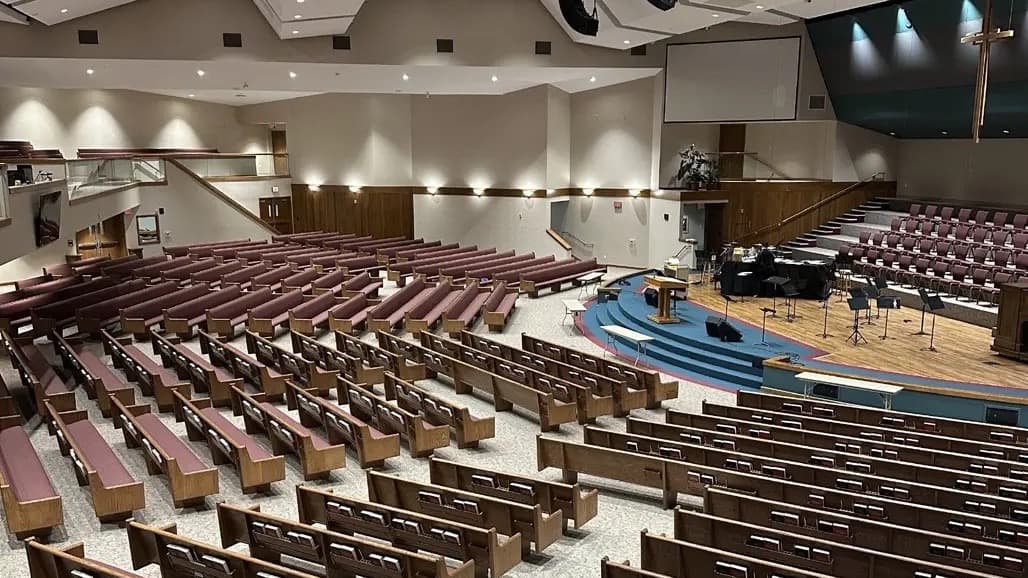
Why Sioux City-Area Churches Are Rethinking Sanctuary Lighting
Across the greater Siouxland region — from Sioux City's historic neighborhoods to surrounding communities like South Sioux City, NE, North Sioux City, SD, Sergeant Bluff, and Morningside — faith communities share a common challenge: sanctuaries built or last renovated decades ago are now home to lighting systems that simply weren't designed for today's demands.
The Midwest's wide temperature swings, from brutally cold winters along the Missouri River valley to humid summer heat, accelerate the wear on aging ballasts and incandescent or fluorescent fixtures. Add in the architectural complexity that defines many of Sioux City's historic church buildings — vaulted ceilings, decorative trusses, ornate nave structures — and routine bulb replacements become costly, time-consuming, and potentially disruptive to the congregation's weekly rhythm.
For facility managers and operations leaders overseeing these spaces, the status quo carries a real and growing cost: repeated lift or scaffolding rentals, escalating utility bills, and the quiet but persistent frustration of lighting that simply doesn't serve the worship environment the way it should.
The Common Pain Points Driving Upgrade Conversations
Church facility managers across northwestern Iowa and the tri-state Siouxland area consistently encounter a familiar set of lighting problems. Understanding them is the first step toward a smarter long-term strategy.
High-Access Fixture Maintenance Traditional incandescent, halogen, and fluorescent fixtures in elevated sanctuary spaces burn out far more frequently than modern LED alternatives. For a church with 40-foot vaulted ceilings, each service call requires renting equipment, coordinating contractors, and taking the sanctuary out of commission — sometimes multiple times per year.
Aging Ballasts and Flickering Systems Fluorescent fixtures rely on ballasts that degrade over time. Flickering lights, inconsistent warm-up times, and compatibility failures with modern dimmer systems are all symptoms of infrastructure that has exceeded its useful life. In a worship setting, these issues are not just maintenance problems — they're distractions that undermine the congregation's experience.
Uneven Light Distribution Older lighting layouts often create bright spots near the front of the sanctuary and dim, shadowy areas toward the rear — a problem that affects congregant visibility, safety, and increasingly, the quality of livestream video productions. As more Sioux City-area congregations invest in media and digital outreach, subpar sanctuary lighting becomes a ministry constraint, not just a facility issue.
Rising Energy Costs Legacy fixtures consume significantly more electricity than modern LED equivalents. For congregations operating on careful budgets — balancing facility costs against programming and community outreach — energy waste is a stewardship issue as much as an operational one.
How LED Retrofits Are Transforming Faith Spaces
The shift from legacy lighting to LED-based systems isn't simply about swapping one bulb for another. Done well, a sanctuary lighting upgrade is an opportunity to fundamentally improve how a space functions — and how it feels.
Modern LED retrofits designed for worship environments offer several meaningful advantages:
- Extended fixture life — Quality LED products are engineered to last 50,000 hours or more, dramatically reducing the frequency of high-access maintenance calls
- Tunable color temperatures — LED systems can be calibrated to deliver warm, inviting tones for traditional worship or cooler, more neutral light for contemporary services and media production
- Dimming compatibility — Purpose-built dimming systems allow sanctuary lighting to shift seamlessly from full-brightness Sunday services to intimate evening gatherings or special ceremonies
- Even light distribution — A properly designed LED layout eliminates the hot spots and dark zones common in aging systems, creating a consistent, comfortable visual environment throughout the entire space
- Reduced energy consumption — LED fixtures typically use a fraction of the wattage of fluorescent or incandescent equivalents, with savings that accumulate meaningfully over time
The project approach matters as much as the technology itself. Churches benefit most from partners who understand the unique logistical realities of faith facilities: services that cannot be rescheduled, congregants who expect consistency, and budgets that require phased or prioritized approaches.
Our work on the Lithia Springs Library Lighting Enhancement in Georgia illustrates the kind of methodical, outcomes-focused approach that translates directly to sanctuary environments. In that project, a space with no functional artificial lighting was transformed through careful fixture layout planning and the installation of 50 flat panel fixtures — resulting in even, bright illumination that met users' real-world needs across varying daylight conditions. The same principles of intentional layout, even distribution, and appropriate light levels apply directly to sanctuary renovation projects.
Planning a Sanctuary Lighting Project: What Facility Leaders Should Know
Whether you're managing a small community chapel in Sergeant Bluff or overseeing a large multisite congregation with facilities spread across the Sioux City metro, a successful lighting upgrade starts with honest assessment and careful planning. Here are the considerations that matter most.
Audit Before You Act A lighting audit establishes a baseline — current energy consumption, fixture condition, light levels by zone, and dimming system compatibility. This data drives smarter decisions and makes it easier to prioritize which elements of a sanctuary lighting system to address first.
Account for Historic and Architectural Constraints Many of Sioux City's established congregations worship in buildings with significant architectural character. Retrofit strategies must work within existing structural and aesthetic parameters — preserving the integrity of the space while modernizing its systems.
Think in Phases if Needed Capital budgets don't always accommodate full sanctuary overhauls in a single fiscal year. A phased approach — starting with the highest-impact or most maintenance-intensive fixtures — allows congregations to realize benefits incrementally while spreading costs responsibly.
Consider the Full System, Not Just Fixtures Lighting controls, dimming systems, and emergency egress lighting are all part of a complete sanctuary lighting ecosystem. Upgrading fixtures while leaving aging controls in place can limit the performance gains of new LED products. A holistic review ensures that the investment delivers its full potential.
Explore Cooperative Purchasing Programs For congregations affiliated with eligible organizations or participating in cooperative frameworks, programs such as Houston Church COOP, Nebraska ESU Co-Op, Sourcewell, BuyBoard, TIPS, AEPA, PACE, and Omnia Partners may offer access to pre-negotiated pricing on lighting products and installation services. These programs can streamline procurement and help facility managers move projects forward without extended bidding processes.
Why Churches Across the Siouxland Region Partner with VOSS
VOSS brings more than 85 years of commercial electrical and lighting experience to every project. Our Omaha branch serves faith communities across northwestern Iowa, northeastern Nebraska, and southeastern South Dakota — including Sioux City, Dakota City, Le Mars, Orange City, and the broader Missouri River corridor.
We understand that a sanctuary is not just a room — it's the heart of a congregation's life together. That shapes how we approach every lighting project: with respect for the space, sensitivity to the operational rhythms of the community, and a commitment to minimal disruption during installation.
Our team navigates the full project lifecycle — from initial lighting assessment and system design through fixture procurement, installation, and controls integration — so facility managers aren't left coordinating between multiple vendors. And because we work with congregations of all sizes and budgets, we're experienced at building practical, phased plans that match real-world constraints.
Service Availability
While VOSS offers a comprehensive suite of national services, specific capabilities may vary by location. Please contact your local branch to confirm the current availability of specific services, technology solutions, or contracting capabilities in your immediate market.
Talk with Our Omaha Team About Your Sanctuary
If your congregation is navigating flickering fixtures, aging ballasts, soaring energy costs, or simply wondering whether it's time to modernize your sanctuary lighting, we'd welcome the conversation. Our team can help you assess where you stand, understand your options, and build a plan that fits your timeline and budget.
VOSS — Omaha Branch Serving Sioux City, IA and the greater Siouxland region
(402) 328-2283
For more insight on related topics, explore our articles on Energy Efficient Church Lighting Upgrades, Commercial LED Lighting Fixtures, Fluorescent Tube Bans and LED Lighting Rebates, and Energy Audits, Incentives, and Rebate Navigation for Businesses — all available in the Latest Lighting section.