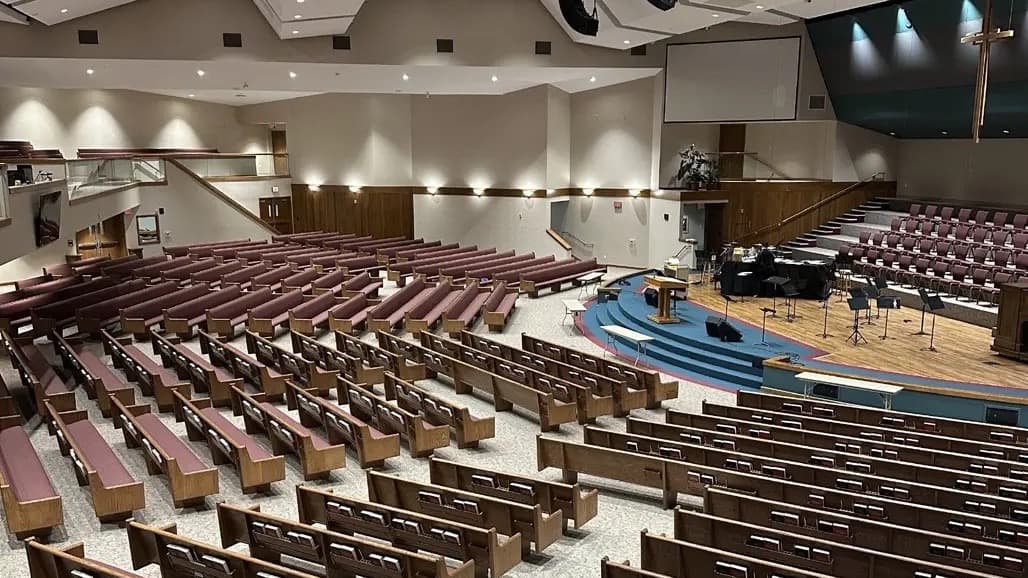
Why Sanctuary Lighting Deserves a Closer Look in Papillion and Greater Omaha
For faith communities across Papillion, La Vista, Bellevue, and greater Omaha, the sanctuary is far more than a meeting room — it is the spiritual and emotional center of congregational life. Yet for the facility managers and operations leaders responsible for keeping these spaces running, the sanctuary often presents some of the most persistent and costly maintenance headaches in the building.
Outdated incandescent, halogen, and fluorescent fixtures were never designed with modern demands in mind. Sanctuaries today must support traditional worship services, livestreamed or recorded programming, special events, and community gatherings — each requiring different lighting moods and intensities. When aging technology can no longer reliably deliver, both the congregation's experience and the facility team's workload suffer.
Across the region, we're seeing a meaningful shift. Churches in the Greater Omaha metro — from suburban Papillion and Gretna to established neighborhoods in Omaha's Midtown and Dundee districts — are taking a strategic look at their lighting infrastructure and finding that the business case for upgrading has never been stronger.
The Real Cost of "Keeping the Lights On" with Aging Technology
Many church facility managers operate with lean budgets and small maintenance teams, making every service call and supply run a meaningful expense. Older sanctuary lighting compounds these pressures in several interconnected ways.
High-ceiling access is one of the biggest hidden costs. Sanctuaries with vaulted ceilings, exposed wood trusses, or decorative pendant fixtures — common architectural features in Nebraska's historic and contemporary church buildings alike — require scaffolding or aerial lifts every time a bulb fails. When traditional incandescent or halogen sources burn out every 1,000 to 2,000 hours, those access events can occur multiple times a year, diverting staff time and budget from higher-priority work.
Aging ballasts and incompatible dimmers create unreliable performance. Flickering fixtures, slow warm-up times, and the buzzing hum of fluorescent ballasts are not just aesthetic nuisances — they distract from worship and signal to congregants that the facility is not well cared for. For churches investing in audio-visual infrastructure to support livestreaming or hybrid services, poor or inconsistent illumination can undermine the entire production quality.
Energy waste accumulates quietly but significantly. Older lamp technologies consume substantially more electricity than their modern LED equivalents to produce the same light output. For a sanctuary that runs services multiple times a week and hosts additional events, this inefficiency can represent a meaningful share of total utility spending.
The Trinity Lutheran Church Sanctuary Lighting Retrofit in Omaha offers a clear illustration of how these challenges play out — and how they can be resolved. Trinity's sanctuary relied on outdated incandescent and halogen lamps that consumed excessive energy. Their primary constraint was aesthetic: they wanted to preserve their traditional decorative pendant fixtures, which are integral to the sanctuary's historic character. Working closely with Trinity's leadership, our team designed a retrofit that replaced only the lamp sources within the existing fixtures with energy-efficient, dimmable LEDs — delivering crisp, uniform illumination throughout the space while leaving the visual character of the sanctuary completely intact. The result was clean, consistent light and a user-friendly control system that allows staff to manage every fixture from a smartphone app or wall-mounted iPad, creating custom lighting scenes for any occasion. As Karna Kudrika, a Trinity board member, noted: "The working relationship was thorough, patient and the product they delivered was as promised."
LED Retrofits for Sanctuaries: What Facility Managers Should Understand
The term "LED retrofit" covers a wide range of approaches, and understanding the options is essential for making a sound investment decision. Not every church needs — or should pursue — a full fixture replacement. In many cases, the most cost-effective and least disruptive path is a lamp-source retrofit within existing housings, as Trinity Lutheran's project demonstrated.
Key considerations for sanctuary lighting upgrades include:
- Color temperature and color rendering: Worship environments benefit from warm-to-neutral color temperatures (typically 2700K–3500K) that flatter skin tones, complement wood and stone finishes, and create an inviting atmosphere. High color rendering index (CRI) values ensure that colors in stained glass, fabric, artwork, and décor appear vibrant and true to life.
- Dimming compatibility: LED sources require compatible dimming controls to perform smoothly across the full range of intensity — from full brightness during a Sunday morning service to a subtle glow during a candlelight evening program. Mismatched components cause flicker, noise, and premature failure.
- Fixture access and installation logistics: In sanctuaries where overhead access requires lifts, scheduling installations to minimize disruption to worship calendars is a priority. Professional project management ensures the work is completed efficiently during planned downtime.
- Controls and scene programming: Modern lighting control systems allow facility staff to pre-program scenes for different service types, eliminating manual adjustment and reducing the risk of lighting errors during live events. For churches with livestreaming capabilities, consistent, programmable illumination is especially valuable.
- Long-term maintenance reduction: Quality LED sources rated at 50,000 hours or more dramatically reduce re-lamping frequency — in some cases eliminating the need for lift access for a decade or longer under normal operating conditions.
For churches in Papillion, Lavista, and surrounding Sarpy County communities, where congregation sizes and facility complexity vary widely, there is no single template that applies universally. The right solution depends on the building's architecture, the congregation's programming needs, and the facility team's operational priorities.
A Regional Track Record That Speaks for Itself
The work done for Trinity Lutheran Church is part of a broader pattern of lighting partnerships with faith communities, nonprofits, and community-serving organizations across greater Omaha and Nebraska. Our Omaha branch team brings direct, hands-on familiarity with the region's church building stock — from newer suburban campuses along the Papillion and Bellevue corridors to historic urban sanctuaries in downtown Omaha and beyond.
The same principles that guided the Trinity Lutheran project — preserving what matters aesthetically, minimizing disruption to operations, and delivering practical, easy-to-manage technology — carry across every engagement. Whether a congregation is navigating a full sanctuary renovation or simply needs a more reliable and efficient lamp source, the approach centers on listening first and engineering a solution that genuinely fits.
Our work in the greater Omaha area also extends beyond faith communities. The Salvation Army Kroc Center gymnasium retrofit in Omaha is one example of how the same lighting engineering disciplines — reducing fixture counts, improving light quality, eliminating chronic maintenance cycles — apply across community-serving facilities. At the Kroc Center, reducing the number of fixtures from 99 to 47 cut energy usage in half, with projected annual savings of $4,257 and a dramatic reduction in the maintenance burden that had previously required monthly or even weekly lamp interventions.
These projects reflect what's possible when lighting upgrades are designed thoughtfully, with a clear understanding of how the facility is actually used.
Purchasing Pathways for Eligible Nebraska Organizations
For public-sector organizations, educational institutions, and nonprofits in Nebraska exploring lighting upgrades, procurement compliance is often a key concern. VOSS holds an approved state contract in Nebraska, providing a straightforward and compliant pathway for government entities and eligible organizations to access our products and services without a separate competitive bid process.
Eligible organizations in and around Papillion may also access VOSS services through a range of cooperative purchasing programs, including Sourcewell, BuyBoard, TIPS, AEPA, Omnia Partners, PACE, Omnia Partners, and the Nebraska ESU Co-Op. For faith communities specifically, the Houston Church COOP program may offer additional procurement advantages worth exploring.
These programs reduce administrative burden and accelerate project timelines — allowing facilities teams to move from planning to implementation more efficiently.
Exploring Further: Related Topics in Lighting and Energy
Church sanctuary lighting is one dimension of a broader conversation about how facilities can use modern lighting technology more strategically. If you're interested in exploring related topics, our Latest Lighting content section covers areas including Energy Efficient Church Lighting Upgrades, Commercial LED Lighting Fixtures, Fluorescent Tube Bans and LED Lighting Rebates, and Energy Audits, Incentives, and Rebate Navigation for Businesses — all of which may be relevant to churches and community organizations evaluating their next steps.
Service Availability
While VOSS offers a comprehensive suite of national services, specific capabilities may vary by location. Please contact your local branch to confirm the current availability of specific services, technology solutions, or contracting capabilities in your immediate market.
Talk with Our Omaha Team About Your Sanctuary
If your church in Papillion, La Vista, Bellevue, Gretna, or anywhere across the greater Omaha metro is navigating lighting challenges — whether that's frequent maintenance cycles, rising energy costs, or the desire for better control over your sanctuary environment — we welcome the conversation. Our Omaha branch team is experienced with the unique demands of faith community facilities and can help you think through what a practical, low-disruption upgrade path might look like for your building.
VOSS Omaha Phone: (402) 328-2283
Reach out to start a consultative discussion about what's possible for your facility.