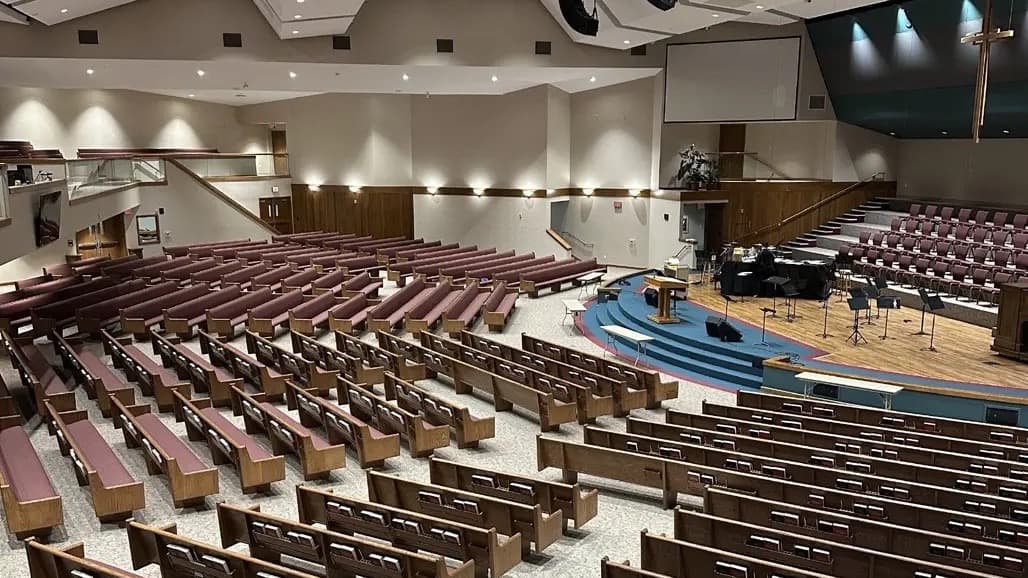
Why Sanctuary Lighting Is a Growing Priority for Omaha-Area Churches
Across Greater Omaha — from established congregations in Midtown and the Dundee neighborhood to growing churches in Papillion, Bellevue, La Vista, and Elkhorn — facility managers are confronting the same quiet crisis: sanctuary lighting systems that were designed for a different era. Incandescent and halogen sources burn out faster than ever under the demands of multi-day worship schedules, livestreamed services, and expanded community programming. Every burnout in a 40-foot vaulted ceiling means scaffolding, downtime, and staff hours that stretch already lean maintenance budgets.
This isn't simply an inconvenience. Lighting quality shapes how congregants experience worship, how volunteers and staff navigate the building safely, and how services appear to online audiences increasingly joining from home. For church leadership across Douglas County and Sarpy County, the question is no longer whether to modernize sanctuary lighting — it's how to do it without disrupting the character and mission of the space.
The good news is that LED technology and lighting control systems have matured to the point where even historically sensitive sanctuaries can be upgraded seamlessly, with results that exceed what the original systems ever delivered.
What Omaha-Area Church Facility Managers Are Actually Dealing With
The challenges showing up in sanctuaries across the Omaha metro are remarkably consistent, regardless of congregation size or building age:
- Frequent relamping in difficult-to-reach fixtures. Traditional incandescent and halogen lamps have short lifespans — sometimes just 1,000 to 2,000 hours — meaning a busy sanctuary may require multiple lamp replacements per year. When those fixtures are mounted on 30- to 50-foot ceilings, the cost in labor, equipment rental, and service disruption adds up quickly.
- Aging ballasts and incompatible dimmer systems. Flickering lights and dimming failures are often symptoms of ballasts nearing end-of-life or control systems that were never designed to work together. These issues create both a poor worship experience and potential electrical safety concerns.
- Uneven light distribution. Many older sanctuaries were designed around a handful of high-wattage sources. The result is bright spots near the front, dim corners in the balcony, and inconsistent illumination across the chancel — all of which affect visibility, safety, and video production quality.
- Rising energy costs with no clear path forward. Nebraska's energy landscape rewards efficiency upgrades, and Omaha Public Power District (OPPD) offers commercial lighting rebate programs that can meaningfully offset upgrade costs. Yet many churches haven't yet pursued these incentives, often because they lack a partner who can navigate the process on their behalf.
- Historic and aesthetic preservation concerns. Many Omaha congregations worship in landmark buildings with decorative pendant fixtures, stained glass, and woodwork that defines their identity. The fear of disrupting that character is a legitimate barrier — but it's one that modern retrofit solutions are specifically designed to address.
A Local Proof Point: Trinity Lutheran Church in Omaha
One of the clearest illustrations of what's possible comes from a project completed right here in Omaha. Trinity Lutheran Church faced exactly the challenges described above: an energy-hungry mix of incandescent and halogen lamps, and a deep commitment to preserving the sanctuary's traditional aesthetic — including the signature pendant fixtures and the beautifully crafted wooden ceiling above them.
Rather than replacing those fixtures, VOSS worked collaboratively with Trinity's leadership to retrofit the existing pendant and house lights with dimmable LED bulbs that preserved every element of the sanctuary's visual identity. What changed was the performance: the sanctuary now delivers crisp, uniform LED illumination throughout the space, with none of the inconsistency or energy waste of the previous system.
What made the project especially impactful for Trinity's team was the transition to an integrated lighting control system. VOSS professionally commissioned every fixture and provided hands-on training so that staff and volunteers could confidently manage the system from day one. Today, Trinity controls all sanctuary lighting through a user-friendly app — accessible from a smartphone or a wall-mounted iPad — and can create and recall custom lighting scenes for Sunday morning worship, evening programs, special events, and everything in between.
"Trinity Lutheran Church was fortunate to connect with Voss Lighting during this project. The working relationship was thorough, patient and the product they delivered was as promised." — Karna Kudrika, Board Member, Trinity Lutheran Church
This project is a model for how Omaha-area congregations can modernize with confidence — no historic character lost, no operational disruption, and a dramatically improved experience for every person who walks through the door.
The Case for LED Retrofits and Lighting Controls in Houses of Worship
For church facility managers evaluating an upgrade, it helps to understand the full picture of what modern LED systems and lighting controls actually deliver — not just in theory, but in practice for organizations operating in the Omaha market.
Dramatically reduced maintenance cycles. Quality LED lamps are rated for 50,000 hours or more — representing 25 times the lifespan of a standard incandescent bulb. For a church with elevated fixtures that currently require relamping multiple times per year, an LED retrofit can effectively eliminate that task for a decade or more. That means fewer lifts, fewer liability exposures, and fewer interruptions to the building's programming schedule.
Energy savings with rebate support. OPPD's commercial rebate programs create a real financial incentive for lighting upgrades, and VOSS has deep experience managing that process — from initial audit through rebate submission — on behalf of clients. The Blue Cross Blue Shield of Nebraska parking lot lighting project completed by VOSS in the state demonstrated a greater than 56% reduction in energy usage, with rebates deployed to help offset project costs. While that project was a commercial application, the energy math and rebate mechanics translate directly to large-footprint worship facilities.
Lighting control systems that serve the whole building. Modern dimming and scene-control systems allow sanctuary lighting to do much more than simply turn on and off. Programmable scenes can be saved for specific service formats — traditional Sunday morning, contemporary evening worship, wedding ceremony, funeral, livestream production — and recalled instantly by any authorized staff member. This capability is no longer expensive or complicated to implement, and it transforms how a facility team manages the space week to week.
Better worship and production quality. Consistent, tunable illumination improves visibility across every seat in the sanctuary, supports clear video capture for livestreamed or recorded services, and creates a more intentional atmosphere for worship. For churches in Omaha's western suburbs like Gretna, Millard, and Ralston — many of which have invested in A/V production infrastructure — quality lighting is the final piece of a professional production environment.
Considerations Unique to Church Facilities in the Greater Omaha Region
Church buildings present a distinct set of facility management challenges that differ from standard commercial construction. A few factors are particularly relevant for Omaha-area congregations planning a lighting upgrade:
Historic and architecturally significant buildings. Older sanctuaries in established Omaha neighborhoods often fall under preservation guidelines or carry deep congregational attachment to their original aesthetic. Any lighting plan must account for fixture compatibility, color temperature consistency, and the visual integrity of the space. Retrofit-first approaches — like the one used at Trinity Lutheran — allow congregations to modernize performance without altering the character of their sanctuary.
Multi-use programming demands. Churches in Greater Omaha increasingly serve as community hubs, hosting food pantries, after-school programs, recovery meetings, concerts, and civic events alongside traditional worship services. Lighting systems need to be flexible enough to serve all of these uses without requiring technical expertise every time a new event is set up.
Budget cycles and phased approaches. Most congregations operate on annual budget cycles with limited capital reserves. A phased upgrade approach — prioritizing the sanctuary first, then fellowship halls, classrooms, and exterior areas — allows churches to realize meaningful savings and improvements while managing cash flow responsibly. Identifying available rebate dollars early in the planning process is essential to making the numbers work within those constraints.
Cooperative purchasing options for eligible organizations. Churches and faith-based organizations that participate in cooperative purchasing programs may have access to pre-negotiated pricing through vehicles like Houston Church COOP, BuyBoard, Sourcewell, TIPS, and Omnia Partners — all programs through which VOSS is an approved vendor. Additionally, VOSS holds an approved state contract in Nebraska, which may benefit church-affiliated schools, daycare programs, or social service organizations operating under a larger institutional umbrella. These pathways can simplify procurement and reduce overall project costs.
Trends Shaping the Future of Sanctuary Lighting
The technology landscape for church lighting continues to evolve. Several trends are worth watching for Omaha-area facility managers planning ahead:
- Tunable white LED systems that allow color temperature to shift throughout a service — warmer tones for reflective moments, cooler tones for high-energy worship — are becoming increasingly accessible at the commercial price point.
- Wireless and app-based control platforms are reducing the complexity and cost of installation while making it easier for non-technical staff to manage sophisticated lighting scenes without ongoing support.
- Integration with building automation systems is enabling churches to tie lighting control to HVAC scheduling, security systems, and occupancy sensors — creating holistic energy management platforms rather than isolated upgrades.
- Demand for livestream-ready environments is accelerating fixture specification decisions, as churches recognize that camera exposure requirements differ from in-person viewing preferences. Getting lighting right for both simultaneously is a design challenge that benefits from experienced guidance.
For congregations in the Omaha metro exploring any of these directions, the starting point is typically a lighting audit — an objective assessment of current conditions, energy consumption, rebate eligibility, and upgrade priorities that forms the basis of a practical, phased plan. Additional context on energy audits, incentive navigation, and commercial LED retrofit best practices is available in related articles in our Latest Lighting series, including our guides on energy-efficient church lighting upgrades and navigating utility rebates for businesses.
Service Availability
While VOSS offers a comprehensive suite of national services, specific capabilities may vary by location. Please contact your local branch to confirm the current availability of specific services, technology solutions, or contracting capabilities in your immediate market.
Connect with VOSS in Omaha
VOSS has been serving faith communities, commercial facilities, and institutions across Greater Omaha and Nebraska for decades. Our local team understands the specific challenges of church facility management in this region — from working in historically sensitive sanctuaries to navigating OPPD rebate programs and meeting the needs of multi-use community buildings.
If your congregation is weighing a sanctuary lighting upgrade, experiencing ongoing maintenance challenges, or simply wondering whether there's a better path forward, we'd welcome a conversation. There's no obligation — just a practical discussion about what's possible for your facility.
VOSS Omaha Branch (402) 328-2283
Reach out to schedule a lighting consultation or facility walkthrough with our Omaha team.