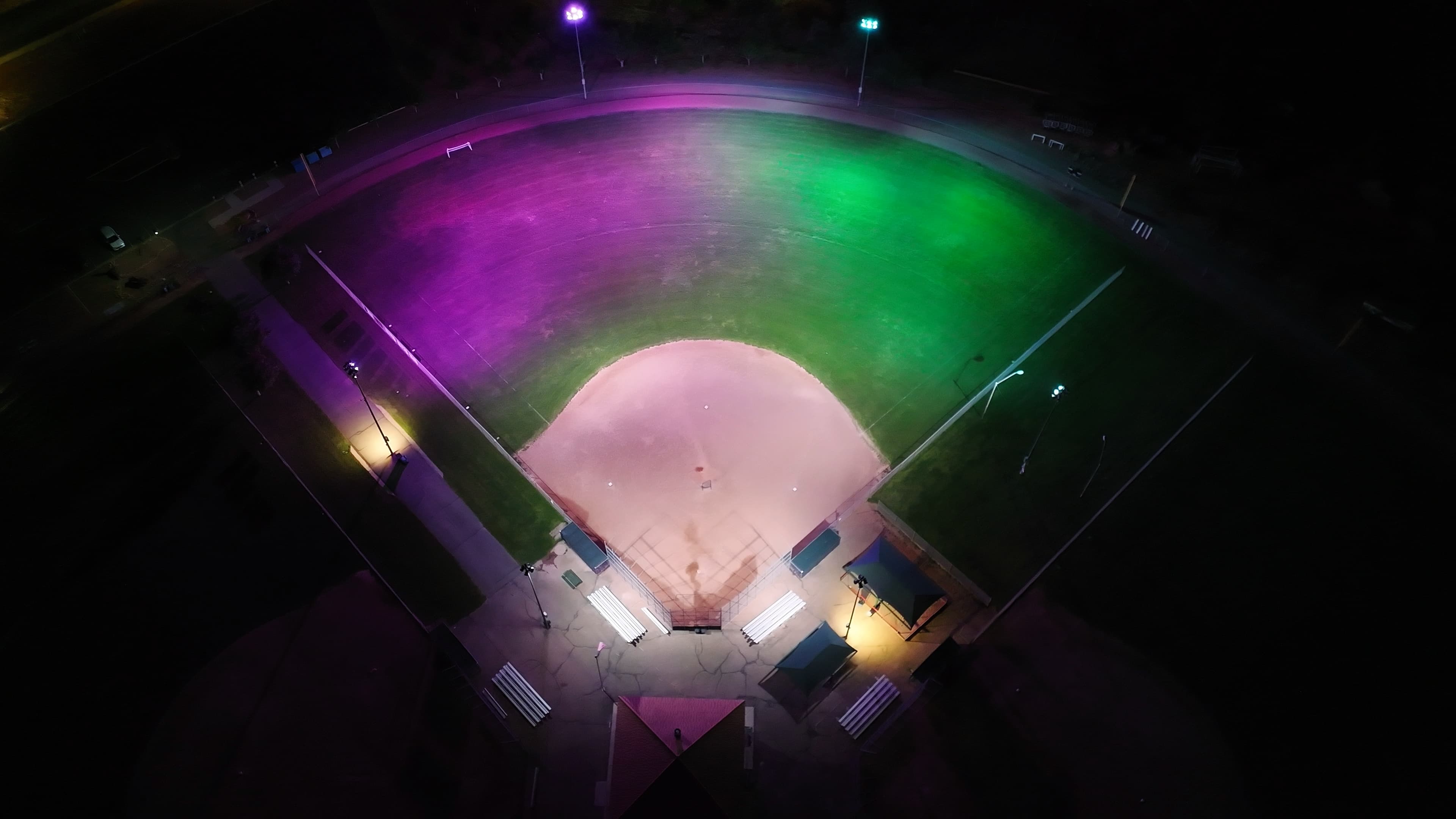
Why Baseball Lighting Deserves More Than a Standard Electrical Upgrade
Walk into any well-lit ballpark — amateur or professional — and you immediately sense the difference. The game looks sharper. Shadows disappear. A fly ball against the night sky is trackable, not a guessing game. That experience doesn't happen by accident. It's the product of deliberate photometric engineering, precise pole placement, and LED technology built specifically for athletic performance.
For facility operators and parks directors across Greater Omaha, this distinction matters more than ever. Youth leagues in La Vista, Millard, and Gretna are competing for families' time and attention. Collegiate programs at University of Nebraska Omaha and Metro Community College are investing in facilities that can attract talent and support broadcast-quality events. Municipal recreation departments in Bellevue, Papillion, and Sarpy County are facing aging infrastructure and rising energy costs simultaneously. LED sports lighting is increasingly the answer — but not all solutions are created equal.
This article explores what separates a well-designed baseball LED lighting project from a generic fixture swap, and why that distinction has real consequences for everyone from a 10-year-old Little Leaguer to a college shortstop.
The Science Behind Great Baseball Lighting
Baseball is one of the most visually demanding sports to light well. Unlike a basketball court or football field — flat, consistent surfaces with predictable action zones — a baseball diamond presents unique challenges. The infield, outfield, foul territories, and warning track all require different illumination levels. Batters staring into a backdrop of dark sky need controlled glare. Outfielders tracking a ball into the lights need precisely aimed fixtures that eliminate spill and hotspots.
The industry benchmark for sports lighting design is maintained footcandles — a measure of how much usable light reaches the playing surface over time, accounting for fixture degradation. Governing bodies like Little League International, the National Federation of State High School Associations (NFHS), NCAA, and Major League Baseball each publish specific footcandle requirements that vary by field level and event type. Meeting — and maintaining — those standards requires more than selecting a bright fixture.
Key design considerations for any baseball LED lighting project include:
- Pole Placement and Height — The number of poles, their positioning around the field, and mounting heights directly determine light uniformity. Errors here create dark zones, glare corridors, or compliance failures that can't be corrected with better fixtures alone.
- Photometric Modeling — Before a single pole goes in the ground, a professional lighting designer runs computer simulations of light distribution across every square foot of the playing surface. This step prevents costly after-the-fact corrections.
- Uniformity Ratios — The difference between the brightest and darkest areas of a field should fall within governing body thresholds. Poor uniformity — common in older metal halide systems — creates visual disadvantages for players and umpires.
- Glare Control — Spill light that bleeds into batters' sightlines or into adjacent residential areas is both a performance issue and a community relations challenge. Proper optics and aiming angles are essential.
- Controls Integration — Modern LED systems can be paired with lighting controls that allow operators to program game modes, reduce output during practice, schedule automatic shutoffs, and monitor energy consumption remotely.
For Omaha-area facilities navigating aging infrastructure, the move from metal halide or high-pressure sodium to a properly engineered LED system addresses all of these dimensions simultaneously — and the energy savings help fund the transition.
Greater Omaha has a deep baseball identity. The College World Series has called Charles Schwab Field home for decades, establishing Omaha as one of the premier baseball markets in the country. That legacy filters down through the region's parks and recreation programs, high school athletics, and youth travel leagues that draw families from Council Bluffs and Carter Lake across the river to Elkhorn, Bennington, and beyond.
For those operating at the field level — parks and recreation directors, athletic directors, booster clubs, and facility managers — the case for LED lighting is increasingly straightforward:
- Energy Reduction — LED fixtures typically consume 50–75% less energy than the metal halide systems they replace. For a municipal field running night games four or five evenings a week through a full season, that translates into meaningful budget relief. VOSS's work with Blue Cross Blue Shield of Nebraska on a parking lot lighting upgrade — a project that reduced energy usage by over 56% — illustrates the kind of efficiency gains that engineered LED solutions routinely deliver in the Omaha market.
- Reduced Maintenance Burden — Metal halide lamps degrade quickly, require frequent replacement, and take time to warm up to full brightness. LED fixtures carry rated lifespans that can exceed 100,000 hours, dramatically reducing the labor and material cost of ongoing maintenance. At the Salvation Army Kroc Center in Omaha, VOSS designed a gymnasium LED retrofit that cut the number of fixtures nearly in half — from 99 to 47 — while improving light quality and eliminating the monthly maintenance calls the facility had come to expect.
- Instant-On Performance — LED systems reach full brightness immediately, with no warm-up delay. For fields hosting multiple games in an evening, or events where rain delays require lights to be cycled, this is a practical operational advantage.
- Broadcast and Event Readiness — As more youth and high school games are streamed for families who can't attend in person, consistent, flicker-free lighting has moved from a "nice to have" to a functional necessity. LED systems designed for sports applications eliminate the flicker that older technologies produced at broadcast frame rates.
For public parks departments and school districts evaluating these investments, Nebraska's utility rebate programs and cooperative purchasing vehicles can meaningfully reduce upfront costs. VOSS holds an approved state contract in Nebraska, making procurement straightforward for government entities. Eligible organizations can also access cooperative purchasing programs including Sourcewell, BuyBoard, TIPS, AEPA, and the Nebraska ESU Co-Op — channels that simplify the bidding process and accelerate project timelines.
Lessons from the Field: Proven Results Beyond Omaha
VOSS has developed baseball and softball lighting solutions for facilities across the country, and the lessons from those projects inform every design we bring to the Omaha market. One instructive example: a baseball facility project in Page, Arizona, where VOSS delivered a sport-specific LED lighting solution that met governing body standards while achieving the energy efficiency and operational performance goals the facility required. Projects like this — completed in varied climates, field configurations, and budget environments — build the practical knowledge base that separates an experienced sports lighting contractor from a general electrical firm attempting a specialized project.
In Greater Omaha, that experience translates directly. Whether a parks department in Papillion is evaluating a retrofit of an existing four-field complex, a private travel ball organization in Elkhorn is breaking ground on a new showcase facility, or an Omaha metro school district is upgrading a varsity diamond to support postseason play, the design principles and project management discipline are the same.
Our broader portfolio in Omaha demonstrates what thoughtful, engineered lighting solutions look like in practice. Trinity Lutheran Church's sanctuary retrofit — a project that required preserving historic pendant fixtures while delivering modern LED performance and smart controls — reflects the same attention to existing conditions and stakeholder priorities that we bring to athletic facilities. Every project, regardless of category, begins with understanding what the space needs to accomplish.
Controls, Connectivity, and Long-Term Performance
One of the most significant advances in sports lighting over the past decade isn't in the fixture itself — it's in how the system is managed. Modern LED sports lighting platforms support sophisticated controls integration that gives operators a level of operational control that simply wasn't possible with older technologies.
For baseball facilities in the Greater Omaha area, this means:
- Programmable Scene Management — Set distinct lighting levels for youth practice, varsity games, and televised events, activated with a single command from a phone or tablet
- Scheduled Automation — Lights can be programmed to activate before first pitch and shut off automatically after the final out, eliminating the energy waste of lights left on unnecessarily
- Remote Monitoring — Facility managers can verify system status, receive fault alerts, and review energy consumption data without physically visiting the site
- Dimming Capability — During warm-up periods or non-competitive events, systems can run at reduced output — saving energy without sacrificing safety
For parks departments managing multiple fields across a municipality like Omaha, Bellevue, or La Vista, centralized controls represent a meaningful step toward smarter infrastructure management. These capabilities also align with broader sustainability goals that many Nebraska municipalities and institutions have adopted in recent years.
Readers interested in the broader landscape of outdoor LED solutions — including parking lot and area lighting — will find related perspectives in VOSS's articles on commercial outdoor LED lighting and parking lot upgrades, both available within our Latest Lighting content series.
Service Availability
While VOSS offers a comprehensive suite of national services, specific capabilities may vary by location. Please contact your local branch to confirm the current availability of specific services, technology solutions, or contracting capabilities in your immediate market.
Discuss Your Baseball Lighting Project with VOSS Omaha
Whether you're managing a single community field in Sarpy County or overseeing a multi-diamond complex serving thousands of players across the Greater Omaha metro, VOSS brings the engineering depth, project management experience, and local market knowledge to deliver a lighting solution that performs — season after season.
We invite you to connect with our Omaha team for a consultative conversation about your facility's current lighting conditions, your performance goals, and the options available to you. There's no obligation — just a straightforward discussion about what the right solution looks like for your field.
VOSS — Omaha Branch
(402) 328-2283