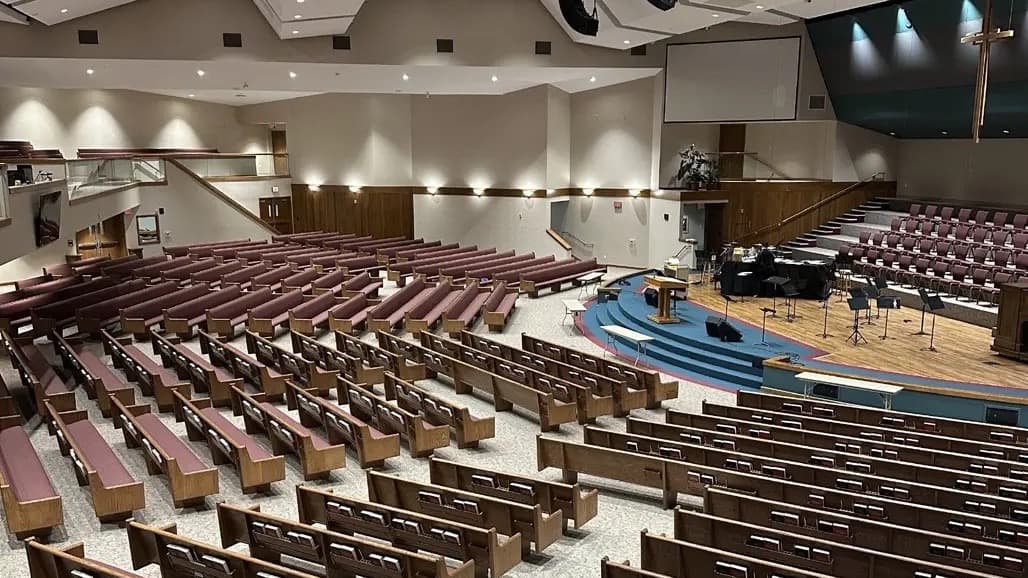
Why Sanctuary Lighting Is a Growing Priority for Fremont-Area Churches
Across Fremont, Nebraska and the surrounding Greater Omaha region — from North Bend and Arlington to the western suburbs of Omaha itself — church facility managers are quietly grappling with a shared operational challenge: aging sanctuary lighting that was never designed to last this long.
Most sanctuary lighting systems installed in the 1980s, 1990s, and even the early 2000s relied on incandescent, halogen, or fluorescent sources. These technologies were standard at the time, but they were built for a different era — one before LED efficiency benchmarks, modern dimming systems, and the widespread adoption of livestreamed worship services. Today, those same fixtures are burning out faster, costing more to maintain, and struggling to meet the demands of contemporary congregational life.
For facility managers and maintenance directors overseeing church properties in Fremont and Dodge County, these aren't abstract concerns. They're weekly realities: scheduling lift rentals to reach 30-foot ceilings, fielding complaints about flickering lights mid-service, or explaining yet another budget line for lamp replacements. Understanding why these problems are accelerating — and what modern solutions look like — is the first step toward a sustainable path forward.
The Anatomy of a Struggling Sanctuary Lighting System
Sanctuary lighting presents a unique set of challenges that distinguish it from typical commercial lighting environments. Unlike an office building or retail space, a church sanctuary must serve dramatically different functions within the same space — often within the same day. Morning worship requires warm, welcoming illumination. A memorial service calls for subdued, dignified tones. A holiday production or livestreamed service demands bright, even, camera-ready light levels. Most legacy systems simply weren't designed with that range of versatility in mind.
The most common pain points that facility managers in the Fremont and Greater Omaha area report include:
- Frequent relamping in hard-to-reach fixtures. High ceilings and ornate pendant fixtures — hallmarks of traditional church architecture — make every burned-out bulb a logistical event. Scaffolding, lift rentals, and labor costs add up quickly when relamping happens multiple times per year.
- Flickering and dimming inconsistencies. Aging ballasts, incompatible dimmer switches, and decades-old wiring create unpredictable light behavior that disrupts services and frustrates congregants and staff alike.
- Uneven illumination. Older lighting layouts often produce bright spots near fixtures and dim zones farther away, creating visual discomfort and — in some configurations — legitimate safety concerns for congregants navigating aisles and steps.
- Poor video and livestream quality. As more Fremont-area congregations embrace video production and online worship, inadequate or inconsistent lighting becomes a visible problem for remote audiences, not just those in the pews.
- Rising energy costs. Incandescent and halogen lamps are dramatically less efficient than modern LEDs, and the cumulative energy draw of a full sanctuary lighting system over months and years represents a significant and unnecessary expense.
Each of these issues is solvable — but solving them well requires understanding the constraints that make church facilities unique.
What a Modern Sanctuary Lighting Approach Actually Looks Like
The most effective sanctuary lighting upgrades don't start with a product catalog — they start with a clear-eyed assessment of what the space needs to do, what constraints exist (historic architecture, existing wiring, budget cycles, service schedules), and what "success" looks like for the congregation.
In practice, a thoughtful LED retrofit for a Fremont-area church typically involves several interconnected elements:
Lamp and fixture assessment. Not every fixture needs to be replaced. In many sanctuaries, the existing pendant housings, sconces, and architectural fixtures can be retrofitted with energy-efficient, dimmable LED bulbs that match the warm color temperatures traditional congregations prefer. Preserving existing fixtures reduces cost, minimizes disruption, and maintains the aesthetic character of the space — a priority that many historic or traditionally designed sanctuaries in the region hold dear.
Lighting controls integration. Modern lighting control systems allow facility managers and worship leaders to program and recall custom scenes for different service types — all from a smartphone app or wall-mounted tablet. This capability transforms what used to be a manual, time-consuming process into a repeatable, one-touch operation. Scenes can be saved for Sunday morning worship, Wednesday evening services, weddings, funerals, youth events, and more.
Addressing high-ceiling access challenges. For sanctuaries with elevated fixtures, a well-planned retrofit dramatically reduces the frequency of future access needs. LED sources with rated lifespans of 50,000 hours or more can go years between any required maintenance — turning a chronic operational headache into an occasional scheduled task.
Commissioning and staff training. Technology is only as useful as the people operating it. A quality installation includes professional commissioning of every fixture and scene, along with hands-on training that empowers church staff — not just contractors — to manage their own system confidently.
This approach was exactly what VOSS implemented at Trinity Lutheran Church in Omaha, a project that offers a compelling model for congregations throughout the Greater Omaha region, including those in Fremont. Trinity's sanctuary was relying on outdated incandescent and halogen lamps that were consuming excessive energy and requiring constant attention. Critically, the congregation wanted to preserve their traditional decorative pendant fixtures — a common priority for churches with historic or architecturally significant interiors.
VOSS collaborated with Trinity to design a retrofit that worked within those constraints: replacing the lamp sources with energy-efficient, dimmable LEDs while keeping the existing pendant and house light fixtures intact. After installation, VOSS commissioned each fixture individually and provided hands-on training so that Trinity's team could manage their new system independently. The result was crisp, uniform LED illumination throughout the sanctuary, a user-friendly app for controlling all lights from a phone or wall-mounted iPad, and a workspace that felt meaningfully transformed — without altering the character of the space.
As board member Karna Kudrika reflected: "Trinity Lutheran Church was fortunate to connect with Voss Lighting during this project. The working relationship was thorough, patient and the product they delivered was as promised."
For Fremont congregations facing similar challenges, Trinity's experience demonstrates what's possible when the upgrade process is driven by collaboration and a genuine understanding of how a church operates.
Energy Efficiency and the Financial Case for Upgrading
Beyond the operational and aesthetic benefits, the financial rationale for LED sanctuary upgrades has become increasingly compelling — and increasingly accessible to congregations of all sizes.
LED technology consumes a fraction of the energy required by incandescent, halogen, or fluorescent sources. For a sanctuary that runs lighting for multiple services per week, plus rehearsals, community events, and facility rentals, the cumulative energy savings over a 5- to 10-year horizon can be substantial. Nebraska utility providers, including those serving the Fremont and Greater Omaha area, have offered rebate programs that can help offset a meaningful portion of upfront project costs for qualifying commercial and nonprofit accounts — reducing the net investment required to modernize a lighting system.
It's worth noting that this intersection of energy efficiency and cost recovery is well-documented in practice. VOSS's work with Blue Cross Blue Shield of Nebraska on a parking lot lighting upgrade — while a different setting — reduced energy usage by over 56% and leveraged utility rebates to help offset project costs. The underlying principle applies to interior lighting upgrades as well: thoughtful fixture selection, proper design, and proactive rebate navigation can meaningfully change the financial picture of a lighting project.
For church finance committees and board members in Fremont weighing the timing of a lighting upgrade, the relevant question isn't just "what will this cost?" — it's "what is our current system costing us, and for how long?"
For sibling topics that expand on the financial dimension of lighting upgrades, the Energy Efficient Church Lighting Upgrades, Maximize ROI with Commercial LED Lighting Rebates, and Energy Audits, Incentives, and Rebate Navigation for Businesses articles in the Latest Lighting series offer additional context on how rebates and incentive programs work in practice.
Cooperative Purchasing Options for Fremont-Area Nonprofits and Public Entities
Churches and nonprofit organizations in Fremont and across Dodge County may have access to procurement pathways that simplify the process of engaging a qualified electrical contractor. VOSS holds an approved state contract in Nebraska, enabling eligible government and public-sector entities to procure lighting and electrical services through a compliant, streamlined process.
Additionally, VOSS participates in a range of cooperative purchasing programs available to qualifying organizations, including Sourcewell, TIPS, BuyBoard, AEPA, Omnia Partners, PACE, Nebraska ESU Co-Op, and the Houston Church COOP — a program specifically designed for faith-based organizations. These cooperative agreements can reduce procurement complexity and accelerate project timelines for eligible Fremont-area churches and community organizations.
Service Availability
While VOSS offers a comprehensive suite of national services, specific capabilities may vary by location. Please contact your local branch to confirm the current availability of specific services, technology solutions, or contracting capabilities in your immediate market.
Talk With Our Omaha Team About Your Sanctuary
VOSS's Omaha branch serves congregations throughout Greater Omaha and the surrounding region, including Fremont, North Bend, Arlington, Wahoo, and communities across Dodge and Saunders Counties. With 85+ years of experience and a track record of successful church lighting projects in Nebraska, our team understands the operational realities, aesthetic sensitivities, and budget priorities that shape decisions for faith-based facilities.
If your sanctuary is showing signs of aging — flickering lights, frequent outages, uneven illumination, or energy costs that seem disproportionate to the space — we'd welcome a conversation about what a modern, low-disruption solution could look like for your facility.
VOSS Omaha Branch Phone: (402) 328-2283
Reach out to schedule a consultation, and let's explore how the right lighting approach can serve your congregation for years to come.