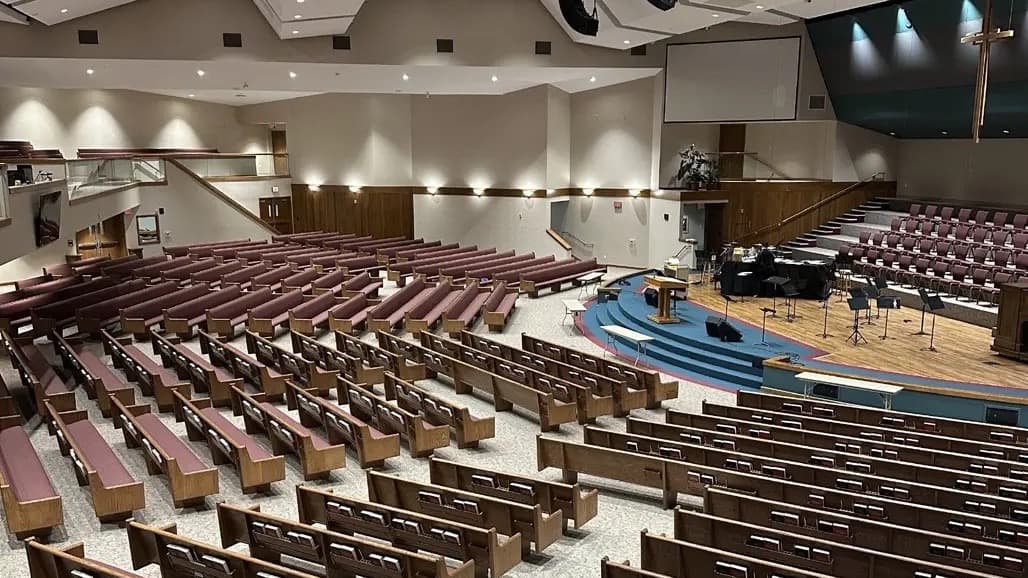
Why Sanctuary Lighting Is a Growing Priority for Iowa Faith Communities
For many church facility managers across Des Moines and the surrounding Greater Omaha market area, sanctuary lighting is one of those maintenance challenges that rarely gets addressed until it becomes a crisis. A flickering chandelier mid-service. A burned-out spotlight above the pulpit. Scaffolding erected on a Saturday to replace bulbs in a 40-foot ceiling — again.
The challenge is real, and it's widespread. Iowa's faith communities range from historic downtown Des Moines sanctuaries with ornate fixtures to contemporary suburban campuses in communities like Ankeny, Urbandale, West Des Moines, and Johnston. Each presents its own lighting complexity. But across all of them, one trend is accelerating: church leadership teams are recognizing that reactive lighting maintenance is far more expensive — and far more disruptive — than a thoughtful, planned approach to modernization.
This article explores why sanctuary lighting deserves a strategic lens, what facility managers in the Des Moines area should understand about their options, and how peer institutions are tackling these challenges with results that speak for themselves.
The Hidden Cost of Aging Sanctuary Lighting Systems
Traditional sanctuary lighting — incandescent, halogen, and fluorescent — was designed for an era when energy costs were lower and labor for maintenance was more accessible. Today, the calculus has changed significantly.
Frequent bulb replacement in hard-to-reach fixtures is among the most commonly cited pain points for church facility teams. When fixtures are mounted 25, 35, or even 50 feet overhead, every replacement requires lift equipment, safety coordination, and significant labor time — often disrupting scheduled programming or requiring after-hours work. For smaller churches without dedicated maintenance staff, this means paying for outside contractors on a recurring basis throughout the year.
Aging ballasts and dimming incompatibilities compound the problem. As fluorescent fixtures age, ballasts fail, flicker, and create audible hum — a distraction that can undermine the reverence of a worship service or the quality of a livestream broadcast. Many older dimming systems are simply incompatible with modern lamp types, creating unpredictable performance and limiting a facility's flexibility.
Energy consumption is another factor reshaping the conversation. Iowa commercial electricity rates, combined with the sheer number of hours a sanctuary operates weekly — Sunday services, Wednesday programs, special events, community gatherings — mean that inefficient lighting carries a meaningful, recurring cost. For a congregation managing a tight operational budget, that's real money that could support mission-driven programming instead.
Perhaps most importantly for Des Moines-area churches that have expanded into video production and livestreaming, inadequate or uneven light levels create serious quality challenges. Inconsistent color rendering and hot spots can make professional-quality video nearly impossible without costly supplemental equipment.
What Modern Sanctuary Lighting Solutions Look Like
The LED revolution in commercial lighting has moved well beyond simple bulb swaps. For church sanctuaries, today's solutions are purpose-built for the unique demands of worship spaces — combining energy efficiency with the aesthetic quality that sacred environments require.
LED retrofit and fixture replacement remains the foundational solution for most facilities. Modern LED sanctuary fixtures offer dramatically longer lifespans — often 50,000 hours or more — which directly translates to fewer maintenance interventions in high-ceiling applications. For a Des Moines congregation that has been replacing halogen lamps every 6–12 months in an elevated fixture, the shift to LED can reduce that maintenance cycle to once a decade or longer.
Tunable white and color-changing LED technology is gaining adoption in worship environments because it allows a single system to serve multiple purposes. A Sunday morning service may call for warm, inviting light. A special event or theatrical presentation may benefit from cooler, more dynamic illumination. Modern LED systems, paired with intuitive control interfaces, give worship leaders that flexibility without technical complexity.
Lighting controls and scene programming are increasingly part of the conversation for Des Moines-area churches. Rather than manually adjusting multiple dimmers before each service or event, a programmable control system allows staff to call up a pre-set "worship scene," "presentation scene," or "community gathering" configuration with a single touch. This not only reduces the burden on volunteers and part-time staff but also ensures consistent, repeatable results.
Maintenance planning and system assessments are a less visible but equally important part of the picture. A professional lighting audit can identify fixtures approaching end-of-life, wiring concerns, and opportunities to consolidate maintenance cycles — reducing the number of disruptions a facility team has to manage throughout the year.
Lessons from Peer Institutions: Light Quality Matters More Than You Think
While sanctuary-specific data from Des Moines is always the most compelling, the principles at work translate across building types and geographies. A project completed by our team at the Lithia Springs Library in Georgia illustrates a core truth about commercial lighting: poor light quality has real, measurable consequences for the people using a space.
In that project, library patrons regularly complained that the space was too dark — particularly on overcast days — because the facility relied almost entirely on table lamps with no overhead artificial lighting. After conducting a professional lighting layout to determine optimal fixture placement and quantity, the team installed 50 flat panel LED fixtures in an arrangement engineered for even light distribution at table level. The result was a space that was consistently bright and welcoming regardless of outdoor conditions.
The parallel to a church sanctuary is direct. Uneven illumination — bright spots near some pews, dim areas near others — affects how congregants experience a service. It affects the readability of printed materials, the comfort of extended worship gatherings, and the professionalism of any video content captured in the space. A planned, engineered approach to lighting layout isn't a luxury; it's the difference between a space that serves its community well and one that quietly works against it.
Cooperative Purchasing: A Practical Path for Eligible Des Moines Organizations
For churches affiliated with qualifying organizations or for faith-based facilities that serve public or educational functions, cooperative purchasing programs can simplify the procurement process and reduce project costs. VOSS works with a range of cooperative purchasing vehicles that eligible organizations may find valuable, including AEPA, BuyBoard, TIPS, Sourcewell, Omnia Partners, PACE, Houston Church COOP, and the Nebraska ESU Co-Op.
These programs are worth exploring early in the planning process, as they can streamline vendor selection, establish pre-negotiated pricing frameworks, and accelerate project timelines — particularly for larger congregations or multi-campus church organizations in the Des Moines metro and surrounding Iowa communities.
What Des Moines-Area Faith Communities Should Be Asking Right Now
If you're a facility manager or operations leader at a Des Moines-area church — whether in the urban core, in growing suburban communities like Altoona, Waukee, or Clive, or in smaller communities across central Iowa — here are the questions worth putting on the agenda:
- When was the last time your sanctuary lighting system was professionally assessed? Many facilities are operating equipment that is 15–25 years old, well past the point where reactive maintenance becomes significantly more costly than planned modernization.
- How much of your maintenance budget goes toward recurring lighting labor and lamp replacement? This number often surprises facility teams when it's actually calculated — and it's a powerful input for an LED retrofit business case.
- Is your current lighting system compatible with your video and livestreaming needs? As more Iowa congregations expand digital ministry, lighting that worked well in 2005 may be a genuine limitation today.
- What is your current control system capable of? Facilities still operating manual dimmer banks may be surprised by the accessibility and affordability of modern scene-control technology.
The Latest Lighting section of our resource library addresses many of these questions in depth. Companion articles on Energy Efficient Church Lighting Upgrades, Commercial LED Lighting Fixtures, and Energy Audits, Incentives, and Rebate Navigation for Businesses offer useful context for organizations building a fuller picture of their options.
Service Availability
While VOSS offers a comprehensive suite of national services, specific capabilities may vary by location. Please contact your local branch to confirm the current availability of specific services, technology solutions, or contracting capabilities in your immediate market.
Talk With Our Omaha Team About Your Sanctuary
VOSS's Omaha branch serves Des Moines and the broader Greater Omaha market area, bringing local familiarity to a nationwide network of lighting expertise. Whether you're planning a full sanctuary LED retrofit, looking for a professional lighting assessment, or simply trying to get ahead of a growing maintenance backlog, we're ready to have a practical, no-pressure conversation about what makes sense for your facility.
VOSS Lighting — Omaha Branch (402) 328-2283
Reach out to schedule a consultation with our team. We're here to help Des Moines-area faith communities make informed, confident decisions about their lighting infrastructure — so your facility can focus on what matters most.