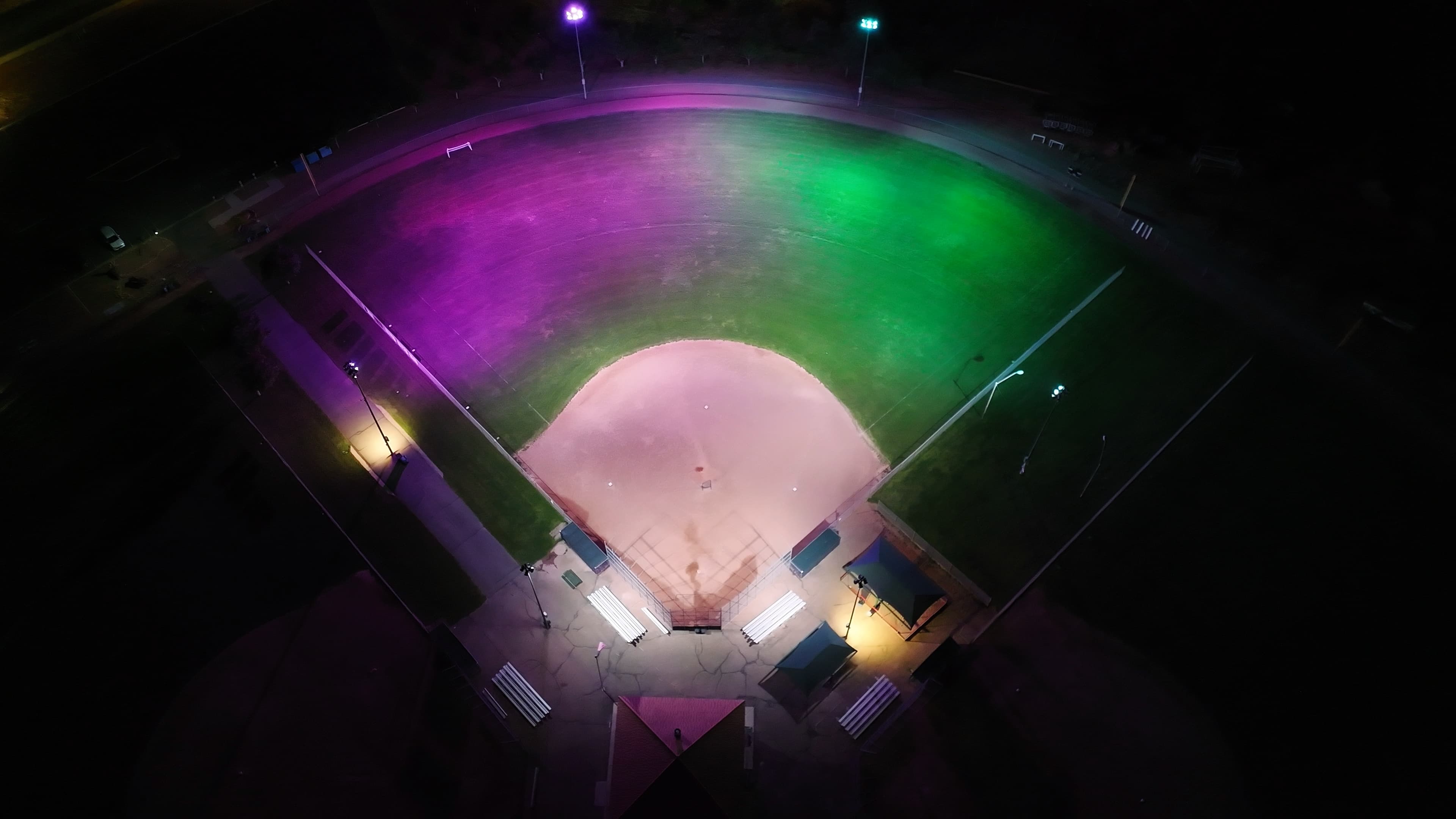
Why Baseball Lighting Is Having a Moment in the Midwest
Walk the parks, recreation complexes, and competitive athletic facilities across Des Moines, Ankeny, West Des Moines, Urbandale, and Johnston on any given evening and you'll find fields buzzing with activity — youth recreational leagues, high school programs, college clubs, and adult softball leagues sharing diamonds under aging metal halide or high-pressure sodium fixtures that were designed for a different era.
That era is ending. Across the country and right here in central Iowa, facility owners and parks administrators are accelerating their transitions to LED sports lighting — not just because the technology has matured, but because the financial and performance case has become impossible to ignore. The question is no longer whether to upgrade, but how to do it right.
This article explores what decision-makers in Des Moines and the surrounding communities should understand about baseball LED lighting — the standards, the design considerations, the energy implications, and the real-world outcomes that are reshaping athletic facilities across the region.
The Problem with Legacy Field Lighting
Most baseball and softball fields built before 2015 were illuminated with metal halide or high-pressure sodium (HPS) systems. At the time, these were the best available options. Today, they represent a significant operational liability.
The core challenges with legacy sports lighting include:
- Warm-up delays — Metal halide fixtures require 15–25 minutes to reach full output, and they cannot be re-struck immediately after being turned off. For night games, rain delays, or broadcast schedules, this creates real logistical problems.
- Uneven light distribution — Older systems were limited in their optical precision, resulting in hot spots near poles, shadowed zones in the outfield corners, and inconsistent illumination across the warning track.
- High energy consumption — A typical four-field recreational complex running 1,500-watt metal halide fixtures can consume enormous amounts of electricity during evening hours — costs that compound across an entire season.
- Maintenance burden — Traditional HID lamps require frequent relamping, often at height, creating safety risks and labor costs that drain parks and recreation budgets year after year.
For facility directors and parks administrators across Polk County and the greater Des Moines metro, these aren't abstract concerns — they show up in maintenance work orders, utility bills, and complaints from players and coaches about visibility conditions.
What Modern LED Sports Lighting Actually Delivers
The shift to LED technology in sports lighting isn't simply about swapping one lamp type for another. Purpose-built LED sports fixtures are engineered systems — designed with optics, thermal management, and mounting geometry optimized for the specific dimensions and viewing geometry of a baseball or softball diamond.
Key performance improvements that Des Moines facility operators should understand:
- Uniform illuminance — Advanced LED optics distribute light evenly across the infield, outfield, and foul territory, reducing the contrast ratios that cause visual fatigue for players and umpires. Batters read pitches better. Outfielders track fly balls with greater confidence.
- Instant on/off capability — LED fixtures reach full brightness the moment power is applied. There is no warm-up, no re-strike delay. Night games start on time; rain delays don't leave players waiting in the dark.
- Dramatically reduced energy use — Modern LED systems typically consume 40–60% less energy than the metal halide systems they replace, a reduction that translates directly into lower utility bills across an Iowa spring, summer, and fall season.
- Extended service life — Quality LED sports fixtures are rated for 100,000 hours or more, meaning a field that operates 1,500 hours per year could go decades before facing major relamping costs.
- Controls integration — LED systems pair naturally with lighting controls platforms, enabling zone-by-zone dimming, occupancy-based scheduling, remote monitoring, and even broadcast-specific light level presets. A facility can run practice lighting at 50% output and switch to full game-level illumination in seconds.
For parks and recreation departments working within fixed budgets — a reality well understood by municipalities across the Des Moines metro, from Altoona to Clive to Waukee — the long-term cost profile of LED is fundamentally different from legacy technology.
Designing for the Diamond: Why Precision Matters
Not all athletic LED lighting projects are alike, and baseball presents some of the most technically demanding design requirements in sports lighting. The geometry of a diamond — with play occurring from home plate to the outfield wall at varying distances and elevations — requires careful photometric modeling before a single pole is placed.
The critical design variables for baseball and softball LED lighting include:
- Pole placement and height — Pole positioning must account for the outfield fence line, existing infrastructure, underground utilities, and local zoning or ordinance requirements. Pole height directly determines the achievable uniformity ratios across the field.
- Mounting angle and aiming — Each fixture must be aimed with precision to contribute to the target illuminance grid while minimizing spill light onto neighboring properties, roadways, or residential areas — a real concern for urban and suburban parks across the Des Moines metro.
- Footcandle targets by use class — The Illuminating Engineering Society (IES) and governing bodies like Little League International, USA Softball, and the NCAA publish recommended illuminance levels for each class of play. A recreational youth field has different requirements than a competitive college or semi-professional venue.
- Glare control — LED fixtures produce high-intensity point sources of light. Without proper shielding and optical design, glare can impair player vision and create liability issues. Quality sports lighting design addresses glare quantitatively through metrics like Glare Rating (GR).
VOSS approaches every baseball lighting project with a full photometric design process — modeling the field digitally before installation to verify that the final system will meet the target standards and the specific needs of the facility and its users.
A Proof Point: Delivering Results in Real Communities
While our primary focus here is the Des Moines market, VOSS's track record across municipal and public-sector lighting projects speaks to our ability to deliver well-engineered solutions that improve both function and community experience.
Our work on the Lithia Springs Library Lighting Enhancement in Georgia — a government and municipal project — illustrates the discipline we bring to public-space lighting design. Faced with a facility where patrons consistently complained about inadequate lighting, our team completed a detailed photometric layout before any fixtures were ordered, ensuring the final installation delivered even, comfortable illumination at the task level across the entire space. The result was 50 flat panel fixtures installed in an optimized layout that transformed the environment — with performance validated against real-world use conditions, not just specification sheets.
The same design-first philosophy drives our baseball and softball lighting practice. We don't size a system by counting poles; we model the field, validate the design, and deliver a system that performs to specification from opening night forward.
The Controls Dimension: Smarter Fields for Des Moines
One of the most significant but underappreciated advantages of modern LED sports lighting is its native compatibility with intelligent controls systems. For facility managers overseeing multiple fields — think of the regional sports complexes that serve communities across Polk, Dallas, and Warren counties — controls integration can meaningfully reduce both energy consumption and staff workload.
What lighting controls enable for baseball facilities:
- Scheduled on/off automation — Fields power up before first pitch and shut down after the last inning, without requiring staff to physically operate controls on-site.
- Zone-based dimming — Warm-up areas, bullpens, and batting cages can be lit independently of the main field, reducing energy use during non-game activities.
- Remote monitoring and fault alerts — Facilities management teams can monitor system status and receive alerts for fixture failures from anywhere — reducing the risk of a darkened field mid-game.
- Broadcast and event presets — High-profile tournaments, broadcast events, and special programming can call up specific light level configurations with a single command.
For parks departments managing facilities across Des Moines and its surrounding communities — Altoona, Pleasant Hill, Grimes, Bondurant — a centrally managed controls platform can simplify operations across an entire portfolio of fields.
A Note for Public Agencies and School Districts
For eligible public-sector organizations across the Des Moines metro — municipal parks departments, school districts, and county recreation programs — cooperative purchasing programs can significantly simplify the procurement process for LED sports lighting projects.
VOSS works through several nationally recognized cooperative purchasing vehicles, including Sourcewell, TIPS, BuyBoard, AEPA, Omnia Partners, PACE, and the Nebraska ESU Co-Op — programs that allow qualifying agencies to access pre-competed contracts without the administrative burden of a standalone bid process.
If your organization is evaluating a baseball or softball lighting upgrade and is eligible for cooperative purchasing, this is a practical path worth exploring. Contact our Omaha branch team to learn more about which programs may apply to your situation.
Connecting to the Broader Conversation
Baseball and softball LED lighting is one dimension of a much larger trend reshaping athletic and recreational infrastructure across the country. If your facility includes other sports venues, our related articles on LED Gymnasium Lighting Solutions, Pickleball LED Lighting Solutions, Tennis Court Lighting and Energy Solutions, and LED Football Stadium Lights & Sports Field Lighting Solutions provide additional context for facility-wide planning. For organizations exploring energy incentives, our content on Energy Audits, Incentives, and Rebate Navigation for Businesses and Parking Lot and Outdoor LED Lighting Upgrades may also be relevant as you think about a comprehensive lighting strategy.
Service Availability
While VOSS offers a comprehensive suite of national services, specific capabilities may vary by location. Please contact your local branch to confirm the current availability of specific services, technology solutions, or contracting capabilities in your immediate market.
Talk to Our Team About Your Field
Whether you're managing a single community diamond in Des Moines or overseeing a multi-field complex serving communities across the greater metro, VOSS can help you think through the design, technology, and financial dimensions of a baseball LED lighting upgrade — without pressure and without guesswork.
Our Omaha branch serves the Greater Omaha and Iowa markets with the full depth of VOSS's national capabilities. We'd welcome the opportunity to review your facility's current conditions, discuss your goals, and help you understand what a well-designed LED system could mean for your players, your fans, and your operating budget.
VOSS — Omaha Branch (402) 328-2283
Reach out today to start a conversation about what's possible for your field.