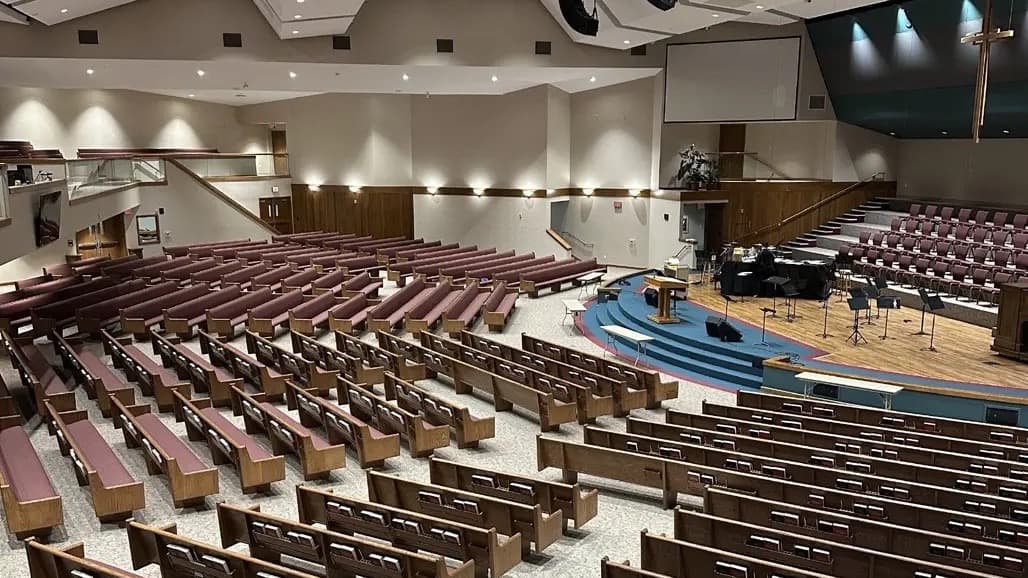
Why Sanctuary Lighting Is a Growing Concern for Bellevue-Area Churches
Across Bellevue, Papillion, La Vista, Ralston, and the broader Greater Omaha metro, faith communities are quietly grappling with a facility challenge that rarely makes it onto the Sunday bulletin: aging sanctuary lighting. What once felt like a low-priority maintenance item has become an increasingly urgent operational, financial, and even pastoral concern.
The reasons are converging. Traditional incandescent, halogen, and fluorescent lamps that once served sanctuaries well are now reaching the end of their useful lives simultaneously — the result of decades of deferred upgrades. Meanwhile, congregational expectations have shifted. Today's worship services often incorporate livestreaming, video production, and sophisticated audio-visual environments where lighting quality is no longer just about visibility — it's about how a church presents itself to an online audience that may span far beyond Nebraska.
For facility managers and maintenance supervisors overseeing church properties in Bellevue and the surrounding communities, the question is no longer whether to modernize sanctuary lighting, but how to do it thoughtfully — in a way that respects the building's character, minimizes disruption to services, and makes financial sense.
The Real-World Pain Points Faith Communities Face
Church sanctuaries are architecturally unlike almost any other commercial or institutional space. Vaulted ceilings, historic pendant fixtures, stained glass, ornate woodwork, and deeply symbolic interior design all create constraints that generic lighting approaches simply cannot accommodate. Facility managers at Bellevue-area churches know this firsthand.
The most common issues we hear from church facilities teams across the Greater Omaha region include:
- Frequent bulb failures in hard-to-reach fixtures — Replacing lamps in 30-, 40-, or even 50-foot ceilings requires scaffolding or aerial lifts, often costing hundreds of dollars per maintenance visit and requiring coordination with service providers to avoid disrupting weekend services or midweek programming.
- Flickering or dimming problems — Aging ballasts and incompatible dimmers cause visible flickering that distracts congregants and creates unprofessional visual artifacts in livestream footage.
- Uneven or insufficient illumination — Older lighting systems were often designed for a different era of worship. Modern congregations expect clear, consistent light across the nave, chancel, choir loft, and gathering spaces — particularly as more churches invest in video recording and broadcast.
- Rising energy costs — Older incandescent and halogen systems are energy-intensive. In a sanctuary that may be in use for rehearsals, services, weddings, funerals, and community events throughout the week, energy consumption adds up quickly.
- Controls that don't match modern needs — Many sanctuaries still rely on manual switches or basic dimmers with no scene-setting capability, making it difficult to quickly adapt lighting for a candlelight service, a funeral, a children's program, or a broadcast event.
These aren't abstract problems. They represent real operational burden — and in many cases, a meaningful drain on stewardship resources that churches would rather direct toward mission and ministry.
What Modern Sanctuary Lighting Upgrades Look Like
The good news for Bellevue and Omaha-area churches is that lighting technology has advanced dramatically, and today's LED retrofit solutions are specifically designed to address the constraints that make church facilities unique. The best upgrades are not one-size-fits-all — they're engineered around the building's existing infrastructure, aesthetic requirements, and the congregation's operational patterns.
LED Retrofitting That Preserves Historic Character
One of the most important developments in church lighting over the past decade is the availability of high-quality, dimmable LED lamps specifically engineered to retrofit into historic pendant fixtures, chandeliers, and decorative sconces — without replacing the fixtures themselves. This means a congregation can modernize to LED performance while keeping the architectural elements that define the character of their worship space.
This approach is precisely what VOSS implemented at Trinity Lutheran Church in Omaha — a project directly relevant to the faith communities of Bellevue and the surrounding metro. Trinity's sanctuary featured beloved traditional pendant and house lights, and the congregation was committed to preserving them. VOSS collaborated with Trinity's leadership to retrofit those existing fixtures with energy-efficient, dimmable LED bulbs, commissioning each fixture individually to ensure consistent color temperature and dimming performance throughout the space. The result was crisp, uniform LED illumination that honored Trinity's historic wooden ceiling and interior aesthetic, while delivering the energy efficiency and longevity of modern technology.
Smart Lighting Controls That Empower Non-Technical Staff
A lighting upgrade is only as valuable as the control system behind it. For churches, where volunteers and part-time staff often manage facilities, complexity is the enemy. The best sanctuary lighting control systems today are intuitive enough for anyone to operate — and powerful enough to set and recall customized scenes for every type of service or event.
As part of the Trinity Lutheran project, VOSS commissioned a user-friendly control platform that allows church staff and volunteers to manage all sanctuary lighting from a smartphone app or a wall-mounted iPad. Custom scenes — a bright, welcoming setting for Sunday morning worship; a subdued, reverent atmosphere for Advent; a warm, intimate arrangement for a memorial service — can be recalled with a single tap. That kind of operational simplicity is transformative for facilities teams managing diverse weekly programming.
Karna Kudrika, a Board Member at Trinity Lutheran, reflected on the experience: "Trinity Lutheran Church was fortunate to connect with Voss Lighting during this project. The working relationship was thorough, patient and the product they delivered was as promised."
Energy Efficiency With a Measurable Return
Nebraska churches that make the transition to LED can expect meaningful, sustained reductions in energy consumption. The efficiency gains from replacing incandescent and halogen systems with high-quality LEDs are substantial — and in many cases, utility rebates and incentive programs are available to offset a significant portion of project costs.
VOSS's experience managing energy rebate programs across Nebraska — including the work done for organizations like Blue Cross Blue Shield of Nebraska, where a commercial LED upgrade reduced energy usage by over 56% — reflects the kind of disciplined, rebate-aware project management that translates directly to church facilities budgets. Understanding how to identify and capture available incentives is a meaningful part of how VOSS helps clients maximize the return on their lighting investment.
For faith communities exploring their options, the companion article "Energy Efficient Church Lighting Upgrades" in the Latest Lighting section offers additional context on incentive programs and technology considerations. The "Fluorescent Tube Bans and LED Lighting Rebates" and "Energy Audits, Incentives, and Rebate Navigation for Businesses" articles are also worth reviewing for any church facility managing a mix of interior lighting types.
Navigating Implementation: Minimizing Disruption to Church Life
For any congregation, the practical question of how an upgrade will be installed matters just as much as the technology itself. Bellevue-area churches typically have packed weekly schedules — Sunday services, midweek programming, youth groups, music rehearsals, community events, and private rentals. A lighting project that forces extended closures or creates weeks of construction noise is simply not viable.
VOSS designs installation timelines and sequencing specifically to work around a congregation's calendar. This means pre-planning each phase to minimize the number of active workdays in the sanctuary, scheduling lift and scaffolding work during low-activity windows, and completing commissioning and training before a project is considered closed.
The Salvation Army Kroc Center gymnasium retrofit in Omaha offers a useful illustration of this disciplined approach. The Kroc Center operates year-round with diverse, continuous programming — an environment with constraints comparable to a busy church campus. VOSS reduced the facility's fixture count from 99 to 47, cut energy usage in half, and delivered the project seamlessly within the agreed timeframe. Head of Facilities Carl Larson noted: "Voss's attention to detail ensured that the project was completed seamlessly and within the agreed upon time frame. The transformation is truly remarkable and has made a significant impact on the overall ambiance and functionality of the space."
That same commitment to precision planning and low-disruption execution applies directly to VOSS's work with faith communities in Bellevue, Papillion, Gretna, Springfield, and throughout the Sarpy County and Douglas County corridor.
Cooperative Purchasing Options for Eligible Organizations
For churches or faith-based organizations in Nebraska that participate in cooperative purchasing programs or are affiliated with public or nonprofit institutions, VOSS holds an approved state contract in Nebraska, enabling compliant, cost-effective procurement of lighting and electrical products. VOSS is also an approved vendor through several cooperative purchasing programs — including Houston Church COOP, Nebraska ESU Co-Op, Sourcewell, BuyBoard, TIPS, AEPA, Omnia Partners, and PACE — which may offer eligible organizations a streamlined path to project approval and procurement.
If your congregation or affiliated institution qualifies for any of these programs, our Omaha branch team can help you understand how to leverage them effectively.
Service Availability
While VOSS offers a comprehensive suite of national services, specific capabilities may vary by location. Please contact your local branch to confirm the current availability of specific services, technology solutions, or contracting capabilities in your immediate market.
Connect With VOSS in Bellevue and Greater Omaha
If your church is experiencing maintenance challenges, energy cost pressures, or simply recognizes that your sanctuary deserves better light, we'd welcome the opportunity to have a conversation. Our Omaha branch serves faith communities throughout Bellevue, Papillion, La Vista, Ralston, Gretna, Springfield, and the broader Greater Omaha metro — and we bring both national resources and genuine local experience to every project.
VOSS — Omaha Branch Phone: (402) 328-2283
Reach out to start a consultative discussion about what a sanctuary lighting assessment might look like for your facility — no obligation, just a thoughtful conversation about your building, your congregation's needs, and the options available to you.