Why Sanctuary Lighting Deserves a Closer Look in Moore, OK
For the estimated 64,000 residents of Moore and the surrounding communities of Norman, Midwest City, Del City, and south Oklahoma City, houses of worship are more than gathering spaces — they are anchors of community life. Yet behind the scenes, many church facility managers across the Greater Oklahoma City area are quietly wrestling with lighting systems that are failing to keep pace with modern demands.
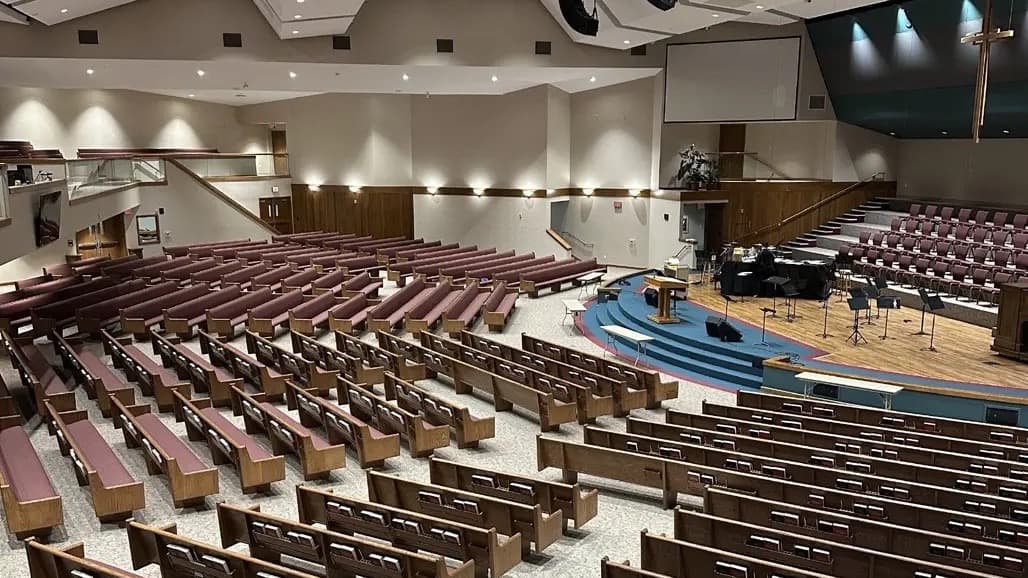
Sanctuary lighting is among the most technically challenging aspects of church facility management. Fixtures mounted 30, 40, or even 50 feet overhead — common in traditional and contemporary worship spaces alike — require lifts or scaffolding for routine bulb changes. Traditional incandescent, halogen, and quartz lamp systems burn hot, fail frequently, and consume far more energy than today's LED alternatives. The result is a cycle of reactive maintenance, rising utility bills, and a worship environment that often falls short of its potential.
This article explores what's changing in church lighting technology, why those changes matter to Moore-area congregations, and what facility managers and administrators should consider when evaluating an upgrade.
The Real Cost of Aging Church Lighting Systems
Many congregations across Moore and the broader Oklahoma City metro have inherited lighting systems that were installed decades ago — designed around lamp technologies that are now largely obsolete. Understanding the true cost of maintaining those systems is the first step toward making an informed decision.
Maintenance labor and access costs are among the most underappreciated expenses. When a lamp burns out 40 feet above a sanctuary floor, replacing it is not a simple task. It typically requires renting a lift, scheduling work around service times, and pulling maintenance staff or volunteers away from other priorities. In active congregations with multiple weekly services, this cycle can repeat many times throughout the year.
Energy consumption is another significant driver. High-wattage quartz, halogen, and fluorescent systems consume considerably more electricity than modern LED equivalents. In Oklahoma, where summer temperatures push cooling loads higher, the heat generated by legacy fixtures also adds indirectly to HVAC costs — a compounding effect that rarely appears on a lighting-specific budget line.
Inconsistent light quality affects both the in-person worship experience and, increasingly, the quality of livestreamed services. Uneven illumination, color temperature inconsistencies, and dimmer compatibility problems are common symptoms of aging systems — and they are problems that modern LED solutions address directly.
The experience at New Covenant Church Worship Center in Oklahoma City illustrates these challenges clearly. Their sanctuary relied on 500-watt quartz lamps that ran extremely hot, causing the sockets to become brittle over time. Lamp life was short, maintenance was frequent and difficult, and at any given time, roughly one-third of the lights were out. VOSS worked with the facility team to specify integrated LED fixtures with selectable color temperature settings and upgraded the dimming system throughout the space. The result of installing 260 new fixtures: brilliantly even illumination that dims to very low levels, virtually maintenance-free operation, and a system that was installed without any disruption to ongoing worship services. In the words of Steve West, the facilities contact at New Covenant: "Maintenance was a nightmare, and often one third of the lights were out. VOSS helped us choose a retrofit LED fixture with multiple color temperature settings so we could pick the color that best suited our space... The lighting is even and dims to very low levels, and when all the lights are on at 100 percent, the light output is brilliant."
This kind of outcome is increasingly achievable for congregations throughout Moore, Norman, and the surrounding communities — and the path to get there is more straightforward than many facility managers expect.
What Modern LED Sanctuary Lighting Actually Delivers
The LED retrofit conversation has matured significantly over the past decade. Early LED products were sometimes inconsistent in color quality, dimmer compatibility, or longevity. Today's commercial-grade LED systems — specified and installed by experienced lighting professionals — are a different category of product entirely.
Extended lamp life is the headline benefit from a maintenance perspective. High-quality LED fixtures designed for sanctuary applications can last 50,000 hours or more — a lifespan that, depending on usage patterns, can translate to decades of service without relamping. For a congregation in Moore whose volunteers have spent years managing high-ceiling lamp changes, that reduction in maintenance burden is transformational.
Improved light quality is equally important. Modern LED systems offer precise control over color temperature — the warmth or coolness of the light — allowing worship teams to create the right atmosphere for different service types, from intimate candlelight-style Christmas Eve services to high-energy contemporary worship. Dimming control has also improved dramatically, with LED-compatible systems capable of smooth, flicker-free dimming across a wide range.
Energy efficiency remains a compelling driver. LED systems typically consume 50–75% less energy than the incandescent, halogen, or quartz systems they replace. For a congregation managing tight operational budgets — as most do — that reduction in monthly utility costs directly frees up resources for ministry, facilities upkeep, and programming.
Livestream and video production quality is a growing consideration for Moore-area congregations that broadcast services online or record for later distribution. Consistent, high-CRI (Color Rendering Index) LED lighting dramatically improves the visual quality of video, reducing the need for post-production corrections and making broadcasts look polished and professional.
For facility managers exploring the broader landscape of LED upgrades, VOSS's related articles on Commercial LED Lighting Fixtures, Energy Efficient Church Lighting Upgrades, and Energy Audits, Incentives, and Rebate Navigation for Businesses provide additional context on product selection, financial incentives, and the audit process.
Navigating the Practical Challenges of Church Retrofits
Church buildings present a unique set of constraints that distinguish them from standard commercial retrofits. Facility managers in Moore and across Oklahoma should expect a thoughtful planning process that accounts for these realities.
Access and scheduling are primary concerns. Sanctuaries are typically in use multiple times per week, and many congregations cannot afford to take the space offline for extended periods. A professional lighting contractor experienced with church properties will plan installation in phases or work during off-hours to minimize disruption — a discipline VOSS applied directly at New Covenant Church, completing the installation of 260 fixtures without interfering with a single worship service.
Historic and architectural sensitivity applies to many older church buildings across the Oklahoma City metro. Exposed trusses, decorative ceilings, original woodwork, and architectural lighting features require careful consideration during fixture selection and mounting. The goal is always to preserve the character of the space while modernizing the system.
Dimmer and control system compatibility is a technical consideration that is easy to overlook. Many legacy dimming systems are not compatible with modern LED drivers, and a retrofit that doesn't address this can result in flickering, buzzing, or limited dimming range. A comprehensive upgrade typically includes an assessment of the existing control infrastructure and, where needed, an upgrade to a compatible LED dimming system.
Budget phasing is a practical reality for most congregations. VOSS works with church facility teams to develop phased implementation plans that prioritize the highest-impact spaces first — typically the main sanctuary — and sequence remaining work to align with capital planning cycles and available funding.
Rebates, Incentives, and Cooperative Purchasing for Oklahoma Churches
One of the most underutilized resources available to Moore-area churches and nonprofits is the landscape of utility rebates and cooperative purchasing programs that can significantly offset the upfront cost of an LED upgrade.
Oklahoma Gas & Electric (OG&E) and Oklahoma Electric Cooperative serve much of the Greater Oklahoma City area, and both have historically offered energy efficiency incentive programs for commercial and institutional customers. VOSS's team helps eligible organizations identify, document, and capture these rebates as part of the project process — reducing the net investment and improving the financial case for moving forward.
For churches that are part of larger denominational structures or that purchase through group buying arrangements, VOSS participates in several cooperative purchasing programs available to eligible organizations, including Houston Church COOP, TIPS, Sourcewell, BuyBoard, Omnia Partners, PACE, and AEPA. These programs streamline procurement, ensure competitive pricing, and eliminate the need for individual bid processes — a meaningful benefit for congregations with limited administrative capacity.
VOSS also holds an approved state contract in Oklahoma, which means Oklahoma state agencies and eligible public institutions can access VOSS products and services through a pre-approved contracting vehicle — simplifying procurement and ensuring compliance.
For more on how rebates and incentives apply to lighting projects in this region, VOSS's article on Maximize ROI with Commercial LED Lighting Rebates in Dallas, TX provides a useful framework, and the Fluorescent Tube Bans and LED Lighting Rebates article covers regulatory changes that may also affect church facilities using fluorescent systems.
Service Availability
While VOSS offers a comprehensive suite of national services, specific capabilities may vary by location. Please contact your local branch to confirm the current availability of specific services, technology solutions, or contracting capabilities in your immediate market.
Talk to VOSS About Your Moore, OK Sanctuary Lighting
VOSS's Oklahoma City branch serves Moore and the surrounding communities of Norman, Midwest City, Yukon, Edmond, and throughout the Greater Oklahoma City metro. Our team brings direct regional experience with church properties of every size and style — from small neighborhood congregations to large multi-campus worship centers.
If your sanctuary is dealing with flickering fixtures, frequent high-ceiling maintenance, uneven illumination, or simply a lighting system that no longer reflects the quality of your worship experience, we invite you to start a conversation. Our approach is consultative — we begin by understanding your facility, your budget, and your goals before recommending any solution.
VOSS Oklahoma City Phone: (405) 949-1919 Toll-Free: (800) 735-8677
Contact our Oklahoma City team to schedule a facility assessment and learn how Moore-area congregations are modernizing their sanctuaries with LED lighting solutions that reduce maintenance, improve worship quality, and deliver long-term operational savings.