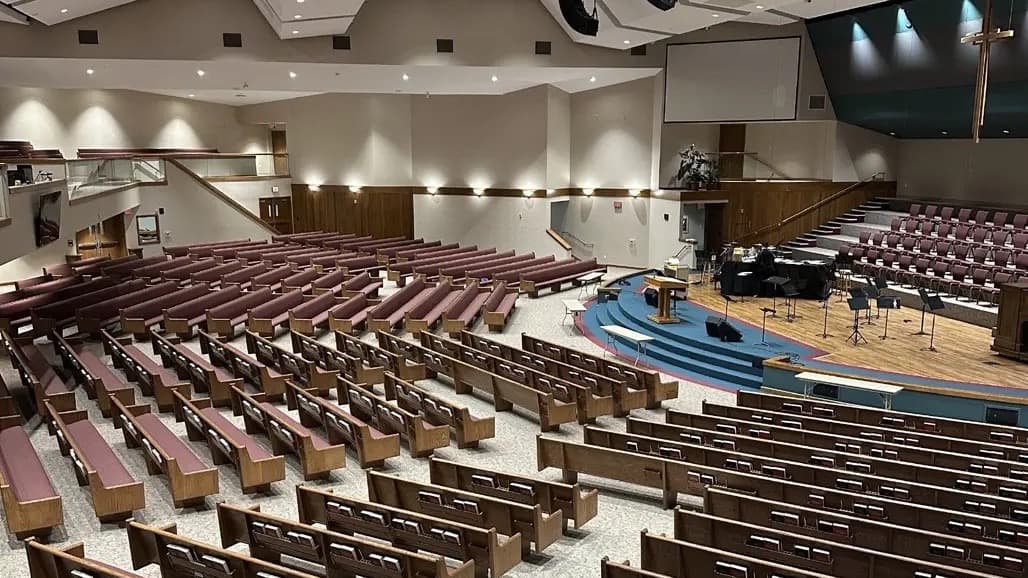
Why Sanctuary Lighting Is a Growing Priority for Oklahoma Churches
Faith communities across Midwest City, Del City, Choctaw, and the broader Greater Oklahoma City metro are facing a quiet but mounting operational challenge: aging sanctuary lighting systems that were designed for a different era. Many of these fixtures — incandescent, halogen quartz, and fluorescent — were installed decades ago and are now delivering diminishing returns in every measurable way.
The issue isn't simply aesthetics. It's operational sustainability. High-mounted fixtures in vaulted sanctuaries require lifts or scaffolding every time a bulb fails. Aging ballasts cause flickering that distracts worshippers and undermines the dignity of services. And energy bills continue climbing as inefficient systems run every Sunday morning, Wednesday evening, and throughout the week for rehearsals, weddings, funerals, and community events. For facility managers at churches of all sizes — from small congregations in Midwest City to large multi-campus ministries spread across the OKC metro — these aren't abstract concerns. They're weekly realities.
The good news is that modern LED lighting technology has advanced to a point where upgrading a sanctuary is no longer a disruptive, cost-prohibitive undertaking. Understanding the landscape of what's possible — and what to watch out for — is the first step toward making a confident, informed decision.
The Hidden Costs of Deferred Sanctuary Lighting Maintenance
One of the most important shifts in how facility managers and church administrators think about lighting is the move from viewing it as a capital expense to understanding it as an ongoing operational cost — and a controllable one.
Consider the typical maintenance cycle of a sanctuary running 500-watt quartz lamps mounted 20 to 40 feet overhead. This is precisely the situation VOSS encountered at New Covenant Church Worship Center in Oklahoma City. The existing quartz lamps ran extremely hot, which over time caused the lamp sockets themselves to become brittle and deteriorate. With short lamp lifespans and difficult access, maintenance cycles were constant — and at times, as many as one-third of the fixtures were simply out, leaving portions of the sanctuary dark during services.
"Maintenance was a nightmare, and often one third of the lights were out. VOSS helped us choose a retrofit LED fixture with multiple color temperature settings so we could pick the color that best suited our space, and they also upgraded our dimming system."— Steve West, New Covenant Church Worship Center
The replacement solution — 260 integrated LED fixtures specified and installed by VOSS — eliminated the heat problem entirely, extended lamp life to more than 25 times that of the original quartz lamps, and delivered even, dimmable light throughout the worship space. Critically, the entire installation was completed without interfering with a single worship service.
This project is a meaningful reference point for churches across Midwest City and surrounding communities like Nicoma Park, Spencer, and Harrah, where similar vintage lighting systems remain in service. The operational savings and improved light quality achieved at New Covenant aren't unique to large churches — the same principles apply at any scale.
What Modern LED Sanctuary Lighting Actually Delivers
For facility managers and administrators evaluating an upgrade, it helps to understand what the technology actually changes — beyond simply swapping a bulb for an LED equivalent.
Light quality and worship experience. Modern LED systems offer tunable color temperatures, meaning a church can select a warmer, more intimate tone for traditional services or a brighter, crisper output for contemporary worship. Dimming capability — especially smooth, flicker-free dimming to very low levels — allows lighting to serve the full emotional and ceremonial range of a worship environment. As Steve West noted of the New Covenant installation, "The lighting is even and dims to very low levels, and when all the lights are on at 100 percent, the light output is brilliant."
Maintenance reduction. LED fixtures in commercial-grade applications are rated for 50,000 to 100,000 hours of operation. For a sanctuary running 10–15 hours per week, that translates to decades of service before a fixture needs attention. For churches in the Midwest City area where maintenance staff may be part-time volunteers, this is a transformational change.
Energy efficiency. A sanctuary that replaces high-wattage quartz or metal halide fixtures with integrated LED technology will typically see dramatic reductions in lighting-related energy consumption. While specific savings vary based on usage patterns and existing equipment, the reduction in wattage draw is measurable and consistent.
Livestream and video quality. As more Oklahoma City-area congregations incorporate livestreamed services and media production into their ministries, lighting quality has become a technical consideration as well as a spiritual one. LED systems with appropriate color rendering indices (CRI) and controlled beam angles can meaningfully improve how a sanctuary reads on camera.
Navigating Historic Buildings, Budget Realities, and Minimal Disruption
Churches present unique renovation challenges that distinguish them from standard commercial projects. Many sanctuaries in Midwest City and across the OKC metro feature architectural details — decorative ceiling treatments, stained glass, ornate woodwork — that require care during installation. Others may have electrical infrastructure that hasn't been updated in 30 or 40 years, creating compatibility questions for modern dimming and control systems.
These are not obstacles to be minimized — they're realities that require an experienced contractor who has worked in faith-based environments before. VOSS's approach to sanctuary lighting projects emphasizes low-disruption scheduling, compatibility assessment before fixture specification, and transparent communication with facility managers throughout the process.
For churches exploring a broader energy efficiency strategy, it's also worth noting that sanctuary lighting upgrades often represent the largest single opportunity for energy reduction in a church building. Combined with parking lot and exterior lighting improvements — another area of demonstrated VOSS expertise in the Oklahoma market — a phased approach can spread capital costs while delivering measurable operational returns year over year. The Latest Lighting section also covers Energy Efficient Church Lighting Upgrades and Parking Lot and Outdoor LED Lighting Upgrades as natural companion topics for churches planning a comprehensive modernization.
Cooperative Purchasing Options for Oklahoma Faith Communities
Churches affiliated with school systems, connected to public institutions, or operating as nonprofits that participate in group purchasing programs may have access to streamlined procurement pathways. VOSS holds an approved state contract in Oklahoma, enabling eligible organizations — including public agencies and institutions across the Midwest City area — to access products and services through established state procurement channels.
For broader faith-based and nonprofit audiences, VOSS participates in several cooperative purchasing programs relevant to this market, including Houston Church COOP, BuyBoard, Sourcewell, TIPS, and Omnia Partners, among others. These programs simplify the procurement process and can be especially useful for larger congregations or multi-campus ministries managing capital improvement projects.
Service Availability
While VOSS offers a comprehensive suite of national services, specific capabilities may vary by location. Please contact your local branch to confirm the current availability of specific services, technology solutions, or contracting capabilities in your immediate market.
Talk With Our Oklahoma City Team About Your Sanctuary
VOSS serves Midwest City and the full Greater Oklahoma City region — including Del City, Choctaw, Nicoma Park, Harrah, Edmond, Norman, Moore, and Yukon — from our local Oklahoma City branch. Our team understands the lighting challenges specific to Oklahoma churches and brings direct project experience in the market to every conversation.
If your sanctuary is dealing with frequent maintenance cycles, uneven light, aging ballasts, or you're simply ready to understand what a modern LED upgrade would look like for your facility, we invite you to reach out. The goal of that first conversation is insight, not a sales pitch — helping you understand what's possible, what it would cost to maintain the status quo, and what a realistic upgrade path looks like for your congregation.
VOSS — Oklahoma City Branch Phone: (405) 949-1919 Toll-Free: (800) 735-8677