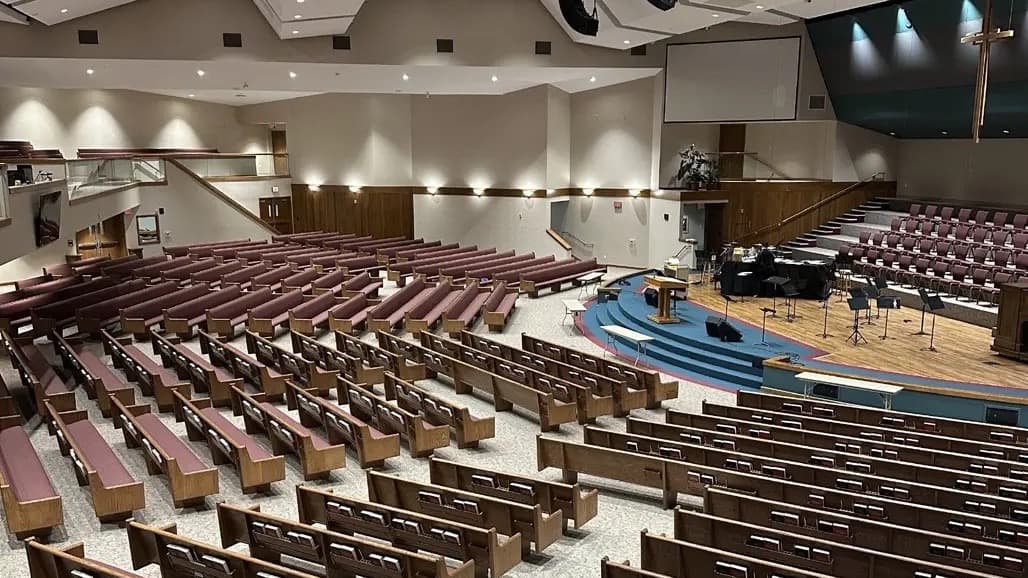
Why Sanctuary Lighting Is a Growing Priority for Oklahoma Churches
Broken Arrow is one of Oklahoma's largest and fastest-growing cities, with a population surpassing 123,000 and a thriving faith community that reflects the broader character of the state. From longtime congregations in historic buildings near downtown Broken Arrow to newer worship centers expanding along the US-51 and Elm Place corridors, churches here face a shared operational reality: the buildings they steward are heavily used, often architecturally complex, and under increasing pressure to operate more efficiently.
Sanctuary lighting sits at the center of this challenge. Unlike office buildings or retail spaces, worship environments demand lighting that is simultaneously functional, atmospheric, and technically reliable — serving Sunday morning services, Wednesday evening programs, livestreamed broadcasts, and special events throughout the week. When lighting systems fall short, the effects are immediate and visible: flickering fixtures during a sermon, dark spots above the choir loft, or maintenance crews navigating scaffolding in a vaulted ceiling between services.
Across the greater Tulsa region — including communities like Bixby, Owasso, Jenks, and Catoosa — facility managers and church administrators are recognizing that aging lighting infrastructure is no longer a minor inconvenience. It's a budget drain, a safety concern, and a barrier to the modern worship experience congregations expect.
The Real Cost of Outdated Sanctuary Lighting
Understanding why lighting upgrades matter requires looking honestly at what traditional systems cost — not just in energy, but in time, labor, and operational disruption.
High replacement frequency in difficult-to-reach spaces is one of the most persistent challenges for church facility teams. Many sanctuaries feature soaring ceilings, decorative trusses, or architectural lighting positions that require lifts or scaffolding for every routine bulb change. When traditional incandescent, halogen, or quartz lamps burn out every few months, the cumulative maintenance burden is significant — and the safety risks are real.
Aging ballasts and incompatible dimming systems compound the problem. Fluorescent and metal halide fixtures depend on ballast technology that degrades over time, producing the flickering and color shifting that disrupts worship and looks poor on video. Many older dimming systems are simply incompatible with modern LED drivers, meaning a piecemeal lamp swap often doesn't fully resolve the issue.
Energy costs from legacy systems remain unnecessarily high. High-wattage quartz and halogen fixtures generate substantial heat, contributing to cooling loads as well as direct electricity consumption — a real concern for facilities running services multiple times a week in Oklahoma's warm climate.
A nearby example illustrates how serious this can become. At New Covenant Church Worship Center in Oklahoma City, 500W quartz lamps were burning so hot that the sockets themselves had become brittle and were deteriorating. Roughly one-third of the lights were out at any given time, creating uneven illumination across the sanctuary. VOSS replaced 260 fixtures with integrated LED units, upgraded the dimming system, and completed the installation without disrupting a single worship service. The result, in the words of Steve West, the facility's representative: "The lighting is even and dims to very low levels, and when all the lights are on at 100 percent, the light output is brilliant." The new fixtures are virtually maintenance-free and last more than 25 times longer than the quartz lamps they replaced.
This kind of transformation isn't unusual — it reflects a broader shift happening in faith communities across Oklahoma and the nation.
What Modern Church Lighting Technology Makes Possible
The LED and lighting controls landscape has matured considerably in recent years, and today's options for sanctuary environments go well beyond simple lamp swaps. Understanding what's now achievable helps facility leaders and church administrators make more informed decisions.
Integrated LED fixtures with tunable color temperatures allow congregations to dial in the precise quality of light that suits their space — warmer tones for traditional worship settings, cooler or more neutral tones for contemporary or multi-use environments. This flexibility matters especially in sanctuaries that serve diverse programming throughout the week.
Advanced dimming and scene control systems allow lighting to be programmed for specific service types, events, or even individual zones within a sanctuary. A Sunday morning service, a candlelight Christmas Eve program, and a weeknight youth gathering can each have a distinct, repeatable lighting scene activated at the touch of a button — eliminating guesswork and reducing the burden on volunteers or part-time staff.
Dramatically extended fixture life is perhaps the most operationally significant benefit for facility teams. LED fixtures in commercial-grade sanctuary applications can last tens of thousands of hours, meaning a congregation that upgrades today may not face meaningful maintenance for many years. For churches with high ceilings or limited maintenance staff, this is transformative.
Livestream and video quality improvements are an increasingly important consideration. As more Broken Arrow congregations expand their digital outreach — whether through dedicated video teams or simple camera setups — the quality and consistency of sanctuary lighting directly affects how services are experienced online. LED systems with high color rendering index (CRI) ratings produce more accurate, flattering light that translates well to video.
For churches exploring related facility improvements, VOSS' broader content on Energy Efficient Church Lighting Upgrades and Energy Audits, Incentives, and Rebate Navigation for Businesses provides helpful context on how lighting projects can align with broader energy strategy.
Navigating the Upgrade Process: What Facility Leaders Should Know
For many church facility managers and administrators, the prospect of a major lighting upgrade raises practical questions: How disruptive will the installation be? What are the real costs and savings? Are there incentives available? How do we choose the right system for our space?
Installation disruption is manageable with the right contractor. A well-planned sanctuary lighting retrofit — including fixture removal, new fixture installation, wiring updates, and dimming system upgrades — can typically be phased or scheduled around a congregation's programming calendar. At New Covenant Church in Oklahoma City, 260 new fixtures were installed without any interference to ongoing worship services. That kind of coordination requires experience with the unique scheduling demands of active church facilities.
Utility rebates and incentives can meaningfully offset project costs. Oklahoma utilities and national programs frequently offer rebates for commercial LED retrofits, and churches are generally eligible. The specifics vary by utility territory and program cycle, so early conversations with a knowledgeable contractor — one experienced in rebate management — can make a material difference in project economics. Readers interested in the broader rebate landscape may find the Maximize ROI with Commercial LED Lighting Rebates article in this series a useful reference.
Cooperative purchasing programs provide an accessible path for eligible organizations. Congregations affiliated with educational institutions, or those that serve communities with public partnerships, may find that cooperative purchasing vehicles simplify procurement. VOSS participates in a range of programs including Houston Church COOP, Sourcewell, BuyBoard, TIPS, and others — providing pre-negotiated contract vehicles that can streamline the purchasing process for qualifying organizations. VOSS also holds an approved state contract in Oklahoma, which may benefit congregations with ties to public-sector programs or educational ministries.
Choosing the right fixtures for your specific space matters more than picking a product category. Sanctuaries vary enormously — a 1960s brick church in downtown Broken Arrow has different acoustic, structural, and aesthetic considerations than a modern worship center near the Creek Turnpike. Lighting design that accounts for ceiling height, reflectance, seating layout, and video production needs will outperform a generic specification every time.
VOSS in Oklahoma: Regional Experience, Local Accountability
VOSS has been serving Oklahoma communities for decades, with deep roots in the Oklahoma City metro and an established understanding of the faith community landscape across the state. Our work at New Covenant Church Worship Center is one example of how we approach church projects — with careful attention to the operational realities of active ministry environments, not just the technical specifications.
Beyond places of worship, our Oklahoma project history spans commercial properties, university facilities, and industrial settings. The University of Oklahoma Warehouse LED Retrofit in Norman — which eliminated completely non-functional lighting across three large rooms and delivered approximately $6,000 in annual energy savings — reflects the same disciplined approach to complex, high-stakes installations that we bring to sanctuary environments.
Our team understands the Greater Tulsa region's growth trajectory. Broken Arrow's continued expansion, alongside development in surrounding communities like Coweta, Wagoner, and Claremore, means that more congregations are managing larger facilities with greater operational complexity. We're here to help those facilities run better.
Service Availability
While VOSS offers a comprehensive suite of national services, specific capabilities may vary by location. Please contact your local branch to confirm the current availability of specific services, technology solutions, or contracting capabilities in your immediate market.
Start the Conversation
If your congregation is dealing with frequent bulb replacements, aging ballasts, inconsistent illumination, or simply wondering whether a lighting upgrade makes financial sense, we'd welcome the opportunity to talk through what's possible for your facility.
Our Oklahoma City branch serves Broken Arrow and the surrounding region, including communities throughout the greater Tulsa metro and beyond.
VOSS — Oklahoma City Branch Phone: (405) 949-1919 Toll-Free: (800) 735-8677
Reach out to schedule a facility consultation. We'll help you understand the options, the incentives, and the realistic outcomes — so your team can make a confident, informed decision.