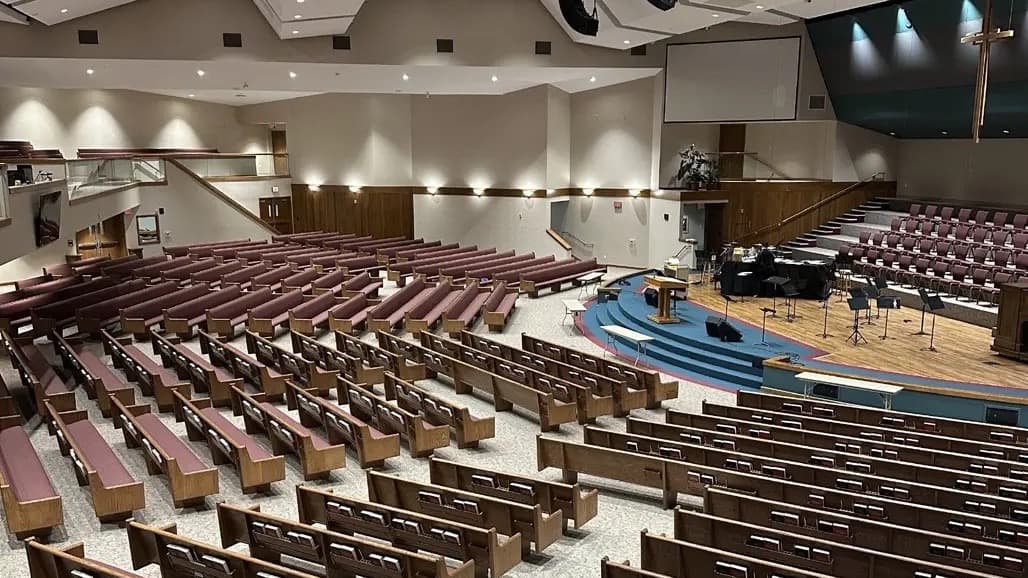
The Sanctuary Lighting Challenge Facing Twin Cities Congregations
St. Paul is home to a remarkably diverse faith community. From the historic stone sanctuaries along Summit Avenue to mid-century worship facilities in the Frogtown, Hamline-Midway, and Payne-Phalen neighborhoods — and extending out to congregations in Maplewood, Woodbury, Roseville, Eagan, and Burnsville — the region's churches represent an extraordinary range of architectural styles and building ages.
That diversity is also what makes sanctuary lighting so uniquely complex here. Many of these facilities were built or last retrofitted decades ago, and their lighting systems reflect it: aging fluorescent fixtures, incandescent or halogen sources, outdated ballasts, and dimmer systems never designed for today's LED technology. Minnesota's long winters mean these systems run hard through extended evening services, midweek programs, and holiday gatherings — all while facility teams are stretched thin and operating under tight budgets.
It's a challenge that's become increasingly difficult to ignore. And for church facility managers and operations leaders across the Greater Minneapolis-St. Paul metro, the conversation around lighting is no longer just about maintenance — it's about transformation.
Why Sanctuary Lighting Is a Distinct Specialty
Not all commercial lighting projects are created equal. A warehouse retrofit is almost entirely about efficiency and foot-candles. A church sanctuary is something different entirely — a space where lighting must serve multiple, sometimes competing, functions simultaneously.
Think about what a modern sanctuary must do in a single week:
- Host traditional worship services where warm, reverent illumination supports a sense of solemnity and community
- Accommodate livestreams and video production, where uneven light levels, color temperature inconsistencies, or harsh shadows create technical problems that undermine online ministry
- Support special events — weddings, funerals, holiday concerts — each with a different atmospheric need
- Provide safe, accessible illumination during evening programs, youth events, and community gatherings
Older lighting systems weren't designed with this versatility in mind. Many congregations in communities like North St. Paul, South St. Paul, Little Canada, and Arden Hills are still operating incandescent chandeliers or halogen spotlights that require replacement every few thousand hours — and accessing those fixtures in a 30- or 40-foot ceiling means scheduling a lift, coordinating around the service calendar, and pulling a facilities team member away from other responsibilities, sometimes multiple times a year.
This is the core maintenance burden that LED technology, properly implemented, can dramatically reduce.
The LED Advantage in Church Environments — and Why Minnesota Context Matters
LED lighting technology has matured significantly over the past decade. Today's church-grade LED fixtures offer:
- Lifespans of 50,000 hours or more, which in a typical sanctuary context can translate to a decade or longer between major replacements
- Superior color rendering (high CRI) that makes skin tones look natural under video lighting and allows architectural details — stained glass, wood grain, stonework — to read more richly
- Tunable white and dimming capabilities that let a single fixture support both a candlelit Christmas Eve service and a bright Sunday morning teaching environment
- Dramatic energy consumption reductions compared to halogen and incandescent sources, which matters in Minnesota where heating and cooling costs already put sustained pressure on operations budgets
That last point connects to an important local opportunity. Minnesota utilities — including Xcel Energy, which serves much of the Twin Cities metro — have historically offered rebate programs for qualifying energy efficiency upgrades. For nonprofit religious organizations operating on faith-based budgets, these incentive programs can meaningfully offset the upfront investment in a lighting retrofit. The dynamics of rebate availability change over time, which is why working with a contractor who understands the current landscape of available incentives is a critical part of project planning.
For those curious about related incentive programs in the region, our sibling article Maximize ROI with Commercial LED Lighting Rebates in Dallas, TX offers a useful framework for thinking about how rebate stacking and utility program navigation work in practice — even if your project is here in the Twin Cities.
Navigating Historic Constraints and Access Challenges
Minnesota's faith communities include some of the most architecturally significant buildings in the Upper Midwest. Congregations in the Cathedral Hill neighborhood of St. Paul, the historic churches of Stillwater, or landmark buildings throughout Minneapolis' Lowry Hill and Whittier neighborhoods often face a particular set of constraints when considering lighting upgrades.
Historic preservation considerations can limit the types of fixtures that can be installed, require coordination with local or state preservation authorities, and demand a level of sensitivity to the existing aesthetic that a standard commercial retrofit approach won't provide. These aren't obstacles that should discourage modernization — but they do underscore the importance of working with a contractor who has navigated these scenarios before.
The same access challenge applies across virtually all sanctuaries, regardless of historic status: high ceilings are an operational fact of life. Whether it's a traditional vaulted nave or a contemporary worship center in Inver Grove Hills or Cottage Grove, safely accessing elevated fixtures requires planning, proper equipment, and coordination that minimizes disruption to the congregation's schedule. The goal of a well-executed retrofit is simple — get in, get it done right, and not come back for years.
A Note on Cooperative Purchasing for Public-Sector and Nonprofit Readers
While the primary audience for church lighting conversations is congregational leadership and faith-based facility managers, it's worth noting that St. Paul's broader faith and community organization landscape intersects with publicly funded facilities — community centers, nonprofit service organizations, and interfaith coalitions that operate out of shared or publicly owned buildings.
For those organizations, procurement doesn't have to be complicated. VOSS holds an approved Minnesota state contract, making it straightforward for eligible public entities to source lighting products and services through a compliant, pre-vetted channel. Additionally, VOSS is accessible through a broad range of cooperative purchasing programs, including Sourcewell, TIPS, BuyBoard, Omnia Partners, AEPA, PACE, Houston Church COOP, and Nebraska ESU Co-Op — many of which are available to faith-based and nonprofit organizations that qualify. If your organization is eligible for cooperative purchasing, it can significantly simplify the procurement process and reduce administrative overhead.
What a Modern Sanctuary Lighting Upgrade Actually Looks Like
For church facility managers in the St. Paul area considering a lighting project, the process is less daunting than it might appear — particularly when approached systematically. A thoughtful upgrade typically involves:
- Facility assessment — Evaluating existing fixture types, wiring, dimming systems, and control infrastructure across the sanctuary and ancillary spaces (narthex, fellowship halls, choir loft, stage areas)
- Needs and use-case analysis — Understanding how the space is used throughout the week, including livestream or broadcast requirements, and identifying which lighting zones need the most flexibility
- Fixture and controls specification — Selecting LED sources and dimming/control systems that are compatible with one another and appropriate for the acoustic and aesthetic character of the space
- Rebate and incentive identification — Mapping available utility and state-level programs to the project scope to maximize financial benefit
- Low-disruption installation — Scheduling work around the congregation's calendar, minimizing the number of Sundays or major services affected
- System commissioning and team training — Ensuring that the facility team understands how to operate and maintain the new system going forward
This is not a one-size-fits-all process. A small congregation in the Merriam Park neighborhood of St. Paul has different needs, budget constraints, and space configurations than a large multisite church with campuses in Woodbury and Oakdale. The value of a knowledgeable contractor is in tailoring the approach to what the facility actually needs — not applying a standard commercial template to a sacred space.
For readers interested in the broader energy efficiency landscape, our Energy Efficient Church Lighting Upgrades and Energy Audits, Incentives, and Rebate Navigation for Businesses articles explore these themes in greater depth and are worth reviewing alongside this piece.
Service Availability
While VOSS offers a comprehensive suite of national services, specific capabilities may vary by location. Please contact your local branch to confirm the current availability of specific services, technology solutions, or contracting capabilities in your immediate market.
Talk to VOSS About Your Sanctuary Lighting Project
VOSS has served commercial and institutional facilities across the Upper Midwest for decades, and our Minneapolis branch team brings deep familiarity with the Twin Cities market — its utilities, its building stock, its procurement landscape, and its faith communities.
If you're a church facility manager, operations director, or congregational leader in St. Paul, Minneapolis, or the surrounding communities — from White Bear Lake to Apple Valley, from Shakopee to Hudson, WI — we'd welcome the opportunity to talk through what a lighting upgrade could mean for your facility.
VOSS Minneapolis Branch Phone: (651) 697-1599 Toll-Free: (800) 776-8677
Reach out to start a conversation with our local team. We're here to help you understand your options, navigate available incentives, and plan a project that works around your congregation — not against it.