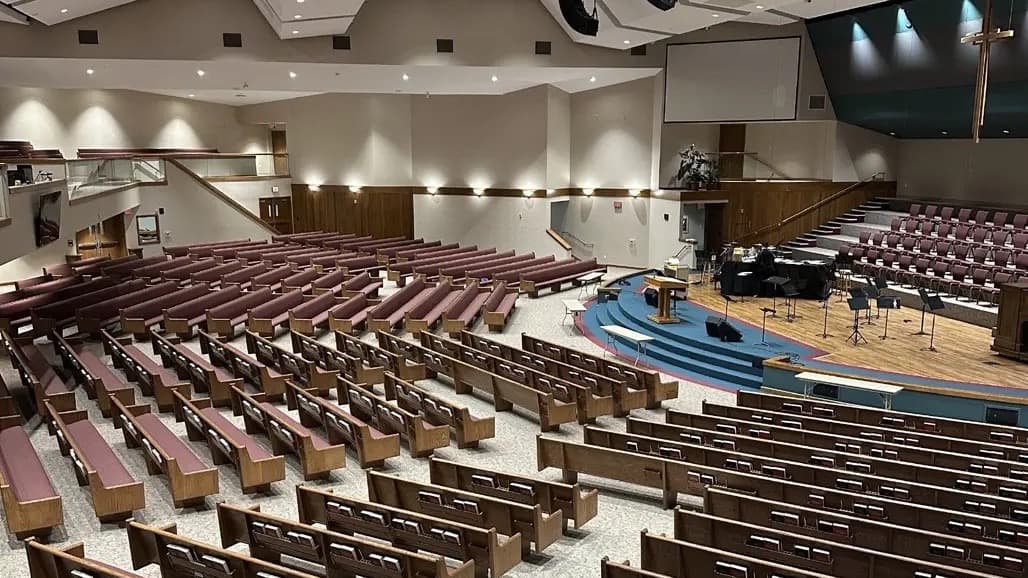
Why Sanctuary Lighting Is a Growing Priority for Twin Cities Churches
Greater Minneapolis is home to one of the most concentrated and architecturally diverse faith community landscapes in the Midwest. From historic Lutheran and Catholic congregations in St. Paul and South Minneapolis to newer nondenominational campuses in suburbs like Eden Prairie, Maple Grove, Bloomington, and Woodbury, churches across the metro area share a common operational challenge: sanctuary lighting systems that were designed for a different era are struggling to keep pace with modern demands.
The problem isn't simply aesthetic. Facility managers at churches throughout the Twin Cities are facing a convergence of pressures — aging ballasts and incandescent or fluorescent fixtures that fail frequently, high ceilings that make bulb replacement a costly, labor-intensive ordeal, rising Xcel Energy utility costs, and growing expectations for broadcast-quality illumination as livestreaming becomes a standard part of Sunday worship. Understanding these trends — and the solutions now available — is the first step toward making smarter, longer-lasting infrastructure decisions for your congregation.
The Real Cost of Deferred Sanctuary Lighting Maintenance
Many church facility managers in the Minneapolis–Saint Paul metro operate with lean maintenance teams and tight budgets. When a fixture fails in a 40-foot vaulted ceiling, the response isn't simple: it typically involves renting a lift, scheduling a crew, sourcing a replacement lamp that may already be discontinued, and coordinating around the service calendar to minimize disruption. Multiply that scenario across a year — or across multiple buildings on a larger campus — and the true cost of reactive maintenance becomes significant.
Several industry-wide trends are accelerating the urgency of this issue for Minnesota churches specifically:
- Fluorescent lamp phase-outs are already underway at the federal level, and Minnesota has been an early mover in supporting commercial transitions away from mercury-containing lamps. Facilities still relying on T12 or older T8 fluorescents are facing an increasingly constrained replacement supply chain. Our sibling article, Minnesota Fluorescent Lamp Ban: Guide for Commercial Building Operators, explores this regulatory landscape in depth and is valuable reading for any facility manager planning ahead.
- Aging ballast infrastructure is a widespread problem in sanctuaries built or last renovated in the 1980s and 1990s. Ballast failures cause flickering, humming, and sudden outages — all of which disrupt services and erode confidence in the facility's reliability.
- LED dimming compatibility is frequently misunderstood. Many churches have attempted partial LED upgrades only to encounter flickering or incompatibility with legacy dimmer controls. A properly engineered retrofit addresses the entire circuit — fixtures, drivers, and dimming controls together — rather than swapping bulbs in isolation.
The good news is that the lighting technology available today is dramatically better suited to sanctuary environments than what was available even five years ago. Warm-white LED sources now accurately replicate the ambiance of incandescent lighting, tunable systems allow worship teams to shift color temperature between intimate prayer settings and high-energy services, and control systems can be programmed to eliminate the complexity of manual adjustments.
LED Retrofit Strategies Built for Church Environments
Not all commercial LED retrofits translate cleanly to house-of-worship applications. Church sanctuaries present a distinct set of constraints that require experienced planning:
Architectural and Historic Sensitivity Many congregations in Minneapolis, Saint Paul, and inner-ring suburbs like Edina, Hopkins, and Richfield worship in buildings with significant architectural character — stained glass, ornate millwork, historic fixtures, and exposed masonry. Any lighting upgrade must complement, not compete with, these features. Fixture selection, beam angles, and color rendering index (CRI) all matter enormously in these environments. High-CRI LEDs (90+) bring out the richness of wood tones, textiles, and artwork in ways that older fluorescent sources simply cannot match.
Access and Installation Logistics Sanctuaries with 30- to 60-foot ceilings require careful lift planning and — critically — scheduling that respects the church's weekly rhythm. A well-managed retrofit minimizes the number of access events required by completing ceiling-level work comprehensively in a single mobilization rather than returning repeatedly for individual fixture failures. This "fix it once, fix it right" approach is one of the most tangible benefits of a planned LED upgrade versus ongoing reactive maintenance.
Dimming and Controls Integration Modern sanctuary lighting systems integrate seamlessly with theatrical dimming consoles, scene-preset control panels, and even smartphone-accessible platforms — giving worship leaders and AV teams the flexibility to create consistent, repeatable lighting environments for different service formats without relying on a trained technician every Sunday. For campuses in growing suburbs like Eagan, Burnsville, Shakopee, and Plymouth that host multiple weekly services, this kind of repeatable control is a genuine operational upgrade.
Livestream and Video Production Quality The rapid adoption of video ministry across Twin Cities congregations has elevated the technical bar for sanctuary lighting. Cameras are far less forgiving than the human eye when it comes to flickering, uneven illumination, or color inconsistency. High-frequency LED drivers eliminate the flicker that was endemic to older fluorescent ballasts, and proper illuminance levels across the chancel and congregation areas ensure that online services reflect the quality and care that in-person worshippers experience.
Energy Rebates and Incentives: A Practical Opportunity for Minneapolis-Area Churches
One factor that frequently surprises church leadership is the financial support available for lighting upgrades through utility incentive programs. Xcel Energy, the dominant electricity provider across the greater Minneapolis–Saint Paul region, offers commercial lighting rebates that can meaningfully offset the upfront cost of LED retrofits. Churches are generally eligible for these programs as commercial accounts, and the long-term energy savings from replacing high-wattage incandescent, halogen, or fluorescent sources with efficient LEDs compound over years of operation.
Our sibling article, Maximize ROI with Commercial LED Lighting Rebates in Dallas, TX, explores the rebate navigation process in detail — and while it focuses on a different market, the strategic principles for identifying, applying for, and stacking available incentives apply broadly. For Minneapolis-area facilities, working with a lighting partner who understands the Xcel Energy rebate process — including documentation requirements, eligible product specifications, and submission timelines — can make the difference between capturing meaningful savings and leaving money on the table.
For public-sector faith-adjacent organizations — including church-affiliated schools, social service facilities, and nonprofit community centers across the metro — procurement flexibility is worth noting. VOSS holds an approved state contract in Minnesota, making it straightforward for eligible Minnesota government and public entities to source lighting solutions through a compliant, pre-vetted channel. Cooperative purchasing programs including Sourcewell, TIPS, BuyBoard, Omnia Partners, and the Houston Church COOP are also available to qualifying organizations, streamlining the procurement process without sacrificing quality or service.
Trends Shaping the Future of Church Lighting in the Twin Cities
The conversation around sanctuary lighting is evolving beyond simple energy efficiency. Several broader trends are worth monitoring as church facilities across the Minneapolis metro plan their next five to ten years of infrastructure investment:
- Human-centric lighting (HCL) is gaining traction in commercial and institutional environments. Tunable white systems that adjust color temperature throughout the day — warmer in the morning, cooler at midday — are now being applied in sanctuary contexts to create more immersive, physiologically supportive worship environments.
- Integration with building management systems (BMS) is becoming more common on larger campuses. Connecting lighting controls to HVAC scheduling, security systems, and occupancy sensors allows facility managers to reduce energy waste during non-service hours without manual intervention.
- Backup and emergency lighting compliance is an area of growing regulatory attention in Minnesota. Ensuring that emergency egress lighting in sanctuaries, fellowship halls, and education wings meets current code requirements is a natural companion project to any primary lighting upgrade.
- Modular and scalable systems allow growing congregations — particularly in fast-developing corridors like the I-494 strip through Minnetonka and Eden Prairie, or the northern suburbs around Coon Rapids and Andover — to expand their lighting infrastructure incrementally as campuses grow, without starting over from scratch.
For facility managers navigating these decisions, the most valuable investment is often not a specific fixture or technology, but rather a clear-eyed assessment of what the facility currently has, what problems need solving, and what a phased upgrade path looks like given realistic budget timelines. Related reading from our Latest Lighting section — including Energy Efficient Church Lighting Upgrades and Energy Audits, Incentives, and Rebate Navigation for Businesses — provides additional depth on both the technology and the financial strategy sides of this decision.
Service Availability
While VOSS offers a comprehensive suite of national services, specific capabilities may vary by location. Please contact your local branch to confirm the current availability of specific services, technology solutions, or contracting capabilities in your immediate market.
Talk With VOSS About Your Sanctuary Lighting Challenges
VOSS has served commercial and institutional facilities across Minnesota and the broader Upper Midwest for decades, and our Minneapolis team understands the specific building stock, utility landscape, and operational rhythms that define church facilities in this region — from historic congregations in the Cathedral Hill and Longfellow neighborhoods of Saint Paul to modern multisite campuses stretching into Chaska, Prior Lake, and White Bear Lake.
If you're managing recurring maintenance headaches, planning a sanctuary renovation, or simply trying to understand what a modernized lighting system could realistically cost and save your facility, we'd welcome the conversation.
VOSS — Minneapolis Branch Phone: (651) 697-1599 Toll-Free: (800) 776-8677
Reach out to schedule a no-obligation consultation with our local team. We'll help you understand your options, identify available incentives, and build a realistic path forward — at a pace that works for your congregation and your budget.