Why Baseball Lighting Is a Bigger Deal in Minnesota Than You Might Think
Minnesota's climate shapes every infrastructure decision a parks director, athletic director, or facility manager makes — and sports lighting is no exception. With a compressed outdoor playing season that stretches roughly from late April through early October, baseball and softball facilities in the Twin Cities metro and surrounding communities carry an enormous amount of activity into evening hours. Night games aren't a luxury; they're a scheduling necessity.
From youth recreational fields in Bloomington, Eden Prairie, and Maple Grove to high school diamonds in Edina, Minnetonka, and Eagan — and from collegiate venues to community parks across Hennepin, Ramsey, and Dakota counties — the demand for reliable, high-performance field lighting is only growing. And as energy costs continue to rise, the technology powering those fields matters more than ever.
This is where the shift to LED sports lighting is reshaping what's possible for Minnesota facilities.
The Case for LED: What's Changed in Baseball Field Lighting
For decades, metal halide and high-pressure sodium (HPS) systems were the standard for outdoor athletic field lighting. They were the only game in town. Today, LED technology has not only matched those systems — it has surpassed them in virtually every meaningful performance category. Here's what that means in practice for baseball and softball facilities.
Light Quality and Uniformity Traditional field lighting often produces inconsistent illumination — bright spots near the poles, shadow zones in the outfield corners, and glare that affects depth perception for batters and outfielders alike. Modern LED systems are engineered with precision optics that distribute light more evenly across the infield, outfield, and warning track. For players, that consistency isn't just a comfort — it's a safety issue.
Energy Efficiency That Changes the Math LED fixtures typically consume significantly less energy than comparable metal halide systems. For a facility running night games several evenings a week across a full Minnesota season, those savings accumulate into a meaningful reduction in operating costs year over year. When you factor in available utility rebates and incentives — which Minnesota facilities may be eligible for through local providers — the financial case for upgrading becomes compelling.
Instant On/Off and Controls Integration LED systems reach full brightness immediately, with no warm-up or cool-down cycle. For baseball and softball, this matters: rain delays, mid-game restarts, and broadcast timing all benefit from lighting that responds instantly. Modern LED systems also integrate with smart controls platforms, enabling remote operation, scheduling automation, dimming, and real-time energy monitoring — capabilities that older field lighting simply cannot support.
Longer Lifespan, Lower Maintenance Outdoor athletic lighting is expensive to maintain — not just the fixtures themselves, but the labor and equipment required to reach poles and replace lamps. LED systems offer dramatically longer operational lifespans than traditional sources, reducing the frequency of maintenance interventions. For parks departments and school districts managing dozens of facilities across a region, that reduction in service calls has real budgetary value.
From the Field: A Proof Point in Action
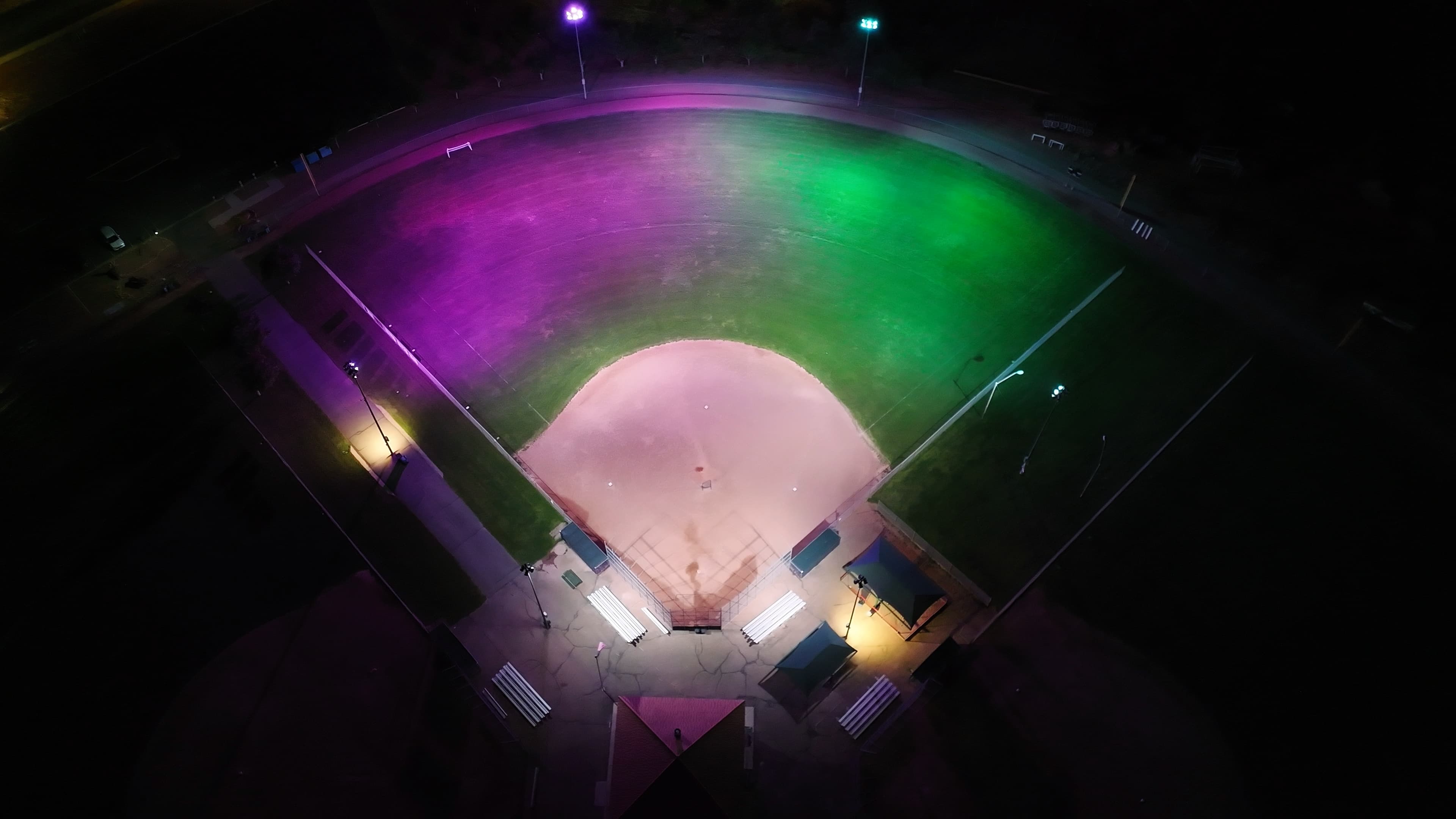
VOSS has delivered LED baseball lighting solutions across markets nationwide, and one project illustrates the scale and complexity we're equipped to handle. In Page, Arizona, VOSS completed a professional-grade LED sports lighting installation for a baseball facility — a project that required precision photometric design, careful pole placement, and full compliance with governing body standards. The result was a dramatically improved playing environment that met both performance and energy efficiency goals.
While Page, AZ is a long way from Minneapolis, the engineering challenges are universal: managing glare, achieving uniform footcandle levels across a full diamond, and integrating controls that give operators real flexibility. Those same capabilities and that same level of design rigor are what VOSS brings to every project — whether it's a renovated community field in Plymouth or a new multi-diamond complex in Roseville.
What to Know Before You Upgrade: Key Design Considerations
LED field lighting isn't a plug-and-play proposition. Done well, it requires a methodical design process that accounts for the specific characteristics of each facility. Here are the factors that matter most.
Photometric Design and Footcandle Standards Different levels of play carry different lighting requirements. Little League, NFHS high school standards, NCAA collegiate requirements, and professional specifications each define minimum footcandle levels and uniformity ratios that a compliant system must achieve. A well-engineered photometric design — modeled in software before a single fixture is ordered — ensures the final installation meets or exceeds those benchmarks.
Pole Placement and Mounting Height The geometry of a baseball field is unique among sports venues. Foul territory, the pitcher's mound elevation, outfield distances, and backstop positioning all influence where poles should be placed and how high fixtures need to be mounted to avoid glare in batters' lines of sight. Getting this wrong is costly — both financially and in terms of player experience.
Glare Control Spill light — illumination that extends beyond the field boundary — is a practical concern for fields located near residential neighborhoods, which describes a significant portion of community parks in cities like St. Paul, Brooklyn Park, Burnsville, and Shakopee. Modern LED optics and house-side shields can dramatically reduce spill and upward light scatter, helping facilities maintain good relationships with neighboring properties.
Controls and Connectivity For facilities managed by parks and recreation departments or school districts, smart controls can transform how fields are operated. Remote on/off capability, occupancy-based scheduling, and energy dashboards reduce both staff burden and operating costs. This is especially relevant for multi-field complexes where staff cannot be physically present at every diamond to manage lighting manually.
A Note for Public Agencies and School Districts in Minnesota
Parks departments, school districts, and municipal recreation programs across the Twin Cities metro often face a specific challenge: tight capital budgets competing against genuine infrastructure needs. Lighting upgrades are easy to defer — until an aging system fails mid-season or a safety inspection flags deficiencies.
VOSS holds an approved state contract in Minnesota, which means qualifying government agencies can procure lighting and electrical services through a pre-negotiated, compliant contract vehicle — eliminating the need for a separate bid process and accelerating project timelines. Minnesota public entities may also access VOSS services through cooperative purchasing programs including Sourcewell, TIPS, BuyBoard, AEPA, Omnia Partners, PACE, and others. These programs are designed to make it easier for public-sector organizations to move quickly on infrastructure improvements without sacrificing compliance or value.
For districts in Anoka, Washington, Scott, Carver, and surrounding counties considering baseball or softball field upgrades, these procurement pathways are worth exploring early in the planning process.
How VOSS Approaches Baseball Lighting Projects in the Minneapolis Market
VOSS is not a lighting manufacturer — we are a full-service commercial electrical contractor with 85+ years of experience managing complex lighting and electrical projects from design through commissioning. That distinction matters. We work with leading sports lighting manufacturers, including systems built to MUSCO-level performance standards, to specify and install solutions that are right for each facility rather than defaulting to a single product line.
Our Minneapolis branch team understands the local utility landscape, is familiar with Minnesota's seasonal project constraints, and has the relationships with inspectors, municipalities, and utility providers that help projects move efficiently from approval to activation. Whether your facility is a single-field neighborhood park in Richfield or a multi-diamond tournament complex serving communities across the western suburbs, we can manage the full scope — electrical infrastructure, pole foundations, fixture installation, controls integration, and final commissioning.
For facilities exploring LED retrofits, our team can also help navigate available utility rebates and energy incentive programs, which can meaningfully offset project costs.
Related Reading
If you're evaluating lighting upgrades more broadly, several related topics in this content series may be useful. Our articles on LED Gymnasium Lighting Solutions, Pickleball LED Lighting Solutions, and Tennis Court Lighting and Energy Solutions address sport-specific design considerations across different venue types. For organizations managing broader campus or facility lighting strategies, our coverage of Commercial LED Outdoor Lighting, Parking Lot and Outdoor LED Lighting Upgrades, and Energy Audits, Incentives, and Rebate Navigation for Businesses provides relevant context for thinking about lighting holistically. Minnesota-specific readers should also review our coverage of Phoenix AZ LED Lighting Rebates and Minneapolis LED Lighting Rebates for utility program guidance applicable to this market.
Service Availability
While VOSS offers a comprehensive suite of national services, specific capabilities may vary by location. Please contact your local branch to confirm the current availability of specific services, technology solutions, or contracting capabilities in your immediate market.
Talk to the VOSS Minneapolis Team
If you manage a baseball or softball facility anywhere in the Greater Minneapolis area — from the urban core to the outer-ring suburbs of the Twin Cities metro — we'd welcome the opportunity to have a practical, no-pressure conversation about what a lighting upgrade could look like for your specific situation. We can discuss your current system, your energy costs, your governing body requirements, and the procurement options available to your organization.
VOSS — Minneapolis Branch
Phone: (651) 697-1599
Toll-Free: (800) 776-8677
Reach out to start a conversation with our local team. There's no obligation — just straightforward expertise from a contractor that has been doing this work, in markets like yours, for more than eight decades.