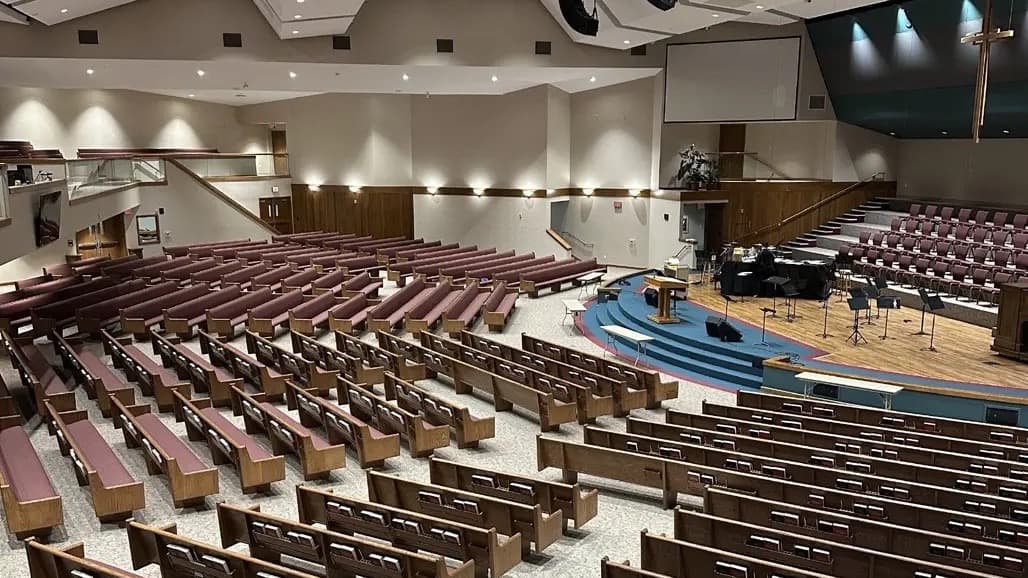
Why Sanctuary Lighting Is a Growing Priority for Minnesota Churches
For faith communities throughout Lakeville, Farmington, Apple Valley, Burnsville, and the southern Twin Cities corridor, the condition of sanctuary lighting is more than a maintenance checkbox — it shapes the entire worship experience. Aging incandescent, halogen, and fluorescent fixtures are increasingly difficult to manage, and the operational reality inside a busy church building makes that challenge even more acute.
Minnesota's long winters mean congregations are gathering in low natural light for months at a time, placing greater demands on interior lighting systems. When fixtures flicker, dim unevenly, or burn out in hard-to-reach ceiling vaults, the impact is immediate: disrupted services, safety concerns, and a growing workload for facility staff who are often already stretched thin. For growing communities in Dakota County — one of the fastest-growing counties in the state — these pressures are only increasing as congregations expand their programming, add livestreaming, and welcome more members.
Understanding the trends reshaping church lighting is the first step toward making smarter, longer-lasting decisions for your facility.
The Real Maintenance Burden Facing Church Facility Teams
Sanctuary lighting maintenance is deceptively complex. Unlike a standard commercial office, a church presents a unique combination of architectural features, usage patterns, and access challenges that make routine bulb replacements far more costly and disruptive than they appear on paper.
High-ceiling access is one of the most significant cost drivers. Many sanctuaries in the Lakeville area — from traditional steepled churches to newer contemporary worship centers — feature vaulted ceilings ranging from 20 to 50 feet or higher. Replacing a single failed bulb in these spaces can require renting a scissor lift or scaffolding, coordinating access around a weekly worship schedule, and pulling in a crew for what amounts to a single fixture. Multiply that across a year of burnouts, and the hidden labor and equipment costs add up quickly.
Ballast failure and dimmer incompatibility are the next most common pain points facility managers report. Older fluorescent and HID (high-intensity discharge) fixtures rely on ballasts that degrade over time, causing the characteristic flickering and humming that disrupts services. Many churches have also attempted to install dimmers with existing fluorescent systems, only to find the technologies are fundamentally incompatible — resulting in buzzing, strobing, or shortened fixture life.
Livestreaming and video production have raised the bar on what "good lighting" means for a modern sanctuary. Color temperature consistency, flicker-free output, and controllable intensity are no longer luxuries for megachurches alone — even mid-size congregations in communities like Prior Lake, Savage, and Eagan are investing in camera systems and online ministry, and their lighting needs to support that mission. Uneven illumination, color shifts across the worship space, or harsh shadows on the platform area can undermine the quality of recorded and broadcast content.
LED Retrofits: What the Technology Shift Means for Church Facilities
The transition from traditional light sources to LED technology has matured significantly over the past decade, and the implications for church facilities are substantial. This is not simply about swapping bulbs — it represents a fundamental change in how sanctuary lighting systems operate, how long they last, and how they can be managed.
Dramatically extended lamp life is the headline benefit. Quality LED fixtures designed for commercial environments are rated for 50,000 hours or more of operation — compared to 1,000–2,000 hours for incandescent bulbs, and 10,000–15,000 hours for fluorescent tubes. For a church that holds multiple services per week plus rehearsals, events, and community programming, this means the difference between climbing that lift several times a year and potentially not needing to return to certain fixtures for a decade or more.
Energy consumption reductions are equally significant. LED technology typically delivers 50–70% reductions in energy use compared to legacy incandescent and halogen sources, and meaningful reductions compared to fluorescent as well. For a facility running several hundred fixtures across a sanctuary, fellowship hall, and ancillary spaces, that translates into real, recurring savings on monthly utility bills — dollars that can be redirected toward ministry.
Minnesota's fluorescent lamp regulations add another dimension of urgency to this conversation. As detailed in our article on the Minnesota Fluorescent Lamp Ban, new restrictions on the sale and distribution of certain fluorescent lamp types are already affecting commercial facilities across the state. Churches that rely on T12 and certain T8 fluorescent tubes need a proactive plan — waiting for lamps to fail before transitioning could mean scrambling to find replacement inventory that is no longer available. An LED retrofit addresses this regulatory pressure while delivering the performance and efficiency benefits described above.
Dimming and lighting controls are where the modern LED upgrade truly elevates the sanctuary experience. Unlike fluorescent systems, quality LED fixtures work natively with modern 0-10V and DMX dimming protocols, allowing facility teams to create preset scenes for different service types — a bright, energizing setting for contemporary worship, a softer, more reverent atmosphere for traditional or candlelight services, and a practical work-light mode for setup and teardown. These presets can be recalled with a single button, reducing the technical burden on volunteer and part-time staff.
Key Considerations for Church Lighting Projects in the Greater Minneapolis Area
Not all LED retrofit projects are the same, and sanctuary environments present specific variables that require expertise and careful planning. Here are the factors that matter most for faith communities in the Lakeville region:
- Color rendering and temperature selection. The color of light affects how wood tones, fabric, stained glass, and skin tones appear in the sanctuary. Most worship environments benefit from fixtures in the 2700K–3000K (warm white) range, though contemporary spaces with high-production video needs sometimes favor 3500K for a cleaner camera look. Color Rendering Index (CRI) ratings of 90+ are increasingly recommended for spaces where visual accuracy matters.
- Historic and architectural constraints. Several congregations in Dakota County and throughout the southern metro occupy buildings with historic significance or architectural character that must be preserved. Retrofit solutions must accommodate existing fixture housings, wiring pathways, and structural limitations without compromising the building's character.
- Phased project delivery. Budget realities often mean that sanctuary lighting upgrades need to be phased across multiple fiscal years or funding cycles. A well-structured project plan can prioritize the highest-impact areas — typically the main worship platform and primary seating — while scheduling remaining spaces in subsequent phases.
- Minimizing service disruption. Installation scheduling must work around the church calendar. That means avoiding holiday seasons, major event weekends, and critical programming blocks. Experienced contractors who understand church operations plan installations during lower-activity windows and can execute efficiently to minimize the time any space is out of service.
- Cooperative purchasing options. Churches and faith-based organizations that participate in cooperative purchasing programs may have access to pre-negotiated pricing and streamlined procurement. The Houston Church COOP is one such program specifically designed for faith communities, and VOSS participates in this cooperative — making it easier for eligible congregations to access quality lighting solutions with simplified procurement. Other cooperatives including Sourcewell, TIPS, BuyBoard, and Omnia Partners are also available to eligible organizations.
Connecting Sanctuary Lighting to Broader Energy and Facility Goals
For church facility managers and operations leaders, a sanctuary lighting upgrade rarely exists in isolation. It connects naturally to a broader set of facility priorities: reducing operating costs, modernizing aging infrastructure, improving safety, and making the most of limited maintenance resources.
Minnesota utility providers offer energy efficiency rebate programs that can offset a meaningful portion of LED retrofit costs. Engaging with these programs early in the planning process — understanding what qualifies, what documentation is required, and how rebates are calculated — can significantly improve a project's financial case. Our article on Energy Audits, Incentives, and Rebate Navigation for Businesses explores this process in greater depth and is a valuable companion read for facility teams preparing a budget proposal.
It's also worth considering how sanctuary lighting improvements connect to the broader electrical and controls infrastructure of the building. Lighting controls, emergency egress systems, and audiovisual integrations often share conduit pathways and panel capacity. A coordinated approach — rather than treating each system as a standalone project — tends to deliver better outcomes and fewer surprises during installation.
For congregations exploring outdoor improvements as well, our content on Parking Lot and Outdoor LED Lighting Upgrades and Commercial LED Outdoor Lighting addresses the unique requirements of church parking areas and exterior spaces, which serve as the first and last impression for every visitor.
Service Availability
While VOSS offers a comprehensive suite of national services, specific capabilities may vary by location. Please contact your local branch to confirm the current availability of specific services, technology solutions, or contracting capabilities in your immediate market.
Talk With a Local Expert About Your Sanctuary Lighting Needs
VOSS has served faith communities, commercial facilities, and public-sector organizations across the greater Minneapolis–St. Paul metro for decades. Our Minneapolis branch team understands the unique demands of Minnesota church facilities — from Dakota County's growing suburban congregations to established urban and rural parishes throughout the region.
If your sanctuary is dealing with aging fixtures, frequent maintenance calls, rising energy costs, or the pressure to support a more modern worship and media environment, we'd welcome the conversation. Our approach starts with listening — understanding your facility's specific challenges, your congregation's priorities, and your budget realities — before recommending any solution.
VOSS Minneapolis Branch
Phone: (651) 697-1599 Toll-Free: (800) 776-8677
Reach out to schedule a consultation with our local team. We're here to help Lakeville-area congregations make informed, confident decisions about their lighting and electrical infrastructure — at whatever pace makes sense for your organization.