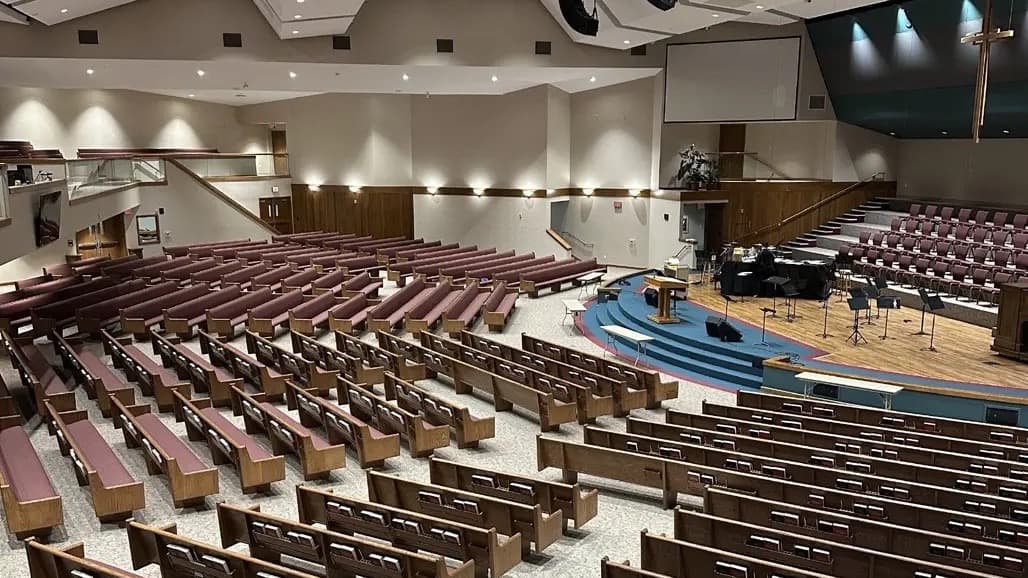
Why Sanctuary Lighting Is a Growing Priority for Eagan-Area Churches
Eagan, Minnesota is home to a vibrant and growing faith community. With a population of approximately 69,000 and strong residential growth across the southern Twin Cities metro, congregations here — from established parishes near Pilot Knob Road to newer worship centers along Yankee Doodle Road and into neighboring communities like Burnsville, Apple Valley, and Inver Grove Heights — are managing increasingly complex facilities. Many of these sanctuaries were built or last renovated decades ago, and their lighting systems reflect it.
Across the region, facility managers and operations leaders at houses of worship are confronting a shared reality: aging lighting infrastructure is no longer just a maintenance nuisance — it's a financial and operational liability. Incandescent and fluorescent fixtures that once seemed adequate are now driving up utility bills, demanding frequent attention, and falling short of the visual standards that modern worship services and livestreamed content require.
Understanding where the industry is heading — and what's working for peer facilities across Minnesota — is the first step toward making smart, sustainable decisions for your congregation.
The Hidden Costs of Deferred Lighting Maintenance in Church Facilities
For many church facility managers, sanctuary lighting maintenance operates on a reactive model: a bulb burns out, a lift or scaffolding is arranged, and the problem is addressed — until the next failure. In sanctuaries with vaulted ceilings, ornate architecture, or limited access points, that cycle is expensive and disruptive in ways that go well beyond the cost of the bulb itself.
The real costs tend to compound in several ways:
- Labor and access equipment — Renting scissor lifts or contracting for high-ceiling access multiple times per year adds up quickly, and scheduling those interventions around service times, rehearsals, and community events creates ongoing logistical friction.
- Aging ballasts and wiring — Flickering or dimming lights are often symptoms of deteriorating ballast infrastructure, not just bulb failure. Ignoring these signs can lead to more significant electrical issues and safety concerns.
- Energy consumption — Traditional incandescent and older fluorescent fixtures consume significantly more energy than modern LED alternatives. In a region like Minnesota, where heating costs already strain facility budgets through long winters, unnecessary electrical draw compounds the challenge.
- Livestream and video quality — A growing number of congregations in the Twin Cities area broadcast services online. Uneven illumination, color inconsistency, or visible flicker on camera can undermine production quality and viewer experience.
Minnesota's energy landscape adds another layer of relevance here. Xcel Energy, the primary utility serving much of the greater Minneapolis-Saint Paul metro including Eagan, offers commercial lighting rebate programs that can meaningfully offset the cost of LED upgrades. Facility managers who understand how to navigate these incentives — and how to pair them with strategic upgrade planning — can dramatically improve the financial case for modernization.
What Modern LED Technology Means for Sanctuary Environments
The LED revolution has matured considerably over the past decade, and the options available to church facilities today are far more sophisticated than the early-generation products that gave some decision-makers pause. For sanctuary environments specifically, several technology developments are worth understanding.
Tunable white and color temperature control allows lighting systems to shift the warmth or coolness of light throughout the day or across different service types. A contemplative midweek prayer service may call for softer, warmer tones, while a high-energy Sunday morning worship experience benefits from brighter, more energizing light. Systems with this capability give worship directors and technical teams meaningful creative control without requiring rewiring or fixture changes.
Dimming compatibility is another area where the industry has advanced. Early LED products were notoriously difficult to integrate with existing dimmer infrastructure, often producing buzz, flicker, or limited range. Today's fixtures and drivers are designed with compatibility in mind, and a well-specified retrofit can eliminate the flickering and buzzing that plagues older systems.
Longevity and reduced maintenance cycles are perhaps the most operationally significant benefit for facility managers. Quality LED fixtures rated for 50,000 hours or more can dramatically reduce the frequency of bulb replacements — in some cases, extending the interval between high-ceiling access interventions from months to years. For a congregation in Eagan or Apple Valley managing a busy facility calendar, that reduction in disruption is itself a meaningful return on investment.
It's also worth noting that Minnesota has been actively moving away from fluorescent lamp technology at the regulatory level. Facility managers who have been following developments around fluorescent lamp phase-outs — a topic explored in depth in our article on the Minnesota Fluorescent Lamp Ban — should understand that sanctuary retrofits represent an opportunity to get ahead of those changes proactively rather than reactively.
Practical Considerations for Church Facility Leaders in the Twin Cities
Upgrading sanctuary lighting is not a one-size-fits-all undertaking. Church buildings present a unique combination of architectural, operational, and budgetary constraints that distinguish them from standard commercial facilities. Here are the considerations we see facility managers and operations leaders navigate most often in this market.
Historic and architectural sensitivity — Many established congregations in the greater Minneapolis area occupy buildings with significant architectural character — stained glass, wood beam ceilings, decorative fixtures, and custom millwork. Retrofit projects in these environments require a contractor experienced in preserving aesthetic integrity while upgrading the underlying technology. Not every lighting contractor has that sensitivity.
Phased implementation — Budget realities often make a complete sanctuary overhaul impractical in a single fiscal year. A phased approach — prioritizing the fixtures with the highest failure rate, greatest energy draw, or most critical aesthetic impact — allows congregations to spread costs while realizing incremental benefits. Understanding how to structure that sequence is part of the strategic value an experienced contractor brings.
Rebate navigation — Xcel Energy's commercial rebate programs are accessible to qualifying nonprofit and religious organizations, but the application process has specific requirements around fixture specifications, installation documentation, and timing. Working with a contractor who has experience navigating these programs in the Minnesota market can mean the difference between capturing available incentives and leaving money on the table. Our article on Maximize ROI with Commercial LED Lighting Rebates in Dallas, TX illustrates the rebate capture strategy in another market, and the same discipline applies here.
Cooperative purchasing for eligible organizations — While rebate programs primarily benefit houses of worship directly, church-affiliated schools, community centers, and other organizations connected to faith communities may qualify for cooperative purchasing programs. VOSS participates in a number of cooperative purchasing vehicles — including Sourcewell, TIPS, BuyBoard, Omnia Partners, and the Houston Church COOP — that can simplify procurement for eligible entities. VOSS also holds an approved state contract in Minnesota, making it straightforward for any connected public or government entities to source lighting solutions through a compliant, pre-vetted channel.
The Role of Controls and Smart Systems in Long-Term Facility Strategy
For congregations thinking beyond the immediate lighting upgrade, building automation and lighting controls represent the next frontier of facility efficiency. Occupancy sensors, daylight harvesting, and programmable scene controls can further reduce energy consumption and maintenance burden while giving facility teams more precise management capability.
A sanctuary that hosts Sunday morning services, Wednesday evening programs, youth group gatherings, community events, and private ceremonies throughout the week has genuinely different lighting needs across those use cases. A well-designed controls system allows staff to activate pre-set lighting scenes with minimal effort — reducing both the operational complexity and the risk of fixtures being left on unnecessarily between uses.
This topic connects naturally to broader trends in commercial building intelligence that we explore across the Latest Lighting section. Whether your congregation is considering its first LED retrofit or thinking about a more comprehensive controls integration, the strategic direction is consistent: lighting systems that are easier to manage, more energy-efficient, and more responsive to the actual needs of the space create lasting value.
Service Availability
While VOSS offers a comprehensive suite of national services, specific capabilities may vary by location. Please contact your local branch to confirm the current availability of specific services, technology solutions, or contracting capabilities in your immediate market.
Connect With VOSS in Eagan and the Greater Twin Cities
VOSS has served the greater Minneapolis-Saint Paul metro for decades, with deep experience in Minnesota's utility programs, building codes, and the diverse facility needs of communities across the region — from Eagan and Burnsville to Bloomington, Rosemount, Lakeville, and beyond. Our local branch team combines that regional knowledge with the resources of a national contractor, giving faith community facility leaders a partner equipped to handle both the technical and logistical dimensions of a sanctuary lighting project.
If your congregation is navigating flickering fixtures, preparing for a fluorescent phase-out, or simply exploring what a modern LED upgrade could mean for your facility's operation and budget, we'd welcome the conversation.
VOSS Minneapolis Branch
Phone: (651) 697-1599 Toll-Free: (800) 776-8677
Reach out to schedule a no-pressure consultation with our local team. We're here to help you think through the options — not just sell you a solution.