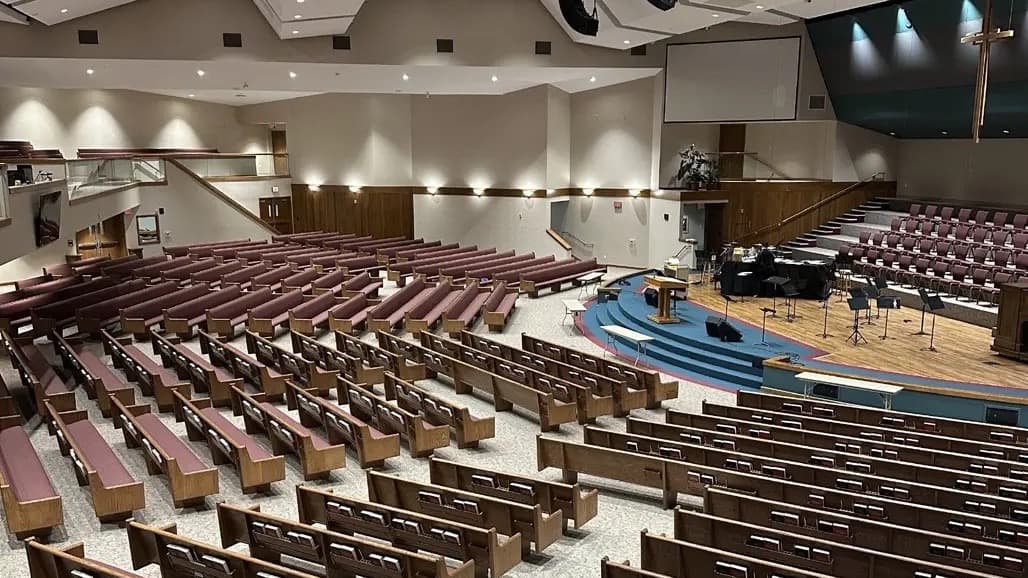
Why Sanctuary Lighting Is a Growing Facility Priority for Blaine-Area Churches
For church facility managers and maintenance supervisors across Blaine, Coon Rapids, Andover, and the broader Anoka County region, sanctuary lighting has quietly become one of the most demanding operational challenges on the building management list. Minnesota's long winters drive congregations indoors for extended hours, putting consistent demand on lighting systems that, in many cases, haven't seen a meaningful upgrade in a decade or more.
The issue isn't simply aesthetics. Flickering fixtures, burned-out lamps in 30-foot vaulted ceilings, incompatible dimmers on aging ballasts, and uneven light levels across the nave create real-world friction — disrupting services, creating safety concerns, and straining the maintenance team with repeated lift rentals and reactive repairs. As churches across the greater Minneapolis metro increasingly invest in livestream and video production for hybrid congregations, poor lighting quality has become a visible and immediate problem.
Understanding the landscape of available solutions — and what separates a meaningful long-term upgrade from a temporary fix — is the first step toward resolving these challenges with confidence.
The Core Challenges Facing Church Facility Teams in Minnesota
Church sanctuaries present a unique combination of architectural, operational, and budgetary constraints that make standard commercial lighting approaches a poor fit. Facility leaders in Blaine and surrounding communities like Ham Lake, Lino Lakes, and Spring Lake Park regularly navigate several overlapping pain points.
High-ceiling maintenance demands are among the most disruptive. Traditional incandescent, halogen, and fluorescent sources installed in elevated fixtures — common in sanctuaries built between the 1970s and early 2000s — carry relatively short operational lifespans. Replacing them requires scaffolding or lift equipment, meaning even routine maintenance becomes a planned event that disrupts programming and adds cost.
Ballast and dimmer incompatibility is another widespread issue. Many sanctuaries operate aging fluorescent or metal halide systems with ballasts that are increasingly difficult to source. When these components fail — often without warning — the result is flickering, buzzing, or complete dark zones during services. Compounding the problem, older dimming systems are rarely compatible with newer LED drivers, creating integration challenges when congregations attempt partial upgrades.
Light quality inconsistencies affect both the congregation's experience and the technical quality of recorded or streamed services. Uneven color temperatures, shadowed zones in the chancel or choir area, and insufficient foot-candle levels at pew height are common findings in pre-upgrade assessments. For churches in the Minneapolis metro that have invested in broadcast-quality video infrastructure, mismatched or inadequate lighting undermines that investment directly.
Minnesota's state energy efficiency landscape adds another layer of relevance. As fluorescent lamp bans continue to reshape the commercial lighting market — a topic explored in detail in the Minnesota Fluorescent Lamp Ban guide within the Latest Lighting section — churches operating older T12 or T8 fluorescent systems face a compliance and transition timeline that makes proactive planning increasingly important.
How LED Technology Is Reshaping Sanctuary Lighting
The shift to LED in commercial and institutional settings has been well-documented across retail, industrial, and municipal environments. For faith communities, however, the conversation has matured in important and specific ways over the past several years. Modern LED systems designed for sanctuary applications offer capabilities that go well beyond simple energy reduction.
Tunable white and color-temperature flexibility allows facility teams to adjust the warmth or coolness of the light environment to match different service types — a traditional Sunday morning service, a candlelit Christmas Eve gathering, or a weekday youth program all carry different lighting needs. Modern LED fixtures with tunable output give operators that control from a single system, often through intuitive digital interfaces.
Dramatically extended lamp life is arguably the most operationally significant benefit for high-ceiling environments. Quality LED sources commonly rated for 50,000 hours or more mean that the quarterly or semi-annual lift rentals required under traditional lamp regimes become infrequent events measured in years rather than months. For lean maintenance teams managing multiple buildings or campuses — a common reality for larger congregations in Blaine and neighboring communities like Fridley and Brooklyn Park — this represents a genuine workload reduction.
Dimming compatibility and controls integration has advanced considerably. Current LED drivers are designed to work with a wide range of dimming protocols, and modern control systems can be programmed with scene presets that operators call up with a single button press. This is particularly valuable for churches that host a variety of events — from intimate memorial services to large-scale productions — in the same space across a given week.
Energy savings and utility incentives make the financial case increasingly compelling. Xcel Energy, which serves a significant portion of the Twin Cities metro including communities throughout Anoka County, offers commercial efficiency rebates that can meaningfully offset the upfront cost of qualifying LED retrofits. Navigating those rebate programs effectively — understanding what fixtures qualify, how to document the project, and how to stack incentives — is a critical part of project planning that too often gets overlooked. The Energy Audits, Incentives, and Rebate Navigation for Businesses article in the Latest Lighting series covers this process in depth and is worth reviewing before scoping any upgrade project.
Procurement Pathways for Eligible Organizations
While many churches operate as independent nonprofit entities, some faith-based organizations in Minnesota may be affiliated with school systems, community development structures, or public-sector networks that qualify for cooperative purchasing programs. VOSS participates in several cooperative purchasing vehicles that simplify the procurement process for eligible organizations — including Sourcewell, TIPS, BuyBoard, AEPA, Omnia Partners, PACE, Houston Church COOP, and Nebraska ESU Co-Op.
Notably, Houston Church COOP is a purpose-built cooperative purchasing program specifically designed to serve faith communities, offering a compliant, pre-negotiated pathway for churches looking to procure lighting, electrical, and technology solutions efficiently and cost-effectively.
VOSS also holds an approved state contract in Minnesota, which streamlines procurement for any government-affiliated or public-sector entities undertaking facility upgrades in the region.
For facility managers and business administrators at faith communities exploring an upgrade, understanding available procurement options early in the planning process can significantly simplify the path from decision to installation.
What a Thoughtful Sanctuary Lighting Assessment Covers
One of the most common missteps in sanctuary lighting projects is moving directly to product selection before completing a thorough facility assessment. The architectural and operational diversity of church sanctuaries — from compact neighborhood chapels in Blaine to large multipurpose worship centers serving congregations across the northern Minneapolis suburbs — means that no two projects are identical.
A well-structured lighting assessment for a faith community typically addresses several interconnected areas:
- Existing fixture inventory and condition — identifying which systems are candidates for retrofit versus full replacement, and flagging any deferred maintenance or code concerns
- Photometric analysis — evaluating current light levels against recommended foot-candle targets for worship spaces, identifying shadowed zones, and modeling proposed LED layouts before any product is ordered
- Electrical infrastructure review — confirming that panels, wiring, and dimming systems can support the planned upgrade without costly surprises during installation
- Controls and programming scope — determining whether a basic dimming upgrade, a scene-preset system, or a more sophisticated integrated control platform best matches the facility's programming needs and staff capabilities
- Incentive and rebate eligibility — mapping the project to available utility programs and any applicable cooperative purchasing vehicles to optimize the financial outcome
Historic sanctuaries require additional attention, as architectural features — decorative fixtures, plaster ceilings, stained glass — create both aesthetic priorities and access constraints that influence product selection and installation sequencing. VOSS brings 85-plus years of commercial electrical experience to these assessments, including familiarity with the preservation sensitivities that come with historic or architecturally significant worship spaces.
Service Availability
While VOSS offers a comprehensive suite of national services, specific capabilities may vary by location. Please contact your local branch to confirm the current availability of specific services, technology solutions, or contracting capabilities in your immediate market.
Connect With VOSS in the Minneapolis Area
Faith communities across Blaine, Coon Rapids, Andover, Lino Lakes, Ham Lake, and the broader Anoka County area are welcome to reach out to the VOSS Minneapolis branch to discuss a sanctuary lighting assessment, explore retrofit options, or get guidance on available utility incentives and cooperative purchasing programs.
Our team is here to be a knowledgeable resource — not just a vendor — as your congregation navigates the decision-making process.
VOSS Minneapolis Branch Phone: (651) 697-1599 Toll-Free: (800) 776-8677
We invite you to start with a conversation. Whether you're managing a flickering fixture problem today or planning a full sanctuary renovation for next year, our team can help you understand your options, build a realistic project scope, and connect you with the incentives that make upgrading more financially achievable than you might expect.