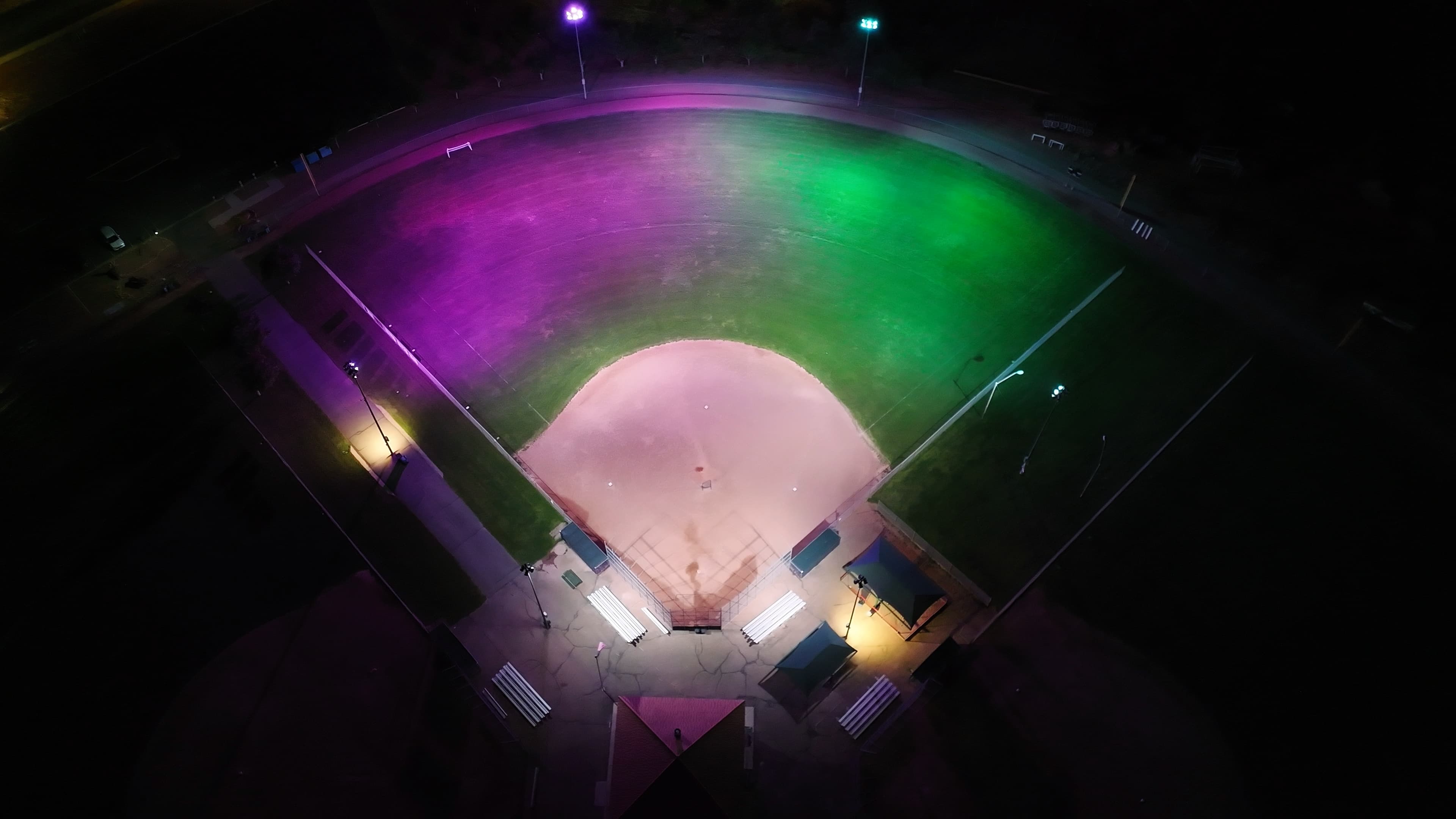
Why Baseball Lighting Deserves More Than a One-Size-Fits-All Approach
Baseball is a sport defined by split-second decisions — a curveball breaking over the plate, a line drive tracking into the gap, a fielder reading the trajectory off the bat. For any of that to happen safely and fairly after sundown, the lighting system carrying the game has to perform at a level most facilities still haven't achieved.
Across Greater Lincoln and the surrounding communities of Waverly, Hickman, Beatrice, Seward, and York, baseball and softball fields range from youth recreational parks to high school varsity complexes to collegiate-level stadiums. What they share is a common challenge: many were built with metal halide or high-pressure sodium (HPS) systems that are now decades old, energy-intensive, and increasingly difficult to maintain. The transition to modern LED technology isn't just a cost story — it's a performance story, and it's reshaping how facilities in Nebraska and across the country think about their fields.
What Makes Baseball Lighting Uniquely Demanding
Not all sports lighting is created equal. A football field, a basketball court, and a baseball diamond each present distinct photometric challenges — and baseball may be the most complex of the three.
The combination of a fast-moving white ball, a pitcher-batter sightline that can span 60 feet or more, and outfield dimensions that vary by facility creates a lighting environment where consistency, uniformity, and glare control are non-negotiable. Key design considerations include:
- Pole placement and mounting height — Poles must be positioned to minimize glare in the batter's line of sight while delivering adequate foot-candles across the infield, outfield, warning track, and foul territory
- Uniformity ratios — The ratio between the brightest and darkest areas of the field must meet the standards set by governing bodies like the NCAA, NFHS, USA Baseball, and ASA/USA Softball
- Spill and glare control — Especially in community park settings near Lincoln's residential neighborhoods, controlling light trespass onto adjacent properties is both a design requirement and a community relations priority
- Vertical illuminance — Players tracking fly balls need vertical light, not just horizontal — a common shortcoming in older HPS systems that LED technology addresses directly
Professional photometric design, not just fixture selection, is what separates a compliant, high-performing field from one that looks lit but still leaves players squinting.
The LED Advantage: Energy, Performance, and Longevity
Facilities across Nebraska are discovering what the data has long supported: LED sports lighting systems dramatically outperform their predecessors on nearly every measurable dimension.
Energy Efficiency at Scale Traditional metal halide systems powering a full baseball complex — four to six poles at 1,500 watts each, running three to four nights per week through an April-through-August season — represent a significant and largely avoidable operating expense. LED systems routinely deliver 50–70% reductions in energy consumption compared to equivalent metal halide installations. For Lincoln-area parks and recreation departments, school districts, and private facilities managing tight operational budgets, that kind of reduction has real budget impact year over year.
Nebraska's utility landscape also creates meaningful financial incentives for upgrades. Energy rebate programs from local utility providers can help offset a substantial portion of upfront project costs — our team actively manages the rebate process on behalf of clients so that organizations aren't leaving money on the table. VOSS has successfully navigated these programs for Nebraska clients across industries, including a parking lot upgrade for Blue Cross Blue Shield of Nebraska where energy usage was reduced by over 56% and utility rebates were secured to help offset project costs.
Instant-On Performance Metal halide systems require a warm-up period — sometimes 15 to 20 minutes to reach full brightness, and a cool-down period before they can be restarted. LED fixtures reach full output the moment they're switched on. For fields managing game schedules, rain delays, or evening events that start after dark, this is a meaningful operational advantage.
Reduced Maintenance Burden A common theme we hear from facilities managers across Nebraska — from youth baseball associations to municipal parks departments — is that the maintenance cycle for aging HPS and metal halide systems has become unsustainable. Re-lamping at height, managing ballast failures mid-season, and coordinating lift equipment for unplanned outages all carry real cost and disruption. LED fixtures rated for 100,000+ hours of operation fundamentally change the maintenance calculus. The Salvation Army Kroc Center in Omaha experienced this firsthand when a gymnasium LED retrofit reduced their fixture count from 99 to 47, cutting energy usage in half and eliminating the monthly maintenance burden that had become a consistent operational headache.
Controls Integration Modern LED sports lighting systems are increasingly paired with intelligent controls platforms — allowing facility operators to manage lighting schedules, dim fields during warm-ups or practice, and coordinate lighting cues with scoreboards or PA systems. For facilities hosting broadcast events or tournaments, controls integration is no longer a luxury; it's an expectation.
The Lincoln, Nebraska Market Context
Lincoln is Nebraska's capital city and home to the University of Nebraska — a community where baseball and softball are woven into the civic and collegiate fabric. From the youth leagues in south Lincoln and the fields at Beechner Athletic Complex to the collegiate-level programs at UNL, the region supports a wide spectrum of baseball and softball activity across age groups and competitive levels.
The greater Lincoln metro area has also seen sustained population growth, drawing families and businesses from surrounding Lancaster County communities including Bennet, Hallam, Milford, and Crete. That growth is driving investment in parks, recreation infrastructure, and school athletic facilities — creating a real and growing need for modern, compliant sports lighting solutions.
For public entities — municipal parks departments, Lincoln Public Schools, and regional recreation authorities — procurement can be a significant hurdle. VOSS holds an approved state contract in Nebraska, allowing government and public-sector organizations to procure lighting and electrical solutions without navigating a separate competitive bid process. Eligible organizations may also access cooperative purchasing programs including Sourcewell, BuyBoard, TIPS, AEPA, Omnia Partners, PACE, and the Nebraska ESU Co-Op, making budget-conscious upgrades more accessible for schools and municipalities across the region.
Project Experience Across Nebraska
VOSS has built a strong track record of sports and recreation lighting projects across Nebraska and the broader region. Our work at the Salvation Army Kroc Center gymnasium in Omaha demonstrated what thoughtful LED design can do for a multi-use recreation facility — improving light quality, simplifying operations, and delivering projected annual energy savings of over $4,000. The facilities director noted that the meticulous planning ensured a seamless installation with no disruption to the center's year-round programming schedule.
Our sports lighting experience extends beyond gymnasiums. VOSS has completed baseball and softball field LED projects that meet the engineering precision this sport demands — pole layout, photometric modeling, glare control, and commissioning included. These aren't catalog-spec installations; they're engineered systems designed around the specific dimensions and use requirements of each facility.
For readers exploring adjacent topics, our broader Latest Lighting content section covers related subjects including LED gymnasium lighting solutions, pickleball LED lighting, tennis court lighting and energy solutions, LED football stadium lights and sports field lighting, and parking lot and outdoor LED lighting upgrades — all of which touch on the broader trend of athletic and recreational facilities modernizing their electrical infrastructure.
What to Expect from a Baseball Lighting Project with VOSS
Whether you're upgrading a two-field Little League complex in southwest Lincoln or planning a multi-field tournament facility in a community like Waverly or Ashland, VOSS manages every phase of the project:
- Site Assessment — We evaluate your existing poles, electrical infrastructure, and current light levels against your target standards
- Photometric Design — Our team produces a full lighting layout with foot-candle calculations, uniformity ratios, and glare analysis tailored to your field dimensions and governing body requirements
- Fixture Specification — We recommend and source the right LED luminaires for your application, including options from industry-leading manufacturers
- Installation & Commissioning — Our licensed electricians handle all structural and electrical work, with full commissioning to confirm the system performs as designed
- Rebate & Incentive Management — We identify and manage applicable utility rebates and incentive programs to reduce your net project cost
- Ongoing Support — VOSS remains a resource after project completion for controls adjustments, warranty support, and future upgrades
Service Availability
While VOSS offers a comprehensive suite of national services, specific capabilities may vary by location. Please contact your local branch to confirm the current availability of specific services, technology solutions, or contracting capabilities in your immediate market.
Talk to a Lincoln-Area Sports Lighting Expert
If you manage a baseball or softball facility in Greater Lincoln, Lancaster County, or the surrounding communities of Seward, York, Beatrice, or Wahoo, VOSS is ready to help you evaluate your current lighting situation and explore what a modern LED upgrade could mean for your players, your fans, and your operating budget.
This is a consultative conversation — not a sales call. Our team's job is to help you understand your options, your potential energy savings, and the path to compliance with league standards, so you can make an informed decision for your facility.
VOSS — Lincoln Branch Phone: (402) 328-2283 Toll-Free: (800) 328-2677