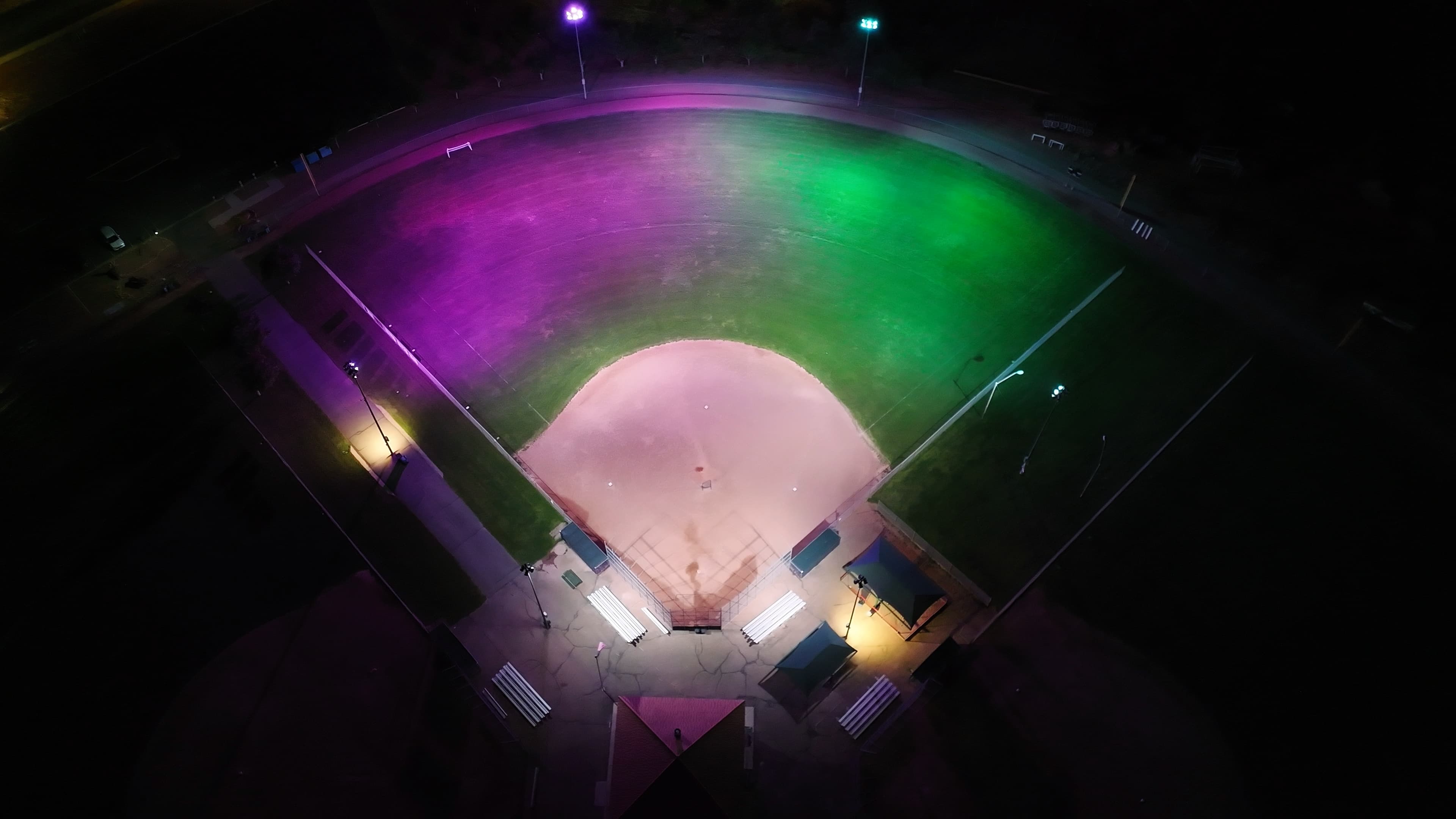
Baseball is woven into the fabric of central Nebraska. From youth rec leagues and high school programs to the University of Nebraska at Kearney Lopers competing at the NCAA Division II level, the demand for safe, high-performance athletic field lighting across the Kearney area has never been greater. Facilities serving communities like Kearney, Lexington, Hastings, Grand Island, and North Platte share a common challenge: aging metal halide and high-pressure sodium (HPS) field lighting systems that drain energy budgets, require constant maintenance, and simply can't keep pace with the expectations of today's players, coaches, and fans.
LED technology has fundamentally changed what's possible for sports field lighting — and the facilities and municipalities across Buffalo County and the surrounding Platte Valley region that are making the transition are seeing the results in their utility bills, in their maintenance logs, and on the field itself. This article explores what facility managers, parks and recreation directors, athletic directors, and community leaders in Kearney need to know before planning their next baseball or softball lighting project.
The Real Cost of Outdated Field Lighting
Many baseball and softball facilities in the Kearney area are still running on lighting infrastructure that's decades old. Metal halide systems, once the industry standard, come with a long list of operational burdens that compound over time:
- High energy consumption — Traditional HPS and metal halide fixtures consume significantly more wattage than modern LED equivalents, and Nebraska's agricultural and municipal budget environments make energy efficiency a real financial priority
- Long warm-up and re-strike times — Metal halide lamps can take 15–20 minutes to reach full brightness after a power interruption — a serious problem during rain delays or unexpected outages during night games
- Frequent lamp replacements — Field light fixtures mounted atop 60- to 80-foot poles require bucket trucks and specialized labor just for routine bulb changes, adding significant maintenance costs season after season
- Uneven light distribution — Older systems frequently produce inconsistent footcandle levels across the infield and outfield, creating dangerous visibility disparities for batters, fielders, and base runners
For parks and recreation departments in cities like Kearney and Hastings — which manage multiple athletic complexes simultaneously — these inefficiencies add up fast. LED retrofits address each of these pain points at the source.
What Makes Baseball LED Lighting Different from General Outdoor Lighting
Not all LED upgrades are created equal, and baseball and softball fields present a unique set of engineering challenges that demand sport-specific expertise. A parking lot LED retrofit and a baseball field lighting project share the same core technology but require an entirely different design methodology.
Photometric precision is everything. Baseball fields have an unusual geometry — a 90-foot diamond with a 95-foot infield arc, a sprawling outfield, and distinct zones including the warning track, bullpens, and dugouts. Each zone has its own recommended illuminance level, typically defined by the governing body of the league or association using the facility. The Illuminating Engineering Society (IES) and organizations like Little League International, the NCAA, and USA Baseball all publish lighting standards that must be met for sanctioned play and, in many cases, for broadcast.
Key design considerations for baseball field LED systems include:
- Pole placement and mounting height — Improper pole positioning creates glare that impairs batter visibility, one of the most critical safety and performance factors in the sport. Tall poles — often 60 to 100 feet — are required to achieve proper beam angles and minimize spill light into neighboring properties
- Uniformity ratios — The ratio of maximum to minimum footcandles across the field must fall within acceptable ranges. Poor uniformity creates "hot spots" and dark zones that affect player performance and safety
- Glare control — LED optics must be carefully specified to direct light downward onto the playing surface without creating blinding glare for batters looking skyward or fielders tracking fly balls
- Spill and trespass control — In community settings near residential neighborhoods — as is common in Kearney's park system — minimizing light spill onto adjacent properties is both a courtesy and increasingly a code requirement
This level of engineering rigor is what separates a successful baseball LED project from one that leaves facility managers dealing with player complaints and re-engineering costs.
LED Sports Lighting in Action: Proof Points from Nebraska
VOSS has deep roots in Nebraska, and our work across the state demonstrates what thoughtful, engineered lighting solutions can accomplish for community and institutional facilities.
At the Salvation Army Kroc Center in Omaha, VOSS redesigned the gymnasium lighting layout — reducing the total fixture count from 99 to 47 while cutting energy usage in half and projecting $4,257 in annual savings. Carl Larson, Head of Facilities, noted: "Voss's attention to detail ensured that the project was completed seamlessly and within the agreed upon time frame. The transformation is truly remarkable and has made a significant impact on the overall ambiance and functionality of the space." While this project focused on indoor gymnasium lighting, the core lesson — that a properly engineered LED design reduces both fixture count and energy consumption simultaneously — applies directly to outdoor sports field projects.
For Blue Cross Blue Shield of Nebraska, VOSS completed a parking lot LED upgrade that reduced overall energy usage by more than 56%, while managing the rebate process to help offset project costs. The precision optics specified for that project ensured maximum light distribution with minimal waste — the same principle that drives our baseball field designs.
Beyond Nebraska, VOSS has completed LED sports lighting projects for baseball facilities, including work in Page, Arizona, where our team delivered a professional-grade LED solution for a baseball field — demonstrating the technical depth and project management capability we bring to outdoor athletic lighting of every scale.
Controls Integration: Smarter Fields for Smarter Operations
One of the most significant advances in modern baseball field lighting isn't the fixture itself — it's how the system is controlled. Today's LED sports lighting platforms support sophisticated control systems that deliver real operational value for facility managers in Kearney and across central Nebraska:
- Wireless dimming and scheduling — Program lights to come on at sunset, dim between innings, or shut off automatically at curfew without anyone on-site to flip a switch
- Instant on/off response — Unlike metal halide systems, LEDs reach 100% brightness immediately — critical for rain delay restarts and broadcast-sensitive scheduling
- Remote monitoring and diagnostics — Facility managers and parks departments can monitor system status, identify outages, and adjust settings from a phone or tablet, reducing response time and after-hours call-outs
- Multi-zone programming — Independently control infield lighting, outfield lighting, parking, and concession areas from a single interface, enabling energy savings during practice sessions and non-game events
For athletic directors at Kearney High School or UNK, and for Buffalo County parks administrators managing multiple complexes, these control capabilities translate directly into labor savings and operational flexibility.
For eligible public agencies — including school districts, municipal parks departments, and county facilities across the Kearney area — VOSS holds an approved Nebraska state contract, enabling compliant, streamlined procurement without the burden of a full competitive bid process. VOSS is also available through cooperative purchasing programs including Sourcewell, BuyBoard, TIPS, AEPA, Omnia Partners, PACE, and the Nebraska ESU Co-Op, giving public entities maximum flexibility in how they access our services.
Planning Your Baseball LED Lighting Project: What to Expect
For facility managers and decision-makers in Kearney considering a baseball or softball LED upgrade, understanding the project timeline and process helps set realistic expectations and build internal support.
A typical project follows these phases:
- Site Assessment & Photometric Design — VOSS engineers evaluate your existing infrastructure, pole conditions, electrical service capacity, and usage requirements. A photometric model is developed to demonstrate predicted footcandle levels, uniformity ratios, and glare performance before a single fixture is purchased
- Specification & Procurement — Fixture selection is matched to your field's specific geometry, league standards, and budget parameters. VOSS works with leading sports lighting manufacturers and manages procurement logistics
- Permitting & Coordination — Electrical permits, utility coordination, and structural engineering for pole foundations are managed as part of the project scope
- Installation & Commissioning — VOSS crews handle all installation work, including pole setting, wiring, fixture aiming, and system commissioning — ensuring the as-built result matches the photometric design
- Rebate & Incentive Management — Nebraska utility providers often offer rebates for LED retrofits on commercial and municipal projects. VOSS identifies applicable programs and manages the paperwork, maximizing your return on investment
Facilities in communities like Kearney, Lexington, Holdrege, and Gothenburg have access to our Lincoln branch team, which understands the utility landscape, contractor relationships, and procurement environment specific to central Nebraska.
Related Topics Worth Exploring
Baseball field lighting sits within a broader conversation about sports and recreational facility upgrades. If your organization is also evaluating other athletic spaces, our LED Gymnasium Lighting Solutions, Pickleball LED Lighting Solutions, and Tennis Court Lighting and Energy Solutions articles explore how LED technology applies across different sport-specific environments. For those managing outdoor facilities more broadly, our Parking Lot and Outdoor LED Lighting Upgrades and Commercial LED Outdoor Lighting content provides additional context on energy savings and design best practices.
For organizations in Nebraska navigating utility rebates and financial incentives, our content on Energy Audits, Incentives, and Rebate Navigation for Businesses offers a practical guide to maximizing project ROI.
Service Availability
While VOSS offers a comprehensive suite of national services, specific capabilities may vary by location. Please contact your local branch to confirm the current availability of specific services, technology solutions, or contracting capabilities in your immediate market.
Talk to a Local Expert About Your Kearney-Area Baseball Facility
Whether you're managing a youth recreational complex, a high school varsity field, a collegiate facility, or a multi-field tournament park, the right LED lighting solution starts with the right conversation. VOSS's Lincoln branch team serves Kearney and communities throughout the greater Platte Valley region — and we're ready to discuss your facility's specific needs, timeline, and goals.
VOSS — Lincoln Branch
Phone: (402) 328-2283
Toll-Free: (800) 733-8677
Reach out to schedule a no-obligation consultation and learn how a professionally engineered LED lighting system can transform your baseball facility — for your players, your fans, and your bottom line.