Why Sanctuary Lighting Is a Growing Priority for Nebraska Churches
For churches across Hastings and the surrounding communities of Kearney, Grand Island, and the greater south-central Nebraska region, the conversation around facility maintenance has shifted considerably in recent years. Aging lighting infrastructure — much of it installed decades ago — is creating a cycle of reactive maintenance that drains volunteer time, strains limited budgets, and increasingly falls short of what modern congregations expect from their worship spaces.
The challenge is not unique to any single denomination or building era. Whether a congregation meets in a historic brick sanctuary built in the early 1900s or a mid-century multipurpose facility, the lighting systems in most Nebraska churches were designed around incandescent, halogen, or fluorescent technology. These systems were acceptable for their time, but they are expensive to maintain, energy-intensive to operate, and increasingly difficult to service as replacement parts and compatible ballasts become harder to source.
What's changed is that LED technology — and the control systems built around it — have matured to the point where even the most aesthetically sensitive sanctuaries can be modernized without sacrificing the visual character that congregations value. This article explores what facility managers and church administrators in the Hastings area should know about the current state of sanctuary lighting, and what a thoughtful upgrade process looks like in practice.
The Real Cost of Deferred Lighting Maintenance in Church Facilities
Church facility managers often inherit lighting systems that were never designed with long-term serviceability in mind. High vaulted ceilings, ornate pendant fixtures, and stained glass environments create access challenges that make routine bulb replacements far more labor-intensive — and expensive — than they would be in a standard commercial building.
In practice, this means:
- Scaffolding or lift rentals may be required multiple times per year just to address burned-out bulbs in elevated fixtures
- Aging ballasts in fluorescent systems frequently cause flickering, humming, and premature lamp failure — degrading the worship environment and creating congregant complaints
- Inconsistent light levels across the sanctuary floor can create safety concerns, reduce visibility for older congregants, and produce unflattering or uneven results for livestreamed services — an increasingly important consideration for churches that broadcast online
- Dimmer incompatibility between legacy control systems and newer lamps often leads to buzzing, strobing, or an inability to achieve smooth, scene-appropriate lighting transitions during services
The deferred cost of these issues compounds over time. What begins as a maintenance inconvenience eventually becomes a capital decision — one that many church boards in communities like Hastings are now actively navigating.
It's worth noting that for churches with historic structures or architecturally significant sanctuaries, the concern isn't just operational. There's a genuine stewardship dimension: preserving the aesthetic integrity of a space that may have deep meaning for a congregation while also ensuring it functions safely and efficiently for the next generation of worshippers.
What Modern Sanctuary Lighting Upgrades Look Like in Practice
The most effective sanctuary lighting projects share a common characteristic: they are planned around the specific needs of the space and the congregation, not around a standard commercial retrofit formula. A church sanctuary is not an office building or a gymnasium — it requires a calibrated approach to illumination that serves liturgical function, architectural beauty, and practical operations simultaneously.
A well-designed upgrade typically addresses several interconnected layers:
LED Retrofit vs. Full Fixture Replacement In many cases, existing pendant fixtures, chandeliers, or decorative housings can be preserved while the internal lamp technology is upgraded to LED. This approach — a retrofit rather than a full replacement — is often the preferred path for churches with architecturally or historically significant fixtures, as it delivers the efficiency and longevity benefits of LED without altering the visual character of the sanctuary. In other cases, where fixtures are beyond their useful life or where the design intent calls for updated aesthetics, full fixture replacement may be the more cost-effective long-term decision.
Lighting Controls and Scene Management Modern LED systems are designed to work in concert with sophisticated control platforms that allow facility managers to program and recall lighting "scenes" tailored to specific service types — a Sunday morning worship service, a candlelight Christmas Eve gathering, a weekday memorial service, or a youth event in the same space. These scenes can be triggered from a wall-mounted panel, a tablet, or a smartphone app, dramatically reducing the operational complexity of managing a multipurpose worship environment.
Dimming and Color Temperature Not all LED products are created equal, and for sanctuary applications, dimming performance and color rendering are critical. Poorly specified LEDs can produce unpleasant color shifts as they dim, or fail to render the warm tones that congregants associate with reverent worship settings. A well-engineered system maintains consistent, flattering color temperatures across the full dimming range.
Minimizing Disruption Churches cannot simply shut down operations for weeks during a lighting retrofit. Effective planning accounts for service schedules, seasonal programming, and the reality that sanctuaries are often in use multiple days per week. A phased installation approach, combined with pre-construction coordination with church leadership, ensures that upgrades are completed with minimal impact on the congregation's activities.
A Nebraska Case Study: Trinity Lutheran Church in Omaha
One of the most instructive examples of a successful sanctuary lighting project in Nebraska comes from Trinity Lutheran Church in Omaha. Trinity's sanctuary was built around decorative pendant fixtures and house lights that had become a significant source of operational frustration — the incandescent and halogen lamps they relied on consumed substantial energy, burned out frequently, and were costly to service.
Importantly, Trinity did not want to sacrifice the character of their historic fixtures. The aesthetic of the sanctuary was central to the congregation's identity, and any upgrade needed to preserve that visual heritage while solving the underlying maintenance and efficiency problems.
VOSS worked with Trinity's leadership to design a retrofit solution that threaded this needle precisely. Rather than replacing the existing pendant and house light fixtures, VOSS retrofitted them with dimmable LED bulbs selected to match the warm color quality that the congregation expected. Each fixture was professionally commissioned to ensure consistent, uniform performance across the entire sanctuary.
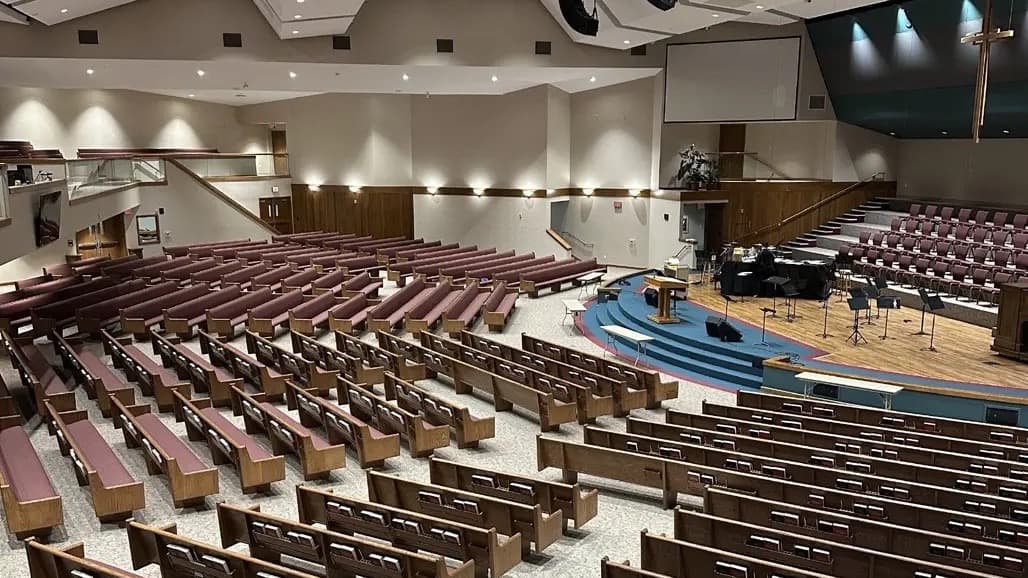
The results were meaningful on multiple levels. The sanctuary now delivers crisp, even illumination throughout the worship space, with the wooden ceiling highlighted beautifully by the new lighting. Trinity's facility team was equipped with a user-friendly app that allows them to control all sanctuary lighting — and create custom scenes for any event — directly from a smartphone or a wall-mounted iPad.
Karna Kudrika, a Board Member at Trinity, reflected on the experience: "Trinity Lutheran Church was fortunate to connect with Voss Lighting during this project. The working relationship was thorough, patient and the product they delivered was as promised."
This project is a useful reference point for church administrators in Hastings and the surrounding south-central Nebraska region who are weighing similar decisions. The combination of preserved aesthetics, improved performance, reduced maintenance demands, and intuitive control technology represents what a well-executed sanctuary upgrade can achieve.
Trends Shaping Church Lighting Decisions in 2024 and Beyond
Several converging trends are accelerating the pace of lighting upgrades at faith-based facilities across Nebraska and nationally:
The Fluorescent Phase-Out Federal regulatory changes are progressively restricting the manufacture and import of certain fluorescent lamp types, including the T12 and linear fluorescent products that remain in widespread use in older church facilities. Churches that have not yet transitioned away from fluorescent systems should be planning that transition now — not in response to a supply crisis, but proactively. The Minnesota Fluorescent Lamp Ban and related federal actions are part of a broader industry shift that is already affecting product availability and pricing. Our article on Fluorescent Tube Bans and LED Lighting Rebates covers this topic in further detail.
Livestreaming and Broadcast Quality The pandemic accelerated the adoption of livestreaming at congregations of all sizes, and many churches have continued to invest in online ministry as a primary outreach channel. Sanctuary lighting that was adequate for in-person worship may produce unflattering, inconsistent, or technically problematic video when captured by cameras. Modern LED systems, when properly specified and positioned, can dramatically improve the broadcast quality of sanctuary spaces — a consideration that is increasingly factoring into lighting upgrade decisions.
Energy Rebates and Incentive Programs Nebraska utility providers and state energy programs have offered rebate opportunities for commercial LED upgrades that can meaningfully offset project costs. While program specifics and availability change over time, the general principle holds: a well-documented LED retrofit project at a church facility may qualify for rebates that reduce the net investment. Working with a contractor experienced in energy incentive navigation — and familiar with Nebraska's utility landscape — is the most reliable way to capture available savings. Our article on Energy Audits, Incentives, and Rebate Navigation for Businesses provides a useful overview of how this process works.
Smart Controls as a Long-Term Investment Lighting control systems are no longer a luxury reserved for large institutional projects. The cost of smart dimming, scene management, and occupancy-based control technology has decreased substantially, making it accessible for church facilities of modest size. For Hastings-area churches managing multipurpose spaces — sanctuaries that also serve as event venues, community gathering spaces, or education facilities — the operational flexibility delivered by a modern control system can be a genuine differentiator.
Cooperative Purchasing Options for Eligible Organizations in Hastings
Churches and faith-based organizations affiliated with public institutions, or those seeking access to pre-negotiated contract vehicles, have additional procurement pathways worth exploring. VOSS holds an approved state contract in Nebraska, and is available through several cooperative purchasing programs that may simplify the procurement process for eligible organizations — including AEPA, BuyBoard, TIPS, Sourcewell, Omnia Partners, PACE, Houston Church COOP, and the Nebraska ESU Co-Op.
For church facilities in Hastings and the greater Adams County area, these programs can streamline vendor selection, reduce administrative burden, and ensure competitive pricing without requiring a standalone bidding process. Contact your local VOSS branch to learn which programs may apply to your organization.
Service Availability
While VOSS offers a comprehensive suite of national services, specific capabilities may vary by location. Please contact your local branch to confirm the current availability of specific services, technology solutions, or contracting capabilities in your immediate market.
Connect with VOSS in the Greater Lincoln Area
VOSS serves churches and faith-based facilities throughout Hastings, Kearney, Grand Island, York, Fairbury, and communities across south-central and southeast Nebraska from our Lincoln branch. Whether your congregation is navigating a specific maintenance challenge, planning a full sanctuary renovation, or simply beginning to explore what a lighting upgrade might involve, our team is available to discuss your facility's needs — with no obligation and no pressure.
We bring more than 85 years of commercial electrical and lighting experience to every project, and we understand that church facilities require a partner who is patient, communicative, and attentive to the unique sensitivities of a worship environment.
VOSS — Lincoln Branch
Phone: (402) 328-2283 Toll-Free: (800) 733-8677
Reach out to schedule a consultation and learn how other Nebraska congregations have transformed their sanctuaries into more functional, efficient, and worshipful spaces.