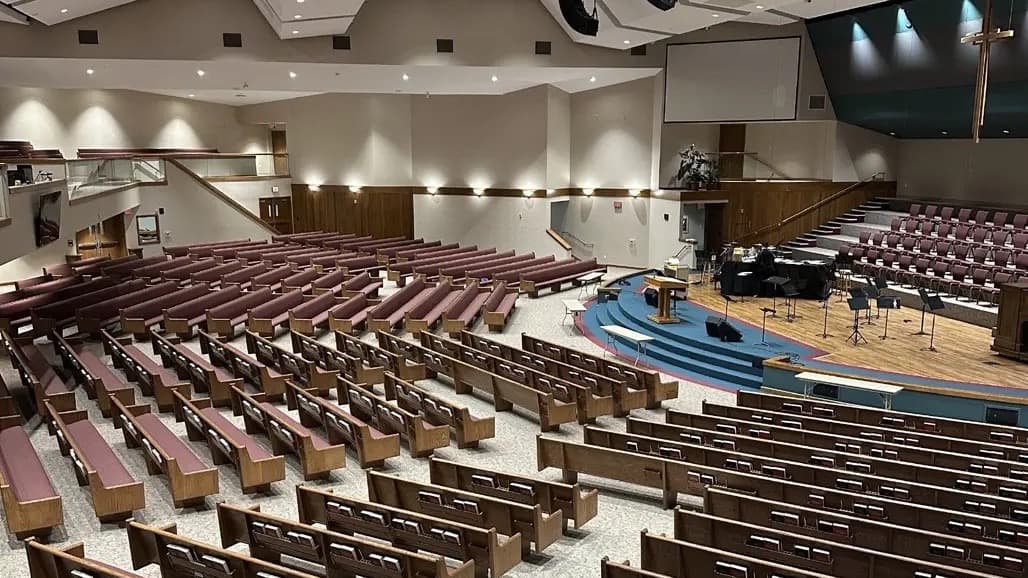
Why Sanctuary Lighting Is a Growing Priority for Nebraska Churches
Across Grand Island, Hastings, Kearney, and the surrounding communities of the greater Lincoln region, church facility managers are quietly wrestling with the same challenge: sanctuaries built for timeless worship housed inside aging electrical systems that were never designed for modern demands.
Whether your congregation gathers in a historic brick building near downtown Grand Island or a modern multi-use campus on the edge of town, the lighting in your sanctuary does more than illuminate a room. It shapes the tone of every service, every wedding, every memorial, and every community gathering your facility hosts. When that lighting fails — or simply underperforms — the impact is felt immediately by the people who matter most.
The good news is that a new generation of LED technology, combined with intelligent control systems, is making it more practical than ever for faith communities to modernize their lighting without compromising tradition, breaking budgets, or shutting down services for extended periods.
The Maintenance Burden Most Facility Managers Didn't Sign Up For
If you oversee facilities for a church in Grand Island or the surrounding Hall County area, chances are you've stood in the sanctuary staring up at a burned-out bulb in a fixture 30 feet overhead — and started mentally calculating the cost of renting a lift.
Traditional incandescent, halogen, and fluorescent lamps have relatively short lifespans under regular use. In a sanctuary that hosts multiple services per week, plus rehearsals, community events, and livestreamed programming, those bulbs cycle through hours rapidly. The result is a recurring maintenance cycle that consumes staff time, requires specialized equipment for high-ceiling access, and introduces safety risk with every lift rental.
Beyond simple burnouts, facility managers frequently encounter:
- Ballast failures that cause flickering and humming — distracting during services and difficult to diagnose without electrical expertise
- Dimmer incompatibility between aging control systems and newer lamp types, resulting in poor dimming performance or premature lamp failure
- Uneven light distribution that leaves front pews brightly lit while rear sections feel dim — a particular concern as more churches invest in livestream and video production
- Rising utility costs from fixtures that were specified decades ago, before energy-efficient alternatives existed at the quality levels now available
These aren't cosmetic inconveniences. They are operational and financial pressures that compound over time — and they are exactly the type of problem that a well-planned LED retrofit is designed to solve.
What a Modern Sanctuary Lighting Retrofit Actually Looks Like
The word "retrofit" sometimes conjures images of wholesale renovation — scaffolding, construction crews, weeks of disruption. In practice, a thoughtfully planned sanctuary lighting upgrade looks very different.
A landmark project by VOSS at Trinity Lutheran Church in Omaha, Nebraska illustrates what's possible when the right approach is taken. Trinity's sanctuary relied on outdated incandescent and halogen lamps that consumed excessive energy and required frequent replacement. Critically, the congregation was deeply attached to their traditional pendant fixtures — a design element central to the character of the space.
Rather than recommending wholesale fixture replacement, VOSS collaborated with Trinity's team to retrofit the existing pendant and house lights with energy-efficient, dimmable LED bulbs that preserved the aesthetic entirely. The technical work was paired with a full commissioning process and hands-on training that empowered Trinity's team to manage their own lighting scenes. The result: crisp, uniform LED illumination across the sanctuary, a user-friendly app allowing staff to control all fixtures from a smartphone or wall-mounted iPad, and a complete elimination of the frequent lamp-replacement cycle.
Trinity Board Member Karna Kudrika summarized the experience: "Trinity Lutheran Church was fortunate to connect with Voss Lighting during this project. The working relationship was thorough, patient and the product they delivered was as promised."
This kind of outcome — improved light quality, reduced maintenance, preserved aesthetics, and simplified control — is increasingly achievable for churches of all sizes across Grand Island, Wood River, Alda, and Central City.
Lighting Controls: From Manual Switches to Scene Management
One of the most meaningful improvements a church can make alongside an LED retrofit is the addition of an intelligent lighting control system. For facilities that host diverse programming — traditional Sunday services, contemporary evening worship, choir rehearsals, weddings, funerals, community dinners — the ability to recall a preset lighting scene in seconds is genuinely transformative.
Modern control systems available today allow facility staff to:
- Program and save scenes for every type of service or event, with a single button press recalling the exact combination of brightness and color temperature desired
- Dim fixtures smoothly and silently, without the buzzing or flickering associated with older dimmer technology
- Control the entire sanctuary remotely via a smartphone app or wall-mounted panel — eliminating the need to manually adjust individual circuits
- Integrate with audiovisual and livestream systems so lighting shifts are synchronized with service flow
For churches investing in livestream ministry — a priority that accelerated dramatically across Nebraska and nationwide in recent years — proper lighting control is not a luxury. Camera systems require consistent, controllable light levels to produce broadcast-quality video. Poorly controlled or inconsistent lighting directly impacts the reach and professionalism of online programming.
Energy Costs, Utility Rebates, and the Financial Case for Upgrading
Grand Island is served by Grand Island Utilities (also known as Black Hills Energy for gas and Grand Island Independent Utilities for electric), and like most Nebraska markets, the region has seen steady pressure on commercial energy costs. For a church running services multiple evenings per week plus weekend programming, lighting often represents a disproportionate share of the monthly utility bill.
LED technology reduces energy consumption substantially compared to incandescent and halogen sources — in some cases cutting lighting-related energy use by half or more. That translates directly to lower monthly operating costs, freeing budget for ministry priorities rather than utility payments.
Utility rebate programs can further reduce the upfront investment required for a lighting upgrade. VOSS has extensive experience navigating rebate applications on behalf of clients — as demonstrated in the Blue Cross Blue Shield of Nebraska Parking Lot Lighting Upgrade, where VOSS managed the rebate process and helped the client achieve a 56% reduction in energy usage while offsetting project costs through available incentives.
For faith communities in Grand Island, Hastings, and across the greater Lincoln region, VOSS's familiarity with Nebraska utility programs and rebate structures is a practical advantage — ensuring that eligible savings are identified and captured without placing the administrative burden on your team.
It is also worth noting that for churches affiliated with public institutions, school districts, or other eligible organizations across Nebraska, VOSS holds an approved state contract in Nebraska and participates in a range of cooperative purchasing programs — including Houston Church COOP, Nebraska ESU Co-Op, Sourcewell, BuyBoard, TIPS, AEPA, Omnia Partners, and PACE — that can simplify procurement and support compliance requirements.
Practical Considerations for High-Ceiling and Historic Sanctuaries
Churches present installation challenges that standard commercial facilities do not. Sanctuary ceilings commonly range from 20 to 50 feet or higher. Decorative fixtures — pendant lights, chandeliers, wall sconces — are often irreplaceable architectural elements. Historic buildings may carry preservation considerations that limit the types of modifications permitted.
VOSS's experience across church properties nationwide, including multiple Nebraska projects, informs a practical approach to these constraints:
- Phased upgrade schedules that work around your programming calendar, avoiding disruption during high-attendance seasons like Advent, Lent, or summer programming
- Retrofit-first strategies that preserve existing fixtures wherever possible, changing only the lamp and driver components rather than replacing entire assemblies
- Access planning for high ceilings that accounts for pew layouts, balconies, and fragile flooring that may not support standard lift equipment
- Low-disruption installation practices that allow a project to proceed across multiple short windows rather than requiring extended facility closure
For Grand Island congregations with historic properties — and the city's architectural heritage includes notable sanctuaries that carry significant community meaning — these considerations are not abstract. They are the difference between a project that protects what matters and one that creates new problems while solving old ones.
Service Availability
While VOSS offers a comprehensive suite of national services, specific capabilities may vary by location. Please contact your local branch to confirm the current availability of specific services, technology solutions, or contracting capabilities in your immediate market.
VOSS serves Grand Island, Hastings, Kearney, Wood River, Alda, Central City, Aurora, and communities throughout Hall, Adams, Buffalo, and Merrick Counties from our Lincoln, Nebraska branch.
Lincoln Branch Phone: (402) 328-2283 Toll-Free: (800) 733-8677
Let's Talk About What Your Sanctuary Needs
Every sanctuary is different — different ceiling heights, different fixture types, different programming demands, and different budget realities. The most useful conversation we can have with a church facility manager or operations leader in Grand Island is a candid one about where your current system is falling short and what a realistic path forward looks like.
We're not here to recommend the most expensive solution. We're here to recommend the right one — and to help you build a case for it that your board and leadership team can understand and support.
If flickering fixtures, frequent maintenance calls, or rising energy costs are on your radar for 2025 or beyond, we'd welcome the opportunity to walk through your facility and share what we've learned from working with congregations across Nebraska and the nation.
Reach out to our Lincoln branch at (402) 328-2283 or toll-free at (800) 733-8677 to schedule a no-obligation conversation. You can also explore related topics in our Latest Lighting resource section — including our article on Energy Efficient Church Lighting Upgrades, which goes deeper on long-term energy strategy for faith communities, and our guides on Fluorescent Tube Bans and LED Lighting Rebates and Energy Audits, Incentives, and Rebate Navigation for Businesses, which are directly relevant to any Nebraska facility evaluating an upgrade in the current regulatory and utility environment.