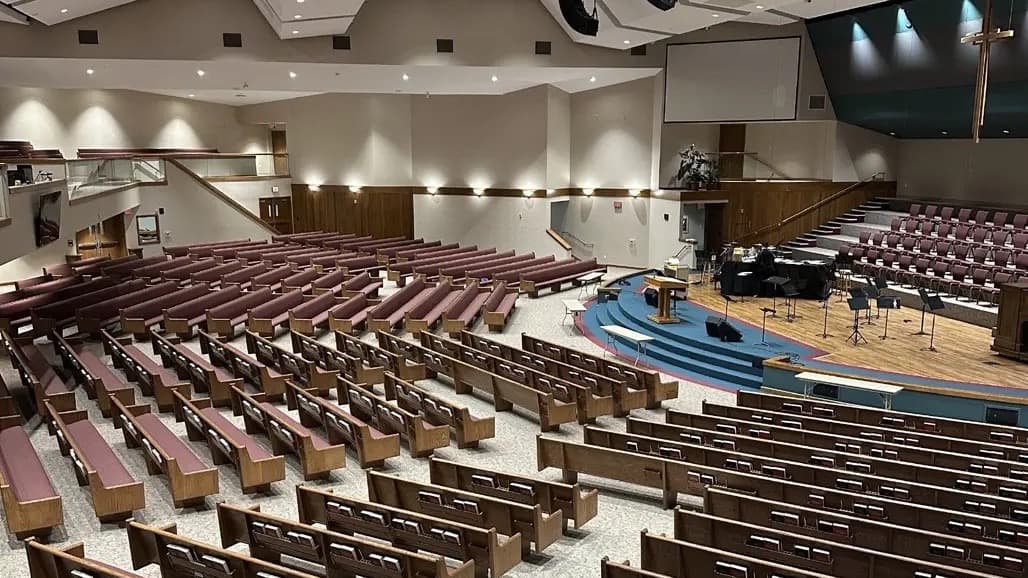
Why Kansas City-Area Churches Are Rethinking Their Sanctuary Lighting
The Greater Kansas City region is home to a remarkably vibrant faith community. From historic congregations anchoring neighborhoods in Midtown and the Crossroads District to fast-growing suburban campuses in Overland Park, Lenexa, Lee's Summit, and Liberty, churches here represent an enormous range of building types, ages, and operational needs. What they share, increasingly, is a common facility challenge: sanctuary lighting systems that were designed for a different era.
Many of the region's landmark church buildings — some dating back more than a century — were wired for incandescent and halogen fixtures at a time when LED technology didn't exist and livestreaming worship wasn't a consideration. Even newer facilities built in the 1980s and 1990s are now well past the useful life of their original fluorescent and halogen systems. The result is a familiar pattern for facility managers: frequent bulb burnouts in hard-to-reach ceiling fixtures, aging ballasts causing flicker and buzzing, escalating electricity bills, and congregation members commenting on dim or uneven light during services.
Understanding why these problems emerge — and what modern lighting technology can realistically solve — is the first step toward making confident, well-informed decisions for your facility.
The Unique Maintenance Challenges of Church Sanctuaries
Sanctuary lighting is not like office lighting or retail lighting. The physical and operational characteristics of a church building create a set of maintenance dynamics that standard commercial lighting approaches don't fully address.
Ceiling height and access difficulty are among the most significant factors. Sanctuaries in Kansas City's older faith communities — particularly those in established neighborhoods like Brookside, Waldo, Westwood, and Prairie Village — often feature vaulted ceilings ranging from 25 to 60 feet or higher. Every bulb replacement in these environments requires scaffolding, aerial lifts, or specialized access equipment, turning what should be a routine task into a half-day project with real labor costs and safety considerations.
Ballast and dimmer compatibility issues compound the problem in aging systems. Many sanctuaries were retrofitted with fluorescent fixtures in the 1970s and 1980s, and those magnetic ballasts are now failing with increasing frequency. When a ballast goes, the result isn't just a dark fixture — it's often flickering, humming, and erratic behavior that distracts congregants during worship or broadcasts poorly on camera for livestreamed services.
Livestreaming and video production demands have fundamentally changed what "good lighting" means for modern churches. Congregations across the Kansas City metro — from large multisite campuses in Blue Springs and Olathe to smaller community churches in Raytown and Gladstone — now produce regular video content. Lighting that looks acceptable to the human eye can render poorly on camera, with uneven color temperatures, harsh shadows on the platform, or insufficient footcandles for broadcast quality. Facility managers who haven't evaluated their lighting through a video production lens are increasingly finding this to be a source of congregation feedback.
Historic preservation constraints add another layer of complexity for churches in designated historic districts or those with architecturally significant interiors. Replacing fixtures in a sanctuary with original stained glass, decorative plasterwork, or handcrafted woodwork requires a thoughtful approach that honors the aesthetic while delivering modern performance. This is not a challenge unique to Kansas City, but it is particularly relevant given the region's wealth of historic religious architecture.
What the Shift to LED Actually Means for Church Operations
LED technology has matured significantly over the past decade, and the gap between early-generation LED retrofits and today's products is substantial. For church facility managers evaluating an upgrade, it's worth understanding what current LED systems actually deliver — and where the nuances lie.
Lamp life and maintenance interval extension are the most immediately practical benefits. High-quality LED sources rated at 50,000 hours or more can reduce re-lamping frequency dramatically compared to incandescent or halogen sources. For a sanctuary with 60-foot ceilings, reducing the number of times per year a lift is required isn't just a convenience — it represents real dollars in avoided labor and equipment rental costs, and a meaningful reduction in disruption to service schedules.
Energy consumption reduction is significant and well-documented across the commercial lighting industry. LED fixtures typically consume 50–75% less energy than the incandescent and halogen sources they replace, and 30–50% less than fluorescent systems, depending on the specific products and applications involved. For Kansas City-area churches managing tighter operational budgets, this reduction in monthly utility costs can meaningfully offset the investment in an upgrade over time.
Color rendering and controllability have both improved dramatically. Modern LED systems designed for worship environments can be tuned to complement the warmth of wood interiors, the colors of stained glass, and the natural tones of human skin under platform lighting. Dimming performance — historically a weakness of early LED products — has improved to the point where smooth, flicker-free dimming across the full range is achievable with properly specified systems. This matters both for the in-person worship experience and for broadcast quality.
Smart controls integration is increasingly relevant for multiuse facilities. Many Kansas City-area churches host weddings, concerts, community events, and weekday programming in addition to weekend worship services. Lighting control systems that allow facility managers to recall preset scenes — "Sunday morning worship," "concert lighting," "fellowship event," "cleaning mode" — reduce the cognitive burden on staff and volunteers while ensuring the space always looks its best for its intended purpose.
It's worth noting that the fluorescent lamp bans now being implemented across several states — including related regulatory trends covered in our articles on the Minnesota Fluorescent Lamp Ban and Fluorescent Tube Bans and LED Lighting Rebates — are an additional driver prompting many facility managers to accelerate their LED transition timelines. Church facilities in Missouri and Kansas should be aware of how evolving product availability may affect their future maintenance supply chains.
Navigating Rebates and Incentives in the Kansas City Market
One of the most underutilized resources available to Kansas City-area churches pursuing lighting upgrades is utility incentive programs. Both KCP&L (Evergy) and other regional utility providers serving the metro area — including communities in Johnson County, Kansas, and across the Missouri side — offer commercial lighting rebates that can meaningfully reduce the net cost of a qualifying LED retrofit project.
Rebate programs are not automatic. They require documentation, pre-approval in many cases, and careful attention to product eligibility requirements. Churches that have worked with experienced contractors familiar with local utility program requirements are far better positioned to capture available incentives than those who attempt to navigate the process independently. Our article on Maximizing ROI with Commercial LED Lighting Rebates in Dallas, TX explores the broader strategic framework for rebate navigation, much of which applies directly to the Kansas City market.
For faith-based organizations with public-sector affiliations, or for churches connected to school districts or municipal entities in communities like Independence, Shawnee, or Gardner, it's also worth knowing that VOSS holds an approved Missouri state contract, which can streamline procurement for eligible organizations. Cooperative purchasing programs including Sourcewell, TIPS, BuyBoard, and Houston Church COOP are also available to qualifying organizations, providing a pre-vetted procurement pathway that reduces administrative burden.
Practical Considerations for Kansas City Church Facility Managers
Whether you manage a 200-seat neighborhood church in Westport or a 2,000-seat campus facility in Leawood, the decision to invest in a sanctuary lighting upgrade follows a similar sequence of practical questions. Addressing them thoughtfully before a project begins is what separates a smooth, low-disruption installation from one that creates operational headaches.
- Timing and scheduling are critical. The best upgrade projects are planned around the church calendar — avoiding peak seasons like Advent, Easter, and major community events — and executed with clear coordination between the contractor and facility staff. A well-run project in a functioning sanctuary should cause minimal disruption to programming.
- Phasing and budget often go hand in hand. Not every church can replace every fixture in a single project cycle. Understanding which spaces — the main sanctuary, fellowship hall, narthex, or exterior entrances — deliver the greatest return on investment helps facility managers prioritize intelligently.
- System documentation is frequently overlooked but enormously valuable. Many Kansas City-area churches are operating with incomplete or outdated records of their electrical infrastructure. A professional lighting assessment that documents fixture types, circuit layouts, and control systems creates a baseline that makes future maintenance and upgrades far more efficient.
- Warranty and ongoing support matter as much as the initial installation. LED fixtures carry manufacturer warranties, but the real question for a facility manager is who is responsible for addressing issues that arise six months or three years after installation — and whether that support is available locally.
These questions are exactly the kind of facility-level considerations that VOSS brings to every church engagement. Our related article on Energy Efficient Church Lighting Upgrades explores the energy and financial dimensions of these decisions in greater depth.
Service Availability
While VOSS offers a comprehensive suite of national services, specific capabilities may vary by location. Please contact your local branch to confirm the current availability of specific services, technology solutions, or contracting capabilities in your immediate market.
Talk with Our Kansas City Team
VOSS has been serving commercial and institutional facilities across the United States for more than 85 years. Our Kansas City branch works with faith communities, facility managers, and operations leaders across the Greater Kansas City metro — including communities on both sides of the state line in Missouri and Kansas.
If you're evaluating your sanctuary lighting situation — whether you're dealing with immediate maintenance issues or planning a longer-term upgrade — we're glad to have a practical, no-pressure conversation about what's possible for your facility.
VOSS — Kansas City Branch
(816) 471-8677